-
Use Cases
-
Resources
-
Pricing
The extinction of the dinosaurs occurred approximately 66 million years ago at the end of the Cretaceous Period, when an asteroid impact combined with massive volcanic activity caused dramatic climate changes that wiped out about three-quarters of all plant and animal species on Earth, ending the reign of non-avian dinosaurs and paving the way for mammals to dominate. More Less
1978
% complete
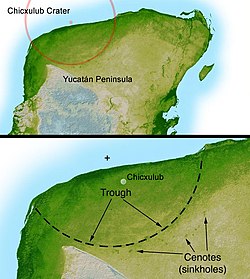
Working as a geophysicist in 1978, Glen Penfield identified geophysical evidence of a massive buried impact crater on the Yucatán Peninsula. The structure was later recognized as the Chicxulub crater, the impact site linked to the Cretaceous–Paleogene extinction event.
Image source: Chicxulub crater
1980
% complete
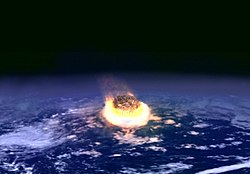
In 1980, Nobel Prize-winning physicist Luis Alvarez, his son geologist Walter Alvarez, and chemists Frank Asaro and Helen Michel discovered that sedimentary layers worldwide at the Cretaceous–Paleogene boundary contain iridium concentrations many times greater than normal (30, 160, and 20 times in three sections originally studied), supporting an asteroid impact hypothesis.
Image source: Cretaceous–Paleogene extinction event
1990
% complete
Identified in 1990 based on Glen Penfield's 1978 work, the Chicxulub crater is oval with an average diameter of roughly 180 km (110 mi), about the size calculated by the Alvarez team, confirming the impact site of the asteroid that caused the mass extinction.
2007
% complete
In 2007, it was proposed that the impactor belonged to the Baptistina family of asteroids, suggesting a shattered parent body in the asteroid belt supplied the object that struck Earth at the end of the Cretaceous.
Image source: Baptistina family
2009
% complete
It was reported in 2009 that the asteroid 298 Baptistina does not share the chemical signature of the K–Pg impactor, weakening the proposed link between the Baptistina family and the extinction-causing asteroid.
Mar 2010
% complete
In March 2010, an international panel of 41 scientists reviewed 20 years of scientific literature and endorsed the asteroid hypothesis, specifically the Chicxulub impact, as the cause of the extinction, ruling out other theories such as massive volcanism.
2011
% complete
A 2011 Wide-field Infrared Survey Explorer (WISE) study of reflected light from the asteroids of the Baptistina family estimated their break-up at 80 million years ago, giving them insufficient time to shift orbits and impact Earth by 66 million years ago.
Image source: Wide-field Infrared Survey Explorer
2016
% complete
In 2016, a scientific drilling project obtained deep rock-core samples from the peak ring around the Chicxulub impact crater, providing new insight into the formation and consequences of the impact.
2016
% complete
A 2016 drilling project into the Chicxulub peak ring confirmed that it contained granite ejected within minutes from deep in the Earth, and that it contained hardly any gypsum, the usual sulfate-containing sea floor rock in the region — a finding with major implications for the severity of post-impact climate cooling.
1988
% complete
In 1988, researchers replied to claims about dinosaur decline by arguing that paleontologists were being misled by sparse data, defending the interpretation of patterns in the fossil record leading up to the extinction event.
1991
% complete
The climatic forcing of the impact winter following the Chicxulub collision was estimated to be about 100 times more potent than that of the 1991 eruption of Mount Pinatubo, illustrating the extreme scale of post-impact climate disruption.
Image source: Mount Pinatubo
2010
% complete
A study of 29 fossil sites in the Catalan Pyrenees of Europe in 2010 supports the view that dinosaurs there had great diversity until the asteroid impact, with more than 100 living species, indicating the extinction was sudden rather than a long decline.
2013
% complete
A paper in 2013 by a prominent modeler of nuclear winter suggested that, based on the amount of soot in the global debris layer, the entire terrestrial biosphere might have burned, implying a global soot-cloud blocking out the sun and creating an impact winter effect.
Image source: Impact winter
Oct 2019
% complete
In October 2019, researchers proposed a mechanism of the mass extinction, arguing that the Chicxulub asteroid impact event rapidly acidified the oceans and produced long-lasting effects on the climate, explaining the collapse of marine ecosystems.
1991
% complete
A 1991 study of fossil leaves dated the extinction-associated freezing to early June, providing seasonal constraints on when the catastrophic impact event occurred.
2013
% complete
However, in a 2013 paper, Paul Renne of the Berkeley Geochronology Center dated the impact at 66.043±0.011 million years ago, based on argon–argon dating, refining the chronology of the extinction event.
Image source: Cretaceous–Paleogene boundary
2021
% complete
Research in 2021 opted for the spring–summer range for the timing of the Chicxulub impact, refining earlier estimates such as the 1991 early June dating derived from fossil leaves.
2024
% complete
In 2024, During et al. reevaluated and criticized a prior seasonal-timing study based on its lack of primary data, unidentified laboratory for the analyses, insufficient methods for accurate replication and problematic isotopic graphs with irregular data and error bars.
2008
% complete
Jouve and colleagues suggested in 2008 that juvenile marine crocodyliforms lived in freshwater environments as do modern marine crocodile juveniles, which would have helped them survive where other marine reptiles became extinct; freshwater environments were not so strongly affected by the K–Pg extinction event as marine environments were.
Image source: Crocodyliformes
2020
% complete
However, scientists in 2020 concluded that climate-modeling of the mass extinction event favored the asteroid impact and not volcanism, reinforcing the consensus that the Chicxulub impact was the primary driver of the dinosaurs' demise.
2020
% complete
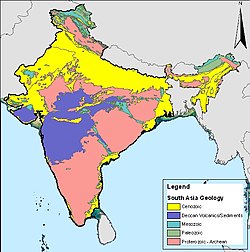
A study published in 2020 concluded that the paleoclimatic data were most coherent with two peaks of degassing caused by the Deccan Traps eruptions, the first more than 200,000 years before the extinction, and a second peak starting around the extinction event and lasting about 355,000 years.
Image source: Deccan Traps
Or browse the full history timeline directory, with more than 2,000 topics.
This Extinction of the Dinosaurs timeline was generated with the help of AI, using information found on the internet.
We work hard to keep these timelines accurate, but mistakes do get through. If you spot one, email us at [email protected] and we'll fix it for future visitors.
Generate yours with AI or build it from scratch, for free.

Export your timeline, add your own events, edit or remove AI-generated events, and much more
No credit card required.
Cancel anytime.
Cancel anytime.
You can create an unlimited number of timelines with up to 10 events on each one, customize how they look, export them to PDF, PNG, PowerPoint, CSV, and Excel, and share them with a link. Paid plans raise the event limit and add features like spreadsheet imports and collaborators.
Yes. You can cancel your subscription from your account page at any time, and you will not be charged again. Your subscription stays active for the rest of the period you already paid for.
Yes. We will email you a reminder before the annual renewal, and we will also email you a receipt.
Yes. You can email us within 15 days of any payment, and we will issue you a full refund.
Check out our pricing docs or send us an email anytime: [email protected].