
-
Use Cases
-
Resources
-
Pricing
1880
% complete
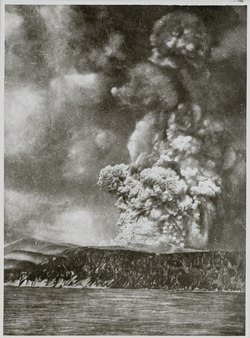
In the years before the 1883 eruption, seismic activity around the Krakatau volcano was intense, foreshadowing the catastrophic explosion to come.
Image source: 1883 eruption of Krakatoa
1880
% complete
Earthquakes linked to the restless volcano were felt as far away as the Australian Northern Territory, demonstrating the scale of the pre-eruption unrest.
1880
% complete
One of the pre-eruption earthquakes, occurring in 1880, was strong enough to damage a lighthouse, underscoring the growing danger in the Sunda Strait region.
May 19, 1883 - Oct 21, 1883
% complete
Between 19 May and 21 October 1883, the volcanic island of Krakatoa in the Sunda Strait, then part of the Dutch East Indies, began erupting in a sequence lasting more than five months.
May 20, 1883
% complete
On 20 May 1883, Strombolian activity began on Krakatoa, marking the start of sustained explosive eruptions from the island's volcanic cones.
May 20, 1883 - Aug 26, 1883
% complete
Steam venting began to occur regularly from Perboewatan, the northernmost of the island's three cones, signaling escalating activity in the months before the climax.
Aug 27, 1883
% complete
Most of the material deposited by the volcano is magmatic in origin, and the caldera formed by the eruption is not extensively filled with deposits from the 1883 eruption.
Aug 27, 1883
% complete
The cataclysmic eruption destroyed much of the island and formed a caldera, most of whose material deposited by the volcano is magmatic in origin.
Aug 27, 1883
% complete
Although the violent phase of the 1883 eruption was over by the late afternoon of 27 August, the volcano's story was far from finished, with reports continuing for months.
Aug 27, 1883
% complete
Around noon on 27 August 1883, a rain of hot ash fell around Ketimbang (now Kalianda in Lampung Province) in Sumatra, killing approximately 1,000 people in what became known as 'The Burning Ashes of Ketimbang'.
Aug 27, 1883
% complete
On 27 August 1883, Krakatoa unleashed its most violent explosions, among the most powerful volcanic blasts in recorded history, devastating the surrounding region.
Aug 29, 1883 - Dec 31, 1883
% complete
After light returned by 29 August, reports continued for months claiming that Krakatoa was still in eruption, reflecting lingering uncertainty about the volcano's state.
Aug 29, 1883
% complete
After days of darkness caused by the massive ash clouds, light finally returned to the region by 29 August 1883, revealing the devastation left behind.
Sep 1, 1883 - Oct 31, 1883
% complete
Small eruptions, mostly of mud, continued into October 1883, representing the dying phases of the great eruption.
Nov 1, 1883 - Feb 28, 1884
% complete
Additional seismic activity was reported until February 1884, though any reports after October 1883 were later dismissed by Rogier Verbeek's subsequent investigation into the eruption.
Jul 1883 - Jun 1884
% complete
San Diego received 660 millimetres (25.97 inches) of rain during the same water year, part of the anomalous precipitation attributed to the Krakatoa eruption.
Jul 1883 - Jun 1884
% complete
During the remarkable water year, Los Angeles received 970 millimetres (38.18 inches) of rain, an extraordinary total linked to the climatic effects of the eruption.
Jul 1883 - Jun 1884
% complete
The record rainfall that hit Southern California during the water year from July 1883 to June 1884 has been attributed to the Krakatoa eruption and its disruption of global weather patterns.
Aug 27, 1883 - Dec 31, 1883
% complete
During 1883, the powerful volcanic eruption deeply tinted sunset skies red in parts of the Western hemisphere, leaving a striking visual mark across the globe.
Aug 27, 1883 - Dec 31, 1883
% complete
The eruption produced spectacular sunsets worldwide for many months, as airborne particles scattered sunlight into vivid shades of red and orange.
Aug 27, 1883 - Dec 31, 1886
% complete
The 1883 Krakatoa eruption darkened the sky worldwide for years afterwards as vast quantities of ash and aerosols were injected high into the atmosphere.
Jan 1, 1884 - Dec 31, 1884
% complete
The vividly colored sunset skies produced by the eruption persisted into 1884, about a decade before Edvard Munch painted The Scream under their remembered influence.
Nov 1, 1883 - 1913
% complete
No signs of further activity were seen at Krakatoa until 1913, when a new eruption was reported, ending three decades of dormancy.
Image source: Anak Krakatoa
Feb 28, 1884
% complete
Dutch geologist Rogier Verbeek conducted a subsequent investigation into the eruption, dismissing reports of activity after October 1883 and producing an authoritative account of the disaster.
Image source: Rogier Verbeek
1893
% complete
Edvard Munch painted The Scream in 1893, and its reddish sky in the background is believed to be the artist's memory of the effects of the powerful Krakatoa eruption.
Image source: The Scream
1913
% complete
In 1913, an eruption was reported at Krakatoa, the first sign of renewed volcanic activity since the catastrophic events of 1883.
1919
% complete
Bathymetric charts made in 1919 recorded the seafloor around the former island, preserving evidence that would prove significant decades later.
1930
% complete
Examinations after 1930 of bathymetric charts made in 1919 showed evidence of a bulge indicative of magma near the surface at the site that became Anak Krakatoa.
2004
% complete
In 2004, an astronomer proposed the idea that the red sky shown in Edvard Munch's 1893 painting The Scream is an accurate depiction of the sky over Norway after the eruption.
Or browse the full history timeline directory, with more than 2,000 topics.
This Krakatoa Eruption timeline was generated with the help of AI, using information found on the internet.
We work hard to keep these timelines accurate, but mistakes do get through. If you spot one, email us at [email protected] and we'll fix it for future visitors.
Generate yours with AI or build it from scratch, for free.
Export your timeline, add your own events, edit or remove AI-generated events, and much more
No credit card required.
Cancel anytime.
Cancel anytime.
You can create an unlimited number of timelines with up to 10 events on each one, customize how they look, export them to PDF, PNG, PowerPoint, CSV, and Excel, and share them with a link. Paid plans raise the event limit and add features like spreadsheet imports and collaborators.
Yes. You can cancel your subscription from your account page at any time, and you will not be charged again. Your subscription stays active for the rest of the period you already paid for.
Yes. We will email you a reminder before the annual renewal, and we will also email you a receipt.
Yes. You can email us within 15 days of any payment, and we will issue you a full refund.
Check out our pricing docs or send us an email anytime: [email protected].