-
Use Cases
-
Resources
-
Pricing
Volcanology is the scientific study of volcanoes, lava, magma, and related geological phenomena. The history of volcanology spans thousands of years, from ancient civilizations attributing eruptions to gods, to early natural philosophers like Pliny the Elder documenting eruptions, through the birth of modern scientific study in the 18th and 19th centuries with pioneers such as William Hamilton and Thomas Jaggar, to today's advanced monitoring technologies including seismology, satellite imagery, and gas analysis used to forecast eruptions and protect communities. More Less
1169
% complete
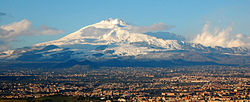
The catastrophic eruption of Mount Etna in 1169 claimed more than 15,000 lives among its inhabitants. Such devastating events shaped how medieval communities understood volcanoes, often through religious and animistic interpretations involving saints and divine forces.
Image source: Mount Etna
1200 - 1299
% complete
The thirteenth century Dominican scholar Restoro d'Arezzo devoted two entire chapters (11.6.4.6 and 11.6.4.7) of his seminal treatise La composizione del mondo colle sue cascioni to the origin of the endogenous energy of the Earth, an early serious inquiry into the internal forces driving volcanoes.
Image source: Restoro d'Arezzo
1500 - 1600
% complete
During the Renaissance, observers such as Bernard Palissy, Conrad Gessner, and Johannes Kentmann (1518–1568) showed a deep intense interest in the nature, behavior, origin and history of the terrestrial globe, laying groundwork for scientific study of volcanoes.
Image source: Bernard Palissy
1503
% complete
The earliest work in what became a landmark collection on volcanology was Censorinus's De die natali, printed in 1503. It later entered the rare book collection bequeathed to University College London by Henry James Johnston Lavis.
1505
% complete
Beroaldus's Opusculum de terremotu et pestilentia appeared in 1505, addressing earthquakes and plague. Along with Censorinus's De die natali and Elisius's De balneis, it stands among the earliest works in the Johnston Lavis collection of volcanological books at University College London.
Image source: Filippo Beroaldo
1510
% complete
Elisius's De balneis, published around 1510, examined thermal springs and baths, phenomena closely tied to geothermal activity. It is one of the three earliest works held in University College London's renowned volcanology rare book collection.
Image source: University College London

1540 - 1568
% complete
Johannes Kentmann (1518–1568), alongside contemporaries like Gessner and Palissy, exemplified the intense Renaissance interest in the nature, behavior, origin and history of the terrestrial globe, helping shift volcano explanations away from ancient wind theories.
Image source: Volcanologist
1550
% complete
Bernard Palissy was among the Renaissance observers who pursued empirical questions about the nature and history of the Earth, contributing to a growing body of knowledge that challenged purely classical explanations of volcanoes and earthquakes.
1580 - 1660
% complete
During the late sixteenth and mid-seventeenth centuries, many theories of volcanic action were framed. Natural philosophers across Europe debated whether fire, water, or chemical reactions drove eruptions, setting the stage for systematic volcanological inquiry.
Image source: Volcanology
Dec 16, 1631
% complete
The 1631 eruption of Mount Vesuvius was the largest eruption of the volcano since 79 AD. Its devastation inspired an extraordinary outpouring of scholarship: no fewer than 44 books cover this single event, including Recupito's influential account.
Image source: 1631 eruption of Mount Vesuvius
1632
% complete
Giulio Cesare Recupito published his account of the 1631 eruption of Mount Vesuvius in 1632 and later editions. His chronicle became a standard source of information about the volcano, which had produced its largest eruption since 79 AD.
Image source: Mount Vesuvius
1637 - 1680
% complete
The Jesuit Athanasius Kircher (1602–1680) witnessed eruptions of Mount Etna and Stromboli, then visited the crater of Vesuvius. He published his view of an Earth with a central fire connected to numerous others caused by the burning of sulfur, bitumen and coal.
Image source: Athanasius Kircher
1650 - 1750
% complete
The causes of volcanic and seismic phenomena were discussed in the large number of theories of the Earth that were published in the hundred years after 1650, a flourishing period of speculative but increasingly systematic geophysical thought.
Image source: History of geology
1660
% complete
In 1660 the eruption of Vesuvius rained twinned pyroxene crystals and ash upon the nearby villages. This remarkable deposit drew scholarly attention and contributed to the growing literature documenting Vesuvian eruptions in detail.
1664
% complete
Building on his firsthand observations of Italian volcanoes, Kircher articulated a model of an Earth with a central fire linked to numerous subsidiary fires fueled by sulfur, bitumen and coal — one of the most influential early modern theories of volcanic action.
1669
% complete
Despite advancing scientific understanding, popular religion persisted: the saint whose intercession had been sought historically was invoked again for the 1669 Etna eruption, and again for an outbreak endangering the town of Nicolosi in 1886.
1670
% complete
Italian natural philosophers living near active volcanoes wrote long and learned books on the subject. Giovanni Alfonso Borelli's account of the eruption of Mount Etna in 1669 became a standard source of information for students of volcanism.
Image source: Giovanni Alfonso Borelli
1690 - 1799
% complete
This animistic philosophy, which attributed volcanic phenomena to spirits and supernatural forces, was waning by the end of the seventeenth century, though traces continued well into the eighteenth century before fully giving way to naturalistic explanations.
1737
% complete
Francesco Serao published his account of the eruption of Vesuvius in 1737, with editions in French and English. Together with Borelli's and Recupito's works, it formed a canon of authoritative descriptions of Italian volcanic eruptions.
Image source: Francesco Serao
1779 - 1794
% complete
British diplomat and amateur naturalist Sir William Hamilton used the register of religious processions and Father Antonio Piaggio's diary of 1779 and 1794 to provide a detailed chronology and description of Vesuvius' eruptions, pioneering systematic documentation.
Image source: William Hamilton (diplomat)
1779 - 1794
% complete
Father Antonio Piaggio maintained a detailed diary covering the eruptions of 1779 and 1794. His records, together with procession registers, allowed Sir William Hamilton to construct a precise chronological description of Vesuvius' eruptive behavior.
1841
% complete
In 1841, the first volcanological observatory, the Vesuvius Observatory, was founded in the Kingdom of the Two Sicilies. This institution marked the birth of continuous, professional monitoring of volcanic activity.
Image source: Vesuvius Observatory
1886
% complete
An eruption of Mount Etna endangered the Sicilian town of Nicolosi in 1886, prompting once again the invocation of the traditional patron saint — a striking survival of old religious responses even as scientific volcanology matured.
1896
% complete
The study of radioactivity commenced in 1896. Over roughly the next 50 years, radioactive dating and heat production were applied to plate tectonics theory, revolutionizing understanding of the Earth's internal energy that drives volcanoes.
Image source: Radioactive decay
1914
% complete
In 1914, physician and volcanologist Henry James Johnston Lavis bequeathed his library to University College London, which now holds the largest collection of rare books on volcanology in the United Kingdom, spanning from 1503 onward.
1950
% complete
About half a century after the discovery of radioactivity, its application to the theory of plate tectonics and radiometric dating transformed volcanology by explaining why volcanoes occur where they do along tectonic boundaries.
Image source: Plate tectonics
1991
% complete
Monitoring techniques combined with modelling enabled successful forecasting of some eruptions, most notably the evacuation of the locality around Mount Pinatubo in 1991, which may have saved 20,000 lives ahead of one of the century's largest eruptions.
Image source: 1991 eruption of Mount Pinatubo
2010
% complete
Scientists can now measure the spread of an ash plume, such as the one from Eyjafjallajökull's 2010 eruption, as well as SO2 emissions, demonstrating how satellite monitoring and instrumentation have advanced the field far beyond its 1841 origins.
Image source: 2010 eruptions of Eyjafjallajökull
Or browse the full history timeline directory, with more than 2,000 topics.
This History of Volcanology timeline was generated with the help of AI, using information found on the internet.
We work hard to keep these timelines accurate, but mistakes do get through. If you spot one, email us at [email protected] and we'll fix it for future visitors.
Generate yours with AI or build it from scratch, for free.
Export your timeline, add your own events, edit or remove AI-generated events, and much more
No credit card required.
Cancel anytime.
Cancel anytime.
You can create an unlimited number of timelines with up to 10 events on each one, customize how they look, export them to PDF, PNG, PowerPoint, CSV, and Excel, and share them with a link. Paid plans raise the event limit and add features like spreadsheet imports and collaborators.
Yes. You can cancel your subscription from your account page at any time, and you will not be charged again. Your subscription stays active for the rest of the period you already paid for.
Yes. We will email you a reminder before the annual renewal, and we will also email you a receipt.
Yes. You can email us within 15 days of any payment, and we will issue you a full refund.
Check out our pricing docs or send us an email anytime: [email protected].