-
Use Cases
-
Resources
-
Pricing
The Mariana Trench, located in the western Pacific Ocean near Guam and the Mariana Islands, is the deepest oceanic trench on Earth, reaching a maximum depth of about 10,935 meters (35,876 feet) at the Challenger Deep. Formed millions of years ago by subduction of the Pacific Plate beneath the Mariana Plate, it was first measured by HMS Challenger in 1875 and has since become the focus of pioneering deep-sea exploration and scientific research. More Less
1875
% complete
The trench was first sounded during the Challenger expedition in 1875 using a weighted rope, which recorded a depth of 4,475 fathoms (8,184 meters; 26,850 feet). This marked the earliest known measurement of what would later be recognized as the deepest point in the world's oceans.
Image source: Challenger expedition
1877
% complete
In 1877, a map was published called Tiefenkarte des Grossen Ozeans ("Depth map of the Great Ocean") by Petermann, which showed a Challenger Tief ("Challenger deep") at the location of that sounding, giving the deepest part of the trench its enduring name.
Image source: Mariana Trench
1899
% complete
In 1899, USS Nero, a converted collier, recorded a depth of 5,269 fathoms (9,636 meters; 31,614 feet), significantly extending the known depth of the trench beyond the original Challenger expedition measurement.
Image source: USS Nero
1951
% complete
Under Chief Scientist Thomas Gaskell, HMS Challenger II surveyed the trench using echo sounding, a much more precise and vastly easier way to measure depth than the sounding equipment and drag lines used in the original expedition.
1957
% complete
The Soviet research vessel Vityaz reported a depth of 11,034 m (36,201 ft) at a location dubbed the Mariana Hollow, one of the deepest readings ever recorded in the trench at that time.
1984
% complete
The Japanese survey vessel Takuyō collected data from the Mariana Trench using a narrow, multi-beam echo sounder; it reported a maximum depth of 10,924 meters (35,840 ft), also reported as 10,920 ± 10 m.
1997 - 2001
% complete
During surveys carried out between 1997 and 2001, a spot was found along the Mariana Trench that had a depth similar to the Challenger Deep, possibly even deeper, prompting further interest in mapping the trench's extremes.
Jun 1, 2009
% complete
On 1 June 2009, mapping aboard the RV Kilo Moana (mothership of the Nereus vehicle), indicated a spot with a depth of 10,971 m (35,994 ft), contributing new high-resolution data about the trench's seafloor.
Image source: RV Kilo Moana
Dec 5, 2011
% complete
At the American Geophysical Union Fall Meeting in 2011, it was announced that a US Navy hydrographic ship equipped with a multibeam echosounder conducted a survey which mapped the entire trench to 100 m resolution, the most complete picture of the trench to date.
Jan 23, 1960
% complete
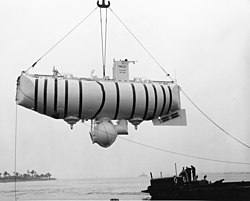
Swiss-designed, Italian-built, United States Navy-owned bathyscaphe Trieste reached the bottom of the Challenger Deep at 1:06 pm on 23 January 1960, with Don Walsh and Jacques Piccard on board, becoming the first crewed descent to the deepest point of the ocean.
Image source: Trieste (bathyscaphe)
Mar 24, 1995
% complete
Remotely Operated Vehicle Kaiko reached the deepest area of the Mariana Trench and made the deepest diving record of 10,911 m (35,797 ft) on 24 March 1995, a milestone for uncrewed exploration of the hadal zone.
Image source: Kaikō ROV
May 31, 2009
% complete
The uncrewed hybrid remotely operated vehicle Nereus successfully descended into the Challenger Deep, becoming only the second vehicle after Kaiko to reach the bottom of the Mariana Trench.
Image source: Nereus (underwater vehicle)
Mar 26, 2012
% complete
Canadian film director James Cameron made the fourth descent ever to the bottom of the Challenger Deep on 26 March 2012, piloting the Deepsea Challenger solo, the first single-person dive and the first crewed return since Trieste in 1960.
Image source: Deepsea Challenger
Apr 28, 2019 - May 5, 2019
% complete
Victor Vescovo achieved a new record descent to 10,928 m (35,853 ft) on 28 April 2019 using the DSV Limiting Factor, a Triton 36000/2 model manufactured by Florida-based Triton Submarines. He dived four times between 28 April and 5 May 2019, becoming the first person to dive into the Challenger Deep more than once.
May 8, 2020
% complete
On 8 May 2020, a joint project between Russian shipbuilders, scientific teams of the Russian Academy of Sciences with support of the Russian Foundation for Advanced Research Projects and the Pacific Fleet submerged the autonomous underwater vehicle Vityaz-D to near the bottom of the Mariana Trench at a depth of 10,028 m (32,900 ft).
Image source: Vityaz-D Autonomous Underwater Vehicle
Jun 2020
% complete
In June 2020 Victor Vescovo again descended to depths of around 10,935 meters (35,876 ft) in the DSV Limiting Factor, matching the maximum known depth of the trench and furthering repeated exploration of the Challenger Deep.
Image source: Victor Vescovo
Nov 10, 2020
% complete
On 10 November 2020, the Chinese crewed submersible Fendouzhe reached the bottom of the Mariana Trench at a depth of 10,909 m (35,791 ft), carrying three crew members to the Challenger Deep.
Image source: Striver (bathyscaphe)
Jul 2022
% complete
In July 2022, DSV Limiting Factor piloted by Victor Vescovo brought Dawn Wright to the bottom, making her the first Black woman to explore the Mariana Trench, a landmark moment in the human history of deep-sea exploration.
Image source: Dawn Wright
2024
% complete
The DSV Limiting Factor returned to the Mariana Trench in 2024, diving 23 times into the depths as part of ongoing commercial and scientific expeditions enabled by Triton Submarines' full-ocean-depth technology.
Image source: DSV Limiting Factor
Jan 23, 1960
% complete
The Trieste expedition claimed to have observed, with great surprise because of the high pressure, large creatures living at the bottom, such as a flatfish about 30 cm (12 in) long, and shrimp, sparking debate about life at extreme depths.
1996
% complete
During its second expedition in 1996, the uncrewed vehicle Kaiko collected mud samples from the seabed of the Mariana Trench, providing scientists with material to study life and chemistry at the deepest levels of the ocean.
Jul 2011
% complete
In July 2011, a research expedition deployed untethered landers, called drop cams, equipped with digital video cameras and lights to explore this deep-sea region, capturing rare footage of life in the trench.
Image source: Deep-sea exploration
2012
% complete
Louis and the Woods Hole Oceanographic Institution conducted a seismic survey in 2012 to investigate the subsurface water cycle, studying how the subducting plate beneath the Mariana Trench transports water into the Earth's mantle.
Image source: Woods Hole Oceanographic Institution
Dec 2014
% complete
In December 2014, a new species of snailfish was discovered at a depth of 8,145 m (26,722 ft), breaking the previous record for the deepest living fish seen on video. Several new species were also filmed during the 2014 expedition, including huge amphipods known as supergiants.
Image source: Pseudoliparis swirei
Jul 2015
% complete
Members of NOAA, Oregon State University, and the Coast Guard submerged a hydrophone into the deepest part of the Mariana Trench, the Challenger Deep — never having previously deployed one past a mile — recording ambient sound from the deepest ocean environment.
Image source: National Oceanic and Atmospheric Administration
2016
% complete
A 2016 research expedition looked at the chemical makeup of crustacean scavengers collected from the range of 7,841–10,250 m within the trench, revealing how these creatures survive by scavenging in the hadal zone.
May 2017
% complete
In May 2017, the newly named Mariana snailfish discovered in 2014 was filmed at a depth of 8,178 meters (26,800 ft), confirming it as the deepest-dwelling fish ever observed on camera.
2025
% complete
Three papers published in Cell in 2025 extensively described life in the hadal zone, between 6,000 and 11,000 meters. One study identified more than 7,000 new microbial species in the Mariana Trench, 89% of them new to science.
Image source: Hadal zone
1979
% complete
In 1979, Japan planned to dump low-level nuclear wastes near Maug, in the Northern Marianas, raising concerns about contamination of the Pacific region near the Mariana Trench.
Image source: Maug Islands
2009
% complete
In 2009, the United States established the Mariana Trench Marine National Monument as a national monument from parts of the Mariana Trench that are inside the exclusive economic zone (EEZ) of the United States, protecting a unique deep-ocean environment.
Image source: Mariana Trench Marine National Monument
Apr 28, 2019 - May 5, 2019
% complete
During his record-setting dives, Victor Vescovo reported finding a plastic bag and candy wrappers at the bottom of the trench, stark evidence that human pollution has reached even the deepest place in the ocean.
2024
% complete
In 2024, a beer bottle was observed in the Western Pool of the Challenger Deep, continuing evidence of human litter accumulating even in the most remote and deepest environments on Earth.
Or browse the full history timeline directory, with more than 2,000 topics.
This History of the Mariana Trench timeline was generated with the help of AI, using information found on the internet.
We work hard to keep these timelines accurate, but mistakes do get through. If you spot one, email us at [email protected] and we'll fix it for future visitors.
Generate yours with AI or build it from scratch, for free.
Export your timeline, add your own events, edit or remove AI-generated events, and much more
No credit card required.
Cancel anytime.
Cancel anytime.
You can create an unlimited number of timelines with up to 10 events on each one, customize how they look, export them to PDF, PNG, PowerPoint, CSV, and Excel, and share them with a link. Paid plans raise the event limit and add features like spreadsheet imports and collaborators.
Yes. You can cancel your subscription from your account page at any time, and you will not be charged again. Your subscription stays active for the rest of the period you already paid for.
Yes. We will email you a reminder before the annual renewal, and we will also email you a receipt.
Yes. You can email us within 15 days of any payment, and we will issue you a full refund.
Check out our pricing docs or send us an email anytime: [email protected].