-
Use Cases
-
Resources
-
Pricing
Email is one of the foundational technologies of the internet age. This timeline traces its evolution from early message exchange on time-sharing computers in the 1960s, through Ray Tomlinson's pioneering network email in 1971, to the rise of webmail services like Hotmail and Gmail, and its ongoing role in modern digital communication. More Less
1933
% complete
Telex became an operational teleprinter service in 1933, beginning in Germany and Europe, and after 1945 spread around the world.
Image source: Telex
1961
% complete
With the introduction of MIT's Compatible Time-Sharing System (CTSS) in 1961, for the first time multiple users could log into a central system from remote terminals, and store and share files on the central disk.
Image source: Compatible Time-Sharing System
1962
% complete
The AUTODIN military network in the United States, first operational in 1962, provided a message service between 1,350 terminals, handling 30 million messages per month, with an average message length of approximately 3,000 characters.
1965
% complete
Computer-based messaging between users of the same system became possible following the advent of time-sharing in the early 1960s, with a notable implementation by MIT's CTSS project in 1965.
1968
% complete
By 1968, AUTODIN linked more than 300 sites in several countries.
1971
% complete
APL Mailbox, by Larry Breed of STSC, aimed at being a more robust mail software than a predecessor written in 1971.
Image source: History of email
1974
% complete
PLATO IV was networked to individual terminals over leased data lines prior to the implementation of personal notes in 1974.
Image source: PLATO (computer system)
1970 - 1972
% complete
IBM developed a primitive in-house solution for office automation over the period 1970–1972, and replaced it with OFS (Office System), providing mail transfer between individuals, in 1974.
1975
% complete
IBM VNET was deployed by 1975, using BSC to communicate among CP-67 and VM hosts running RSCS.
1977
% complete
USPS began looking into electronic mail in 1977 resulting in the E-COM proposal in September 1978. The June 1979 usage of E-mail referred to the USPS project called Electronic Computer Originated Mail, abbreviated E-COM.
1977
% complete
Development work on DEC's ALL-IN-1 system began in 1977 and was released in 1982.
Image source: ALL-IN-1
1977
% complete
The Xerox Star had been in development since 1977 and the development team relied heavily on the technologies they were working on, including electronic mail.
Image source: Xerox Star
1978
% complete
CompuServe began offering electronic mail designed for intraoffice memos in 1978.
Image source: CompuServe
May 1979
% complete
In May 1979, Xerox ran a television advertisement for its 1973 Xerox Alto system, demonstrating the 1978 Distributed Message System (DMS) client, known as Laurel, to the US public.
Image source: Xerox Alto
1981
% complete
This system developed into IBM Profs, which was available on request to customers before being released commercially in 1981.
Apr 1981
% complete
CompuServe rebranded its electronic mail service as EMAIL in April 1981, which popularized the term.
1982
% complete
Development work on DEC's ALL-IN-1 system began in 1977 and was released in 1982.
1982
% complete
Hewlett-Packard launched HPMAIL (later HP DeskManager) in 1982, which became the world's largest selling email system.
1982 - 1985
% complete
The E-COM service launched in 1982, allowing corporate customers to send electronic mail to a post office branch from where it was printed and delivered in the normal way. It operated until 1985.
1982
% complete
Introduced commercially throughout France in 1982, this system provided messaging services to French consumers.
Image source: Minitel
1983
% complete
1983 – MCI Mail operated by MCI Communications Corporation. A US trademark application (USPTO SN:73432146) was filed on June 27, 1983, but abandoned in August 1984.
1984
% complete
In 1984, IBM PCs running DOS could link with FidoNet for email and shared bulletin board posting.
1984
% complete
Soft-Switch released its eponymous email gateway product in 1984, acquired by Lotus Development ten years later.
1987
% complete
HP OpenMail, initially designed in 1987, was known for its ability to interconnect several other APIs and protocols, including MAPI, cc:Mail, SMTP/MIME, and X.400.
Image source: HP OpenMail
1987
% complete
By 1987 users of Microsoft's internal MS-Net network of about 1600 computers, workstations, and terminals sent 60,000 megabytes of email weekly via Xenix systems. As of 1993 the Xenix mail systems handled 650,000-750,000 messages daily, 4.5GB total or about 30-35 per user, 10-15% to or from outside the company.
1989
% complete
MCI Mail was the first commercial public email service to use the Internet in 1989.
1971
% complete
In 1971, Ray Tomlinson sent the first mail message between two computers on the ARPANET, introducing the now-familiar address syntax with the '@' symbol designating the user's system address. He updated an existing utility called SNDMSG so that it could copy messages over the network, initiating the use of the '@' sign to separate the names of the user and the user's machine.
Image source: Email
1974
% complete
Sylvia Wilbur, who worked for Peter Kirstein at University College London, was 'probably one of the first people in [the United Kingdom] ever to send an email [over the ARPANET], back in 1974'.
1975
% complete
The Oxford English Dictionary (OED) has a first quotation for electronic mail in the modern context in 1975.
Mar 26, 1976
% complete
Queen Elizabeth II sent the first electronic mail from a head of state over the ARPANET from the Royal Signals and Radar Establishment in England on March 26, 1976.
Sep 1976
% complete
In September 1976, a Business Week article entitled 'When interoffice mail goes electronic' remarked 'In a sense, electronic mail is not new'.
Jun 1979
% complete
The OED provides a June 1979 first usage for E-mail: 'Postal Service pushes ahead with E-mail' in the journal Electronics.
Aug 3, 1984
% complete
The first Internet email sent to Germany via CSNET was from Laura Breeden to Michael Rotert and Werner Zorn as a carbon copy at the Technical University of Karlsruhe (today Karlsruhe Institute of Technology) on August 3, 1984.
Aug 9, 1991
% complete
The first email sent from outer space was August 9, 1991, Space Shuttle mission STS-43.
Image source: STS-43
1994
% complete
The US president used Internet email in the 1990s, including a reply to an email from the prime minister of Sweden in 1994.
Jul 1971
% complete
A 'Mail Protocol' was proposed by Richard Watson at the Network Information Center's (NIC), hosted by SRI-ARC, in RFC 196 in July 1971. This proposal was revised and updated in RFC 221 and RFC 278 in August and November 1971, respectively.
Jul 1972
% complete
In July 1972, Abhay Bhusan, a professor at MIT, was writing the final specs of the ARPANET File Transfer Protocol (FTP), which would be used to carry network mail.
Image source: File Transfer Protocol
Sep 1974
% complete
Ray Tomlinson proposed a network mail protocol to the International Network Working Group in INWG Protocol note 2, written in September 1974.
1975 - 1992
% complete
The Coloured Book protocols ran on academic networks in the United Kingdom from 1975 until 1992 and gained some acceptance internationally as 'interim' standards.
Nov 1977
% complete
Through RFC 561, RFC 680, RFC 724, and finally RFC 733 in November 1977, a standardized framework was developed for 'electronic mail', also called 'network text messages', using FTP mail servers on the ARPANET.
1978
% complete
Unix mail was networked by 1978's UUCP, which was also used for USENET newsgroup postings, with similar headers. BerkNet, the Berkeley Network, was written by Eric Schmidt in 1978 and included first in the Second Berkeley Software Distribution.
Image source: UUCP
1979 - 1980
% complete
The delivermail tool, written by Eric Allman in 1979 and 1980 (and shipped in 4BSD), provided support for routing mail over dissimilar networks, including Arpanet, UUCP, and BerkNet. It was introduced to replace SNDMSG as an MTA.
1979
% complete
UUCP implementations for Unix systems, initially released in 1979, and later for other operating systems, only had dial-up communications available.
Feb 1979
% complete
Subsequently, Derek Barber implemented a network mail protocol on the EIN, which he presented to INWG in February 1979. This was referenced by Jon Postel in his March 1979 work on an 'Internet Message Protocol' in IEN number 85, which was RFC 753.
1981
% complete
1981
% complete
CSNET, which began operation in 1981, initially used a purpose-built dial-up protocol, called Phonenet, to provide mail-relay services for non-ARPANET hosts.
Image source: CSNET
Nov 1981
% complete
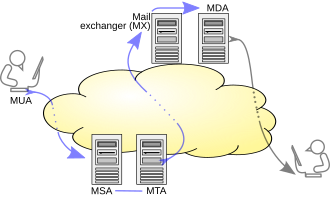
In November 1981, Postel published RFC 788 describing the Simple Mail Transfer Protocol (SMTP) protocol, which was updated by RFC 821 in August 1982. SMTP had been first proposed by Jon Postel and Suzanne Sluizer in September 1980 in RFC 772 as the Mail Transfer Protocol (MTP).
Image source: Simple Mail Transfer Protocol
Addresses were extended to [email protected] by RFC 805 in February 1982.
1983
% complete
A new mail transfer agent (MTA) based on SMTP, Sendmail, was introduced in 1983.
Jan 1, 1983
% complete
ARPANET switched to TCP/IP on January 1, 1983 and the Internet grew rapidly thereafter (see Protocol Wars).
Image source: ARPANET
1983
% complete
The Simple Mail Transfer Protocol (SMTP) protocol was implemented on the ARPANET in 1983.
1984
% complete
X.400, published in 1984, was promoted by major vendors, and mandated for government use under GOSIP, but abandoned by all but a few in favor of Internet protocol suite's SMTP by the mid-1990s (see Protocol Wars).
1984
% complete
The Internet community developed two further standards, the Post Office Protocol (POP) and the Internet Message Access Protocol (IMAP), in 1984 and 1988 respectively.
Jan 1986
% complete
After the introduction of the Domain Name System (DNS) in 1985, mail routing was updated in January 1986 by RFC 974.
Image source: Domain Name System
1986
% complete
Message Handling System (MHS) protocol developed in 1986.
1988
% complete
The Internet community developed two further standards, the Post Office Protocol (POP) and the Internet Message Access Protocol (IMAP), in 1984 and 1988 respectively.
Or browse the full history timeline directory, with more than 2,000 topics.
This History of Email timeline was generated with the help of AI, using information found on the internet.
We work hard to keep these timelines accurate, but mistakes do get through. If you spot one, email us at [email protected] and we'll fix it for future visitors.
Generate yours with AI or build it from scratch, for free.
Export your timeline, add your own events, edit or remove AI-generated events, and much more
No credit card required.
Cancel anytime.
Cancel anytime.
You can create an unlimited number of timelines with up to 10 events on each one, customize how they look, export them to PDF, PNG, PowerPoint, CSV, and Excel, and share them with a link. Paid plans raise the event limit and add features like spreadsheet imports and collaborators.
Yes. You can cancel your subscription from your account page at any time, and you will not be charged again. Your subscription stays active for the rest of the period you already paid for.
Yes. We will email you a reminder before the annual renewal, and we will also email you a receipt.
Yes. You can email us within 15 days of any payment, and we will issue you a full refund.
Check out our pricing docs or send us an email anytime: [email protected].