-
Resources
-
Pricing
The history of flashlights traces the development of portable electric lighting from bulky early designs to efficient, reliable LED technology. More Less
Build a timeline like this one in minutes, for free. Start Yours →
Part of our collection of invention and technology timelines.
1887
The first dry cell battery was invented in 1887. Its sealed, portable construction provided the battery technology needed for practical handheld electric lighting.
Image source: Dry cell
1896
The first mass-produced dry cell batteries appeared in 1896, making portable electrical power more broadly available and helping enable the development of flashlights.
1896
The invention of portable electric lights soon followed the mass production of dry cell batteries in 1896, beginning the transition from stationary electric lighting to handheld devices.
1899
Miniature incandescent electric lamps, combined with dry cells, made the first battery-powered flashlights possible around 1899.
1899
Around 1899, the combination of dry cells and miniature incandescent lamps made the first battery-powered flashlights possible.
Jan 10, 1899
On January 10, 1899, British inventor David Misell obtained U.S. Patent No. 617,592 for a battery-powered electric light. The patent was assigned to the American Electrical Novelty and Manufacturing Company.
Jan 10, 1899
The flashlight patent obtained by David Misell on January 10, 1899, was assigned to the American Electrical Novelty and Manufacturing Company, linking the early invention to a manufacturing enterprise.
1904
Improved batteries in varying sizes, appearing alongside the development of tungsten-filament lamps in 1904, made flashlights more useful and popular.
1904
The tungsten-filament lamp was developed in 1904. It offered three times the efficacy of carbon-filament types, improving the usefulness of battery-powered lighting.
Image source: Incandescent light bulb
1904
The greater efficacy of tungsten-filament lamps and improvements in battery design helped make flashlights more useful and popular from 1904 onward.
1907
By 1907, tubular hand-held flashlights were among the available flashlight designs, establishing a familiar form for portable illumination.
1907
By 1907, lantern-style flashlights were available. They could be set down for extended use rather than held continuously.
1907
Pocket-size penlights were available by 1907, providing compact illumination for close work.
1907
By 1907, large reflector searchlight-type lamps were available for lighting distant objects.
1907
The range of flashlight types documented by 1907 included tubular hand-held models, lanterns, penlights, and large reflector searchlight-type lamps.
1922
The 1922 value of flashlight and renewal-battery sales was comparable to sales of many line-operated electrical appliances, indicating the commercial importance of portable lighting.
1922
Annual U.S. sales of renewal batteries and flashlights reached $20 million in 1922, comparable to sales of many line-operated electrical appliances.
1922
In 1922, the United States had an estimated 10 million flashlight users, demonstrating the technology's broad adoption.
1996
A standard that described only incandescent-lamp flashlights was withdrawn in 1996, reflecting the changing technology of flashlight illumination.
2009
In 2009, the American National Standards Institute published the FL1 Flashlight basic performance standard in the United States.
2009
The ANSI FL1 standard published in 2009 established a basic framework for describing flashlight performance in the United States.
2009
The beam distance is calculated as the square root of beam intensity in candelas divided by 0.25 lux. For example, 1,000 candelas produces a working-range rating of 63 meters.
2013
In 2013, iPhones were updated with iOS 7 to include a built-in function that switched on the camera flash to provide a flashlight.
Image source: IOS 7
2018
In 2018, Underwriter's Laboratories published UL Standard 1576 in the United States for flashlights and lanterns.
2018
UL Standard 1576 outlines safety requirements and performance tests for flashlights and lanterns.
1999
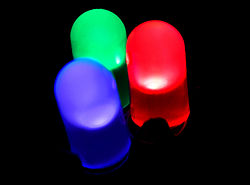
In 1999, Lumileds Corporation of San Jose, California, introduced the Luxeon LED, a high-power white-light emitter that helped enable a new generation of LED flashlights.
1999
The Luxeon LED introduced by Lumileds in 1999 was significant as a high-power white-light emitter suitable for applications requiring bright portable illumination.
Image source: Light-emitting diode
2001
The Arc LS, designed in 2001, was the first flashlight to use the Luxeon LED.
2001
The first Luxeon LED flashlight, the Arc LS, marked the entry of high-power Luxeon-based LED flashlights in 2001.
Image source: LED lamp
2006
Maglite made its first LED flashlight in 2006, extending LED technology into one of the established flashlight brands.
2018
The first laser excited phosphor, or LEP, flashlight became available in 2018, introducing a distinct long-range lighting technology to the flashlight market.
2018
By 2018, a few dozen LEP flashlights were available, mainly from China.
Build a timeline like this one in minutes, for free. Start Yours →
Or browse the full history timeline directory, with more than 2,500 topics.
This History of Flashlights timeline was generated with the help of AI, using information found on the internet.
We work hard to keep these timelines accurate, but mistakes do get through. If you spot one, email us at [email protected] and we'll fix it for future visitors.
Generate yours with AI or build it from scratch, for free.
Export your timeline, add your own events, edit or remove AI-generated events, and much more
No credit card required.
15-day money-back guarantee.
You can create an unlimited number of timelines with up to 10 events on each one, customize how they look, export them to PDF, PNG, PowerPoint, CSV, and Excel, and share them with a link. Timelines made with Timeline Maker AI keep every event the generator created, and you can add up to 5 events of your own. Paid plans remove the event limit, add spreadsheet imports and hide Preceden's branding, and the higher-priced plan also adds collaborators, a custom logo and a custom domain.
Yes. You can cancel your subscription from your account page at any time, and you will not be charged again. Your subscription stays active for the rest of the period you already paid for.
Yes. We email you a reminder 15 days before your annual renewal, and we email you a receipt after every payment.
Yes. You can email us within 15 days of any payment, and we will issue you a full refund.
Check out our pricing docs or send us an email anytime: [email protected].