
-
Resources
-
Pricing
The history of the microwave traces the development of microwave technology from nineteenth-century physics and wartime radar to the modern microwave oven used in homes worldwide. More Less
Build a timeline like this one in minutes, for free. Start Yours →
1920
The development of vacuum tube radio transmitters around 1920 made it possible to exploit high-frequency radio waves for heating substances, establishing an important technical foundation for microwave cooking.
Image source: Vacuum tube
1930
By 1930, the application of short waves to heat human tissue had developed into the medical therapy known as diathermy, demonstrating the heating effects of radio-frequency energy.
1933
At the 1933 Chicago World's Fair, Westinghouse demonstrated cooking food between two metal plates connected to a 10-kilowatt, 60-megahertz shortwave transmitter.
Image source: Microwave oven
1937 - 1940
Between 1937 and 1940, British physicist Sir John Turton Randall and coworkers built a multi-cavity magnetron for British and American military radar installations during World War II.
1940
In 1940 at the University of Birmingham, John Randall and Harry Boot produced a working prototype of the higher-powered microwave generator needed to operate at shorter wavelengths.
Sep 1940
Sir Henry Tizard traveled to the United States in late September 1940 to offer Britain's most valuable technical secrets, including the cavity magnetron, in exchange for American financial and industrial support.
Sep 1940
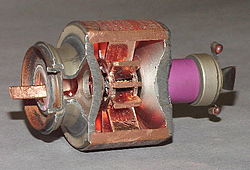
An early 6-kilowatt microwave generator built by the General Electric Company Research Laboratories in Wembley, London, was given to the U.S. government in September 1940.
Image source: Cavity magnetron
1945
In 1945, Percy Spencer, an American self-taught engineer from Howland, Maine, independently and accidentally discovered that a high-power microwave beam could heat food.
1945
Soon after filing its patent application, Raytheon placed a magnetron-powered microwave oven in a Boston restaurant for testing.
Oct 8, 1945
Raytheon filed a United States patent application for Percy Spencer's microwave cooking process and an oven that heated food with microwave energy from a magnetron.
Oct 7, 1946
Raytheon showed two Radarange units to the press at the Waldorf-Astoria in New York City. The presentation publicized the company's commercial microwave technology.
Oct 7, 1946
One of the 1946 Radarange units was intended for limited baking in sandwich shops, while the other was designed to prepare frozen foods for aircraft and serve a complete meal on one plate. Its projected retail cost was $1,250.
Dec 30, 1946
The Federal Communications Commission approved the 2,450-megahertz frequency for Raytheon's new microwave product, supporting the operating frequency used by the Radarange.
Image source: Federal Communications Commission
1947
In 1947, Raytheon built the Radarange, generally regarded as the first commercially available microwave oven and the product associated with Percy Spencer's invention.
Mar 1948
By March 1948, about 100 Radarange units were in commercial use in the United States, including in factory cafeterias.
1952
By early 1952, the Pennsylvania Railroad advertised use of the Radarange on several of its eastern United States lines.
Mar 23, 1952
Raytheon's Radarange was demonstrated on KTTV in Los Angeles on March 23, 1952, bringing the technology to a television audience.
1952
Raytheon licensed Mansfield, Ohio, to develop and market consumer microwave ovens, helping move the technology beyond commercial installations.
1953 - 1954
As home-version production approached, demonstrator microwave models were placed in selected Raytheon television, radio, and appliance dealerships in several states during 1953 and 1954.
1954
In late 1954, a Raytheon vice president disclosed that commercial units cost $3,500 and pledged that consumer models made by stove companies in cooperation with Raytheon would be marketed within months at about $1,000.
Oct 27, 1955
Tappan exhibited a microwave oven in New York on October 27, 1955. It had already tested freestanding and in-wall prototypes in Mansfield households for much of the preceding year.
1956
Raytheon licensed its patents for a home-use microwave oven to Tappan, which first sold the appliance in 1956. The oven remained too large and expensive for general household use.
Apr 1956
Although Tappan had pledged an early-1956 release, U.S. appliance dealers began exhibiting the Tappan Electronic Oven in April 1956, typically advertising it at $1,250.
Image source: Tappan (brand)
1961
Japan's Sharp Corporation began manufacturing microwave ovens in 1961, establishing an important Japanese presence in the expanding appliance industry.
Image source: Sharp Corporation
1964 - 1966
Between 1964 and 1966, Sharp introduced the first microwave oven with a turntable. The rotating platform promoted more even heating than the earlier microwave stirrer feature.
1965
In 1965, Raytheon acquired Amana to gain additional manufacturing capability while expanding its Radarange technology into the home market.
Image source: Amana Corporation
1967
Amana, then owned by Raytheon, introduced the first popular countertop microwave model in 1967. The countertop Radarange sold for $495, equivalent to about $5,000 in 2025 dollars.
1972
By 1972, Litton's Atherton Division in Minneapolis introduced two microwave ovens priced at $349 and $399 to compete in a market projected to reach $750 million by 1976.
Image source: Litton Industries
1974
Amana introduced automatic defrost in 1974 on its RR-4D microwave oven, adding a significant convenience feature for household cooking.
1975
Amana became the first manufacturer to offer a microprocessor-controlled digital control panel, introducing the feature with its RR-6 model in 1975.
1979 - 1998
In Canada, fewer than 5% of households had a microwave oven in 1979, but more than 88% owned one by 1998.
1986
By 1986, roughly 25% of households in the United States owned a microwave oven, compared with only about 1% in 1971.
1994
In France, 40% of households owned a microwave oven in 1994, showing substantial adoption outside the United States.
1997
The U.S. Bureau of Labor Statistics reported that more than 90% of American households owned a microwave oven in 1997, illustrating its transformation into a nearly universal appliance.
2000
In 2000, some manufacturers began adding high-power quartz halogen bulbs to convection microwave ovens. Products marketed as Speedcook, Advantium, Lightwave, and Optimawave emphasized rapid cooking and improved browning.
Image source: Microwave oven
2000
A Lawrence Berkeley National Laboratory study found that the average microwave oven drew almost 3 watts of standby power when unused, amounting to approximately 26 kilowatt-hours per year.
Image source: Standby power
2002 - 2008
Microwave ownership in Vietnam increased from 6.7% of households in 2002 to 16% in 2008, while refrigerator ownership rose from 14% to 30%.
2002 - 2008
Almost twice as many South African households owned microwave ovens in 2008 as in 2002: ownership rose from 19.8% to 38.7%.
2002 - 2008
The share of Russian households with a microwave oven grew from almost 24% in 2002 to almost 40% in 2008.
2004
By 2004, microwave ownership in France had increased to 65% of households.
2006
A 2006 study found that microwaving wet sponges for two minutes at 1,000 watts removed 99% of coliforms, E. coli, and MS2 phages.
2008
A 2008 Australian market research study found that 95% of kitchens contained a microwave oven and that 83% of those appliances were used daily.
2013
In India, about 5% of households owned a microwave oven in 2013, well behind refrigerator ownership at 31%.
2016
New efficiency standards imposed by the United States Department of Energy in 2016 required most types of microwave ovens to use less than 1 watt of standby power, or approximately 9 kilowatt-hours per year.
Image source: Energy conservation
2017
A 2017 study found that microwaving sponges killed about 60% of their microbes, but the remaining organisms quickly recolonized the sponge.
2018
In 2018, microwave ovens globally used an estimated 77 terawatt-hours of electricity, equivalent to about 0.3% of worldwide electricity generation.
2020
As of 2020, the majority of countertop microwave ovens sold in the United States, regardless of brand, were manufactured by the Midea Group.
Image source: Midea Group
2020
Consumer household microwave ovens generally operate with cooking power between 600 and 1,200 watts, a range that became standard across many countertop and built-in models.
Build a timeline like this one in minutes, for free. Start Yours →
Or browse the full history timeline directory, with more than 2,500 topics.
This History of the Microwave timeline was generated with the help of AI, using information found on the internet.
We work hard to keep these timelines accurate, but mistakes do get through. If you spot one, email us at [email protected] and we'll fix it for future visitors.
Generate yours with AI or build it from scratch, for free.
Export your timeline, add your own events, edit or remove AI-generated events, and much more
No credit card required.
15-day money-back guarantee.
You can create an unlimited number of timelines with up to 10 events on each one, customize how they look, export them to PDF, PNG, PowerPoint, CSV, and Excel, and share them with a link. Timelines made with Timeline Maker AI keep every event the generator created, and you can add up to 5 events of your own. Paid plans remove the event limit, add spreadsheet imports and hide Preceden's branding, and the higher-priced plan also adds collaborators, a custom logo and a custom domain.
Yes. You can cancel your subscription from your account page at any time, and you will not be charged again. Your subscription stays active for the rest of the period you already paid for.
Yes. We email you a reminder 15 days before your annual renewal, and we email you a receipt after every payment.
Yes. You can email us within 15 days of any payment, and we will issue you a full refund.
Check out our pricing docs or send us an email anytime: [email protected].