-
Use Cases
-
Resources
-
Pricing
Harvard University, founded in 1636 in Cambridge, Massachusetts, is the oldest institution of higher education in the United States. Established by the Massachusetts Bay Colony and named after benefactor John Harvard, it grew from a small Puritan training school into one of the world's most prestigious universities, shaping American education, politics, and culture for nearly four centuries. More Less
1636
% complete
Harvard College was founded in 1636 in New Towne, a settlement itself founded six years earlier in colonial-era Massachusetts Bay Colony, one of the original Thirteen Colonies. After some 17,000 Puritans had migrated to New England, Harvard was founded in anticipation of the need for training clergy for the new commonwealth, a 'church in the wilderness'.
Image source: Harvard University
1637 - 1639
% complete
Nathaniel Eaton oversaw the college under various titles between 1637 and 1639.
Image source: Nathaniel Eaton
1638
% complete
In 1638, New Towne was renamed Cambridge, in honor of Cambridge, England, where many of the Colony's settlers had attended the University of Cambridge.
Image source: Cambridge, Massachusetts
1638
% complete
In 1638, Harvard received a printing press – the first in North America – and it received a second press in 1659.
Mar 13, 1639
% complete
On March 13, 1639, the college was named Harvard College in honor of the Puritan clergyman John Harvard, a University of Cambridge alumnus who willed the new school £779 pounds sterling and his library of some 400 books.
Image source: John Harvard
1640 - 1654
% complete
When Henry Dunster, the college's second president from 1640 to 1654, abandoned Puritanism in favor of the English Baptist faith in 1654, he provoked a controversy that highlighted two distinct approaches to dealing with dissent in the Massachusetts Bay Colony. Dunster exiled himself in 1654 and moved to nearby Plymouth Colony, where he died in 1658.
1642
% complete
The first commencement of Harvard College was in 1642, with only nine students. The Harvard 'Lawes' of 1642 testify to its original high level of discipline, requiring students to prove their fitness for the bachelor's degree by showing they could 'read the original of the Old and New Testament into the Latin tongue, and resolve them logically'.
1650
% complete
The colony charter creating the Harvard Corporation was granted in 1650 at the beginning of the English Interregnum.
Image source: President and Fellows of Harvard College
1684
% complete
Because it had been unlawful for the colony to establish a college, King Charles II rescinded the Massachusetts Bay Colony charter in 1684 by a writ of scire facias.
Image source: Massachusetts Bay Colony
1692
% complete
In 1692, the leading Puritan divine Increase Mather became Harvard's sixth president. Harvard's leadership and alumni, including Increase Mather and his son Cotton Mather, played central roles in the Salem Witch Trials in 1692–1693.
Image source: Increase Mather
1692 - 1693
% complete
Harvard's leadership and alumni, including Increase Mather and his son Cotton Mather, played central roles in the Salem Witch Trials in 1692–1693.
Image source: Salem witch trials
1701
% complete
The end of Mather's presidency in 1701 marked the start of a long struggle at Harvard between orthodoxy and liberalism. By 1700, Harvard was strong enough to regulate and discipline its own people, and to a large extent the direction in which support and assistance flowed was reversed, Harvard now providing financial support for local economic expansion, improvements to public health, and the construction of local roads, meeting houses, and schools.
Image source: History of Harvard University
1708
% complete
In 1708, John Leverett, Harvard's first secular president, was appointed as Harvard's seventh president.
1721
% complete
Systematic theological instruction was inaugurated in 1721. Throughout the 18th century, Enlightenment ideas of the power of reason and free will became widespread among Congregational ministers, putting those ministers and their congregations in tension with more traditionalist, Calvinist parties.
Image source: Harvard Divinity School
1780
% complete
In the late 18th century, Harvard began granting graduate and doctorate-level degrees, and in 1780 the Constitution of Massachusetts recognized it as a university.
1805
% complete
Following the death of Hollis Professor of Divinity David Tappan in 1803 and that of Harvard president Joseph Willard a year later, a struggle broke out over their replacements. Henry Ware was elected to the chair in 1805, and the liberal Samuel Webber was appointed Harvard president two years later, signaling a changing of the tide from the dominance of traditional ideas at Harvard to the dominance of liberal, Arminian ideas, defined by traditionalists as Unitarian ideas.
1816
% complete
Programs in the study of French and Spanish languages began in 1816 with George Ticknor as its first professor.
Image source: George Ticknor
1830 - 1870
% complete
Between 1830 and 1870, Harvard became 'privatized'. While the Federalists controlled state government, Harvard had prospered and the 1824 defeat of the Federalist Party in Massachusetts allowed the renascent Democratic-Republicans to block state funding of private universities. By 1870, the politicians and ministers that heretofore had made up the university's board of overseers had been replaced by Harvard alumni drawn from Boston's upper-class business and professional community and funded by private endowment. In 1850, Harvard's total assets were five times that of Amherst and Williams combined, and three times that of Yale.
1846
% complete
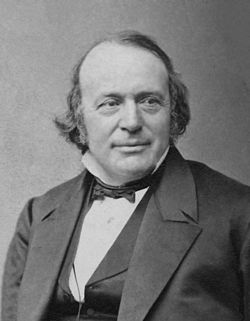
In 1846, the natural history lectures of Louis Agassiz were acclaimed both in New York and on his campus at Harvard College.
Image source: Louis Agassiz
1869 - 1909
% complete
Charles William Eliot, president from 1869 to 1909, was a chemist who had spent two years in Germany studying their universities. Eliot eliminated the favored position of Christianity from the curriculum while opening it to student self-direction. As the college modernized, the faculty was organized into departments and began to add graduate programs, including the PhD.
Image source: Charles William Eliot
1870
% complete
In 1870, one year into Eliot's term, Richard Theodore Greener became the first African-American to graduate from Harvard College.
Image source: Richard Theodore Greener
1872 - 1873
% complete
Eliot used the German model to set up graduate programs at Harvard and he formed a graduate department in 1872, which granted its first Ph.D. degrees in 1873 to William Byerly in mathematics and Charles Whitney in history.
Image source: Harvard Kenneth C. Griffin Graduate School of Arts and Sciences
1879
% complete
Radcliffe College, established in 1879 as a sister school of Harvard College, became one of the most prominent schools for women in the United States. For its first 50 years, Radcliffe paid Harvard faculty to repeat their lectures for a female audience.
Image source: Radcliffe College
1882 - 1885
% complete
In 1882, the faculty formed a three-member athletic committee to oversee all intercollegiate athletics, but due to increasing student and alumni pressure the committee was expanded in 1885 to include three student and three alumni members.
1885
% complete
While Harvard ended required chapel in the mid-1880s, the school remained culturally Protestant and fears of dilution grew as enrollment of immigrants, Catholics and Jews surged at the turn of the 20th century. By 1908, Catholics made up nine percent of the freshman class and between 1906 and 1922 Jewish enrollment at Harvard increased from 6% to 25%.
1890
% complete
Eliot set up the Graduate School of Arts and Sciences with its own dean and budget in 1890, which dealt with graduate students and funded research programs. By 2004, there were 3,200 graduate students in 53 separate programs and forty former or current professors had won a Nobel Prize.
1903
% complete
The class of 1879 donated $100,000 – nearly one-third of the cost – to the construction of the 35,000-seat stadium, which was completed in 1903, with the remainder to be collected from future ticket sales.
Image source: Harvard Stadium
1920
% complete
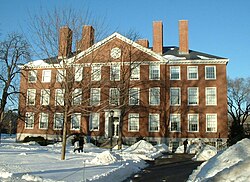
In the 1920s, Edward Harkness (1874–1940), a Yale man with oil wealth, was ignored by his alma mater, leading him to give $12,000,000 to Harvard to establish a house system like that of the University of Oxford in England.
Image source: Quincy House (Harvard College)
1933 - 1953
% complete
James Bryant Conant, the university's president from 1933 to 1953, pledged to reinvigorate creative scholarship at Harvard and reestablish its preeminence among research institutions.
Image source: James B. Conant
1945
% complete
In 1943, Conant decided that Harvard's undergraduate curriculum needed to be revised so as to place more emphasis on general education and called on the faculty to make a definitive statement about what general education ought to be at the secondary as well as the college level. The resulting Report, published in 1945, was one of the most influential manifestos in the history of American education in the 20th century.
Image source: General Education in a Free Society
1970 - 1979
% complete
In the 1970s, two agreements between Harvard and Radcliffe made Harvard responsible for essentially all undergraduate matters for women – including admissions, advising, instruction, housing, student life and athletics – though women were still formally admitted to and graduated from Radcliffe until a final merger in 1979 made Radcliffe a part of Harvard, at the same time creating the Radcliffe Institute for Advanced Study.
1783
% complete
In 1783, a new medical school was established as the Medical Institution of Harvard University. Harvard Medical School, the third-oldest medical school in the United States, was founded in 1782 as Massachusetts Medical College by John Warren, Benjamin Waterhouse, and Aaron Dexter.
1810
% complete
In 1810, Harvard Medical School relocated across the Charles River from Cambridge to Boston. The medical school was tied to the rest of the university 'only by the tenuous thread of degrees', but its strong faculty gave it a national reputation by the early 19th century.
1817
% complete
The establishment of Harvard Law School in 1817 was made possible by a 1779 bequest from Isaac Royall Jr.; it is the oldest continuously operating law school in the nation. By 1827, it was down to one faculty member. Radical reform came in the 1870s under Dean Christopher Columbus Langdell, and from its founding in 1900, the Association of American Law Schools promoted the case method in law schools that sought accreditation.
Image source: Harvard Law School
1908
% complete
From its founding in 1908, Harvard Business School has had a close relationship with the corporate world. The School used Rockefeller funding in the 1920s to launch a major research program under Elton Mayo (1926–1947) for his 'Harvard human relations group'. Starting in 1935, the school began weekend and short-term leadership training workshops for executives of major corporations. By 1949, nearly half of all holders of the MBA degree in the U.S. were Harvard graduates.
Image source: Harvard Business School
1913
% complete
The school grew out of the Harvard-MIT School for Health Officers, the nation's first graduate training program in population health, which was founded in 1913 and then became the Harvard School of Public Health in 1922. It became fully autonomous in 1946 and was renamed the T.H. Chan School of Public Health in 2014 in honor of a $350 million donation from the Morningside Foundation.
Image source: Harvard T.H. Chan School of Public Health
1936
% complete
In 1936, Harvard University founded the Harvard Graduate School of Public Administration, later renamed Harvard Kennedy School in honor of former U.S. President and 1940 Harvard College alumnus John F. Kennedy. The Kennedy School has an endowment of $1.7 billion as of 2021 and is routinely ranked at the top of the world's graduate schools in public policy, social policy, international affairs, and government.
Image source: Harvard Kennedy School
1945
% complete
In 1945, Harvard Medical School admitted its first class of women after a special committee concluded that male students would benefit from learning to view women as equals, that the lower-paid specialties typically shunned by men would benefit from the talents of women doctors and that the weakest third of each entering class of men could be replaced by a superior group of women.
1920
% complete
In 1920, 'Harvard University maliciously persecuted and harassed' those it believed to be gay via a 'Secret Court' led by President Lowell. Harvard President Lawrence Summers later characterized the episode as 'part of a past that we have rightly left behind' and 'abhorrent and an affront to the values of our university'.
Image source: Secret Court of 1920
1984
% complete
In 1984, Harvard severed ties with undergraduate 'final clubs' because of their refusal to admit women. As of 2016, Harvard bars members of single-sex organizations from campus leadership positions such as team captaincies and from receiving recommendation letters requisite for scholarships such as the Marshall Scholarship and Rhodes Scholarship. In June 2020, Harvard independently reversed the sanctions policy.
2006
% complete
In 2006, Lawrence Summers resigned his presidency after suggesting that women's underrepresentation in top science positions could be due to differences in 'intrinsic aptitude'.
Image source: Larry Summers
Oct 2023
% complete
In October 2023, following the Hamas-led attack on Israel, several Harvard undergraduate student groups signed a letter condemning Israel, contending that the 'Israeli regime entirely responsible for all unfolding violence'.
Dec 2023
% complete
In December 2023, following a Congressional hearing on antisemitism, Harvard's president Claudine Gay was condemned by the White House, and Gay released a new statement noting that some 'have confused a right to free expression with the idea that Harvard will condone calls for violence against Jewish students.' At the hearing, Gay had expressed the view that calls for the genocide of Jewish people did not necessarily violate Harvard's code of conduct, 'depending on the context.'
Image source: Claudine Gay
Jan 2024
% complete
In January 2024, after just six months as Harvard president, Gay resigned following a plagiarism investigation, and was replaced by Alan Garber, who was appointed interim president.
Image source: Alan Garber
Aug 2024
% complete
In August 2024, the Harvard Corporation announced Alan Garber's appointment as the university's 31st president through the end of the 2026–27 academic year.
Apr 2025
% complete
In April 2025, the Trump administration requested that Harvard implement changes in policies regarding curriculum, hiring and admissions.
Or browse the full history timeline directory, with more than 2,000 topics.
This History of Harvard University timeline was generated with the help of AI, using information found on the internet.
We work hard to keep these timelines accurate, but mistakes do get through. If you spot one, email us at [email protected] and we'll fix it for future visitors.
Generate yours with AI or build it from scratch, for free.
Export your timeline, add your own events, edit or remove AI-generated events, and much more
No credit card required.
Cancel anytime.
Cancel anytime.
You can create an unlimited number of timelines with up to 10 events on each one, customize how they look, export them to PDF, PNG, PowerPoint, CSV, and Excel, and share them with a link. Paid plans raise the event limit and add features like spreadsheet imports and collaborators.
Yes. You can cancel your subscription from your account page at any time, and you will not be charged again. Your subscription stays active for the rest of the period you already paid for.
Yes. We will email you a reminder before the annual renewal, and we will also email you a receipt.
Yes. You can email us within 15 days of any payment, and we will issue you a full refund.
Check out our pricing docs or send us an email anytime: [email protected].