-
Use Cases
-
Resources
-
Pricing
1478
% complete
The first book was printed in Oxford in 1478, marking the beginning of the university's long association with the printed word. This early venture laid the groundwork for what would eventually become Oxford University Press, one of the world's most prestigious academic publishers.
1480
% complete
The University of Oxford began printing around 1480 and became a major printer of Bibles, prayer books, and scholarly works, establishing itself as an important center of religious and academic publishing.
1534
% complete
Cambridge University Press was founded in 1534, making it the oldest university press. Oxford University Press is the second-oldest university press after Cambridge.
Image source: Cambridge University Press
1586
% complete
The Press was officially granted the legal right to print books by decree in 1586, formalizing Oxford's role as a publisher and giving it a privileged position in the English book trade.
Image source: Oxford University Press
1636
% complete
Archbishop William Laud obtained a succession of royal grants for the university, and Oxford's 'Great Charter' in 1636 gave the university the right to print 'all manner of books', greatly expanding its publishing privileges.
1668
% complete
Following the English Civil War, Vice-chancellor John Fell, Dean of Christ Church, Bishop of Oxford, and Secretary to the Delegates, was determined to install printing presses in 1668, creating the university's first central print shop.
1674
% complete
In 1674, OUP began to print a broadsheet calendar known as the Oxford Almanack, which was produced annually without interruption from 1674 until its final edition in 2019.
1700 - 1750
% complete
The early 18th century marked a lull in the press's expansion, a period of relative stagnation before renewed growth later in the century.
1713
% complete
OUP came to be known as '(The) Clarendon Press' when printing moved from the Sheldonian Theatre to the Clarendon Building in Broad Street in 1713. The name continued to be used when OUP moved to its present site in Oxford in 1830.
Image source: Clarendon Building
1780
% complete
By the late 18th century, the press had become more focused in its publishing activities, concentrating on scholarly and religious works suited to its academic mission.
1600
% complete
Oxford University Press has had a similar governance structure since the 17th century, with oversight by Delegates of the Press appointed from among the university's academics.
1760
% complete
By 1760, the university moved to adopt all of Blackstone's reforms, which helped modernize the administration of the university and its press.
1850
% complete
It took the 1850 Royal Commission on the workings of the university and a new Secretary, Bartholomew Price, to shake up the press and modernize its operations.
1884 - 1897
% complete
The next Secretary, Philip Lyttelton Gell, was appointed by Vice-Chancellor Benjamin Jowett in 1884 but struggled in the role and was finally dismissed in 1897.
Image source: Philip Lyttelton Gell
1940
% complete
The first application for tax exemption, by Cambridge University Press in 1940, was rejected on the ground that the Press's trade went beyond the purpose and objects of the University. Similar applications by OUP in 1944 and 1950 were also rejected by the Inland Revenue.
1976 - 1978
% complete
In November 1975, CUP's chief executive Geoffrey Cass again applied to the Inland Revenue, and a year later CUP's tax exemption was quietly conceded. OUP's Chief Executive George Richardson followed suit in 1977, and OUP's tax exemption was granted in 1978.
Mar 2001
% complete
In March 2001, after a 28-year battle with the Indian tax authorities, OUP lost its tax exemption in India.
2003 - 2018
% complete
In 2003, Joel Rickett of The Bookseller wrote in The Guardian describing commercial rivals' resentment at OUP's tax exemption, predicting funds would be used to buy up other publishers. Between 1989 and 2018, OUP bought out over 70 rival book and journal publishers.
2007 - 2009
% complete
In 2007, with the new 'public benefit' requirement of the revised Charities Act, the issue of the university presses' privileges was re-examined with particular reference to OUP. In 2008, CUP's and OUP's privilege was attacked by rival publishers, and in 2009 The Guardian invited Andrew Malcolm to write an article on the subject.
Image source: Charities Act 2006
1825
% complete
In 1825, the Delegates bought land on Walton Street in Oxford, acquiring the site where the press's new headquarters would be built.
1830
% complete
Buildings were constructed from plans drawn up by Daniel Robertson and Edward Blore, and the press moved into them in 1830. At this time it was still a joint-stock printing business offering learned works to a small readership of scholars and clerics.
1830 - 1872
% complete
Thomas Combe joined the press in 1830 and became the university's Printer until his death in 1872, overseeing a significant period of the press's operations.
Image source: Thomas Combe
1863 - 1880
% complete
Alexander Macmillan became the publisher for Oxford's printing in 1863, helping Price create the Clarendon Press series of cheap, elementary school books – perhaps the first time Oxford used the Clarendon imprint. The press had also ended its relationship with Parker's in 1863. Macmillan's contract ended in 1880 and was not renewed.
1865
% complete
The best-known text associated with Thomas Combe's print shop was the flawed first edition of Alice's Adventures in Wonderland, printed by Oxford at the expense of its author Lewis Carroll (Charles Lutwidge Dodgson) in 1865.
Image source: Alice's Adventures in Wonderland
1868 - 1884
% complete
Appointed in 1868, Bartholomew Price had already recommended that the press needed an efficient executive officer to exercise 'vigilant superintendence' of the business. He retired as Secretary in 1884, the year the Delegates bought back the last shares in the business.
Image source: Bartholomew Price
1870
% complete
In 1870, OUP bought a small London bindery for some Bible work, expanding its London operations after ending its relationship with Parker's in 1863.
1873
% complete
OUP's output increased to include school books and modern scholarly texts such as James Clerk Maxwell's A Treatise on Electricity & Magnetism (1873), which proved fundamental to Einstein's thought.
Image source: A Treatise on Electricity and Magnetism
1875
% complete
In 1875, the Delegates approved the series Sacred Books of the East under the editorship of Friedrich Max Müller, bringing a vast range of religious thought to a wider readership.
Image source: Sacred Books of the East
1879 - 1928
% complete
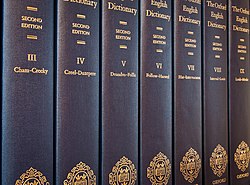
In 1879, the press took on the massive project that became the Oxford English Dictionary (OED). The Dictionary began appearing in print in 1884, but the first edition was not completed until 1928, 13 years after editor James Murray's death, costing around £375,000.
Image source: Oxford English Dictionary
1880
% complete
By this time, Oxford had a London warehouse for Bible stock in Paternoster Row, and in 1880 its manager, Henry Frowde, was given the formal title of Publisher to the university. Frowde became vital to OUP's growth, adding new lines of books and presiding over the publication of the Revised Version of the New Testament in 1881.
Image source: Oxford University Press
1896
% complete
Henry Frowde played a key role in setting up the press's first office outside Britain, in New York City in 1896, marking the start of OUP's international expansion.
1913 - 1945
% complete
By the early 20th century, OUP expanded its overseas trade, partly due to the efforts of Humphrey Milford, the publisher of the University of Oxford from 1913 to 1945. By 1928, the press's imprint read 'London, Edinburgh, Glasgow, Leipzig, Toronto, Melbourne, Cape Town, Bombay, Calcutta, Madras and Shanghai'.
1923
% complete
In 1923, OUP established a Music Department, driven by a sense of cultural philanthropy and a desire to promote 'national music outside the German mainstream'. It was not until 1939 that the Music Department showed its first profitable year.
1927 - 1934
% complete
Between 1927 and 1934, Oxford University Press, Inc., New York, was reorganized by Geoffrey Cumberlege to return it to profitability from the lows of the Depression years. In 1945–1956, Cumberlege would succeed Milford as publisher to the University of Oxford.
Image source: Muslims
1929
% complete
The Depression of 1929 dried profits from the Americas to a trickle, and India became 'the one bright spot' in an otherwise dismal picture for the press's finances.
Feb 1989 - Apr 1989
% complete
In February 1989, Iran's Ayatollah Khomeini issued a fatwa urging the execution of British author Salman Rushdie and all involved in the publication of The Satanic Verses. There was outrage when, in April 1989, OUP broke the worldwide embargo and chose to attend the Tehran Book Fair.
1990 - 1992
% complete
In 1990, in the UK Court of Appeal, author Andrew Malcolm won a landmark legal judgment against Oxford University (Press) for breach of a contract to publish his philosophical text Making Names. The case ended in July 1992 with a Tomlin order permanently barring Oxford's servants and agents from denigrating Malcolm or Making Names.
Nov 1998 - Mar 1999
% complete
In November 1998, OUP announced the closure, on commercial grounds, of its modern poetry list, provoking condemnation from poets, Arts Minister Alan Howarth, and professor Valentine Cunningham. In March 1999, The Times Literary Supplement commissioned Andrew Malcolm to write about why the present constitution of the OUP could not work.
1999
% complete
In 1999, campaigner Andrew Malcolm published his second book, The Remedy, in which he alleged that OUP breached its 1978 tax-exemption conditions.
Jul 2012
% complete
In July 2012, the UK's Serious Fraud Office found OUP's branches in Kenya and Tanzania guilty of bribery to obtain school bookselling contracts sponsored by the World Bank.
Dec 2023
% complete
In December 2023, concerns were raised that OUP had published an academic paper based on genetic data taken from the Uyghur population of Xinjiang, a Turkic ethnic group in China.
Image source: Uyghurs
Jul 2025
% complete
In July 2025, OUP ended its publication of Forensic Sciences Research (FSR), a journal sponsored by China's Ministry of Justice, following ethical concerns related to research involving DNA data from Uyghur and other ethnic minorities in China.
Image source: Forensic science
2001
% complete
Since 2001, Oxford University Press has financially supported the Clarendon bursary, a University of Oxford graduate scholarship scheme.
Mar 2020
% complete
In March 2020, during the COVID-19 pandemic, OUP's Bookshop on the High Street in Oxford closed its doors.
Image source: COVID-19 pandemic
2021
% complete
By the end of 2021, OUP USA had published eighteen Pulitzer Prize–winning books, cementing its reputation as a leading publisher of distinguished scholarship and general-interest works.
Image source: Pulitzer Prize
Aug 27, 2021
% complete
On 27 August 2021, OUP closed Oxuniprint, its printing division. The closure marked the final chapter of OUP's centuries-long history of printing.
2024
% complete
As of 2024, OUP as Oxford Journals publishes more than 500 journals on behalf of learned societies around the world, spanning both the sciences and the humanities.
Or browse the full history timeline directory, with more than 2,000 topics.
This History of Oxford University timeline was generated with the help of AI, using information found on the internet.
We work hard to keep these timelines accurate, but mistakes do get through. If you spot one, email us at [email protected] and we'll fix it for future visitors.
Generate yours with AI or build it from scratch, for free.
Export your timeline, add your own events, edit or remove AI-generated events, and much more
No credit card required.
Cancel anytime.
Cancel anytime.
You can create an unlimited number of timelines with up to 10 events on each one, customize how they look, export them to PDF, PNG, PowerPoint, CSV, and Excel, and share them with a link. Paid plans raise the event limit and add features like spreadsheet imports and collaborators.
Yes. You can cancel your subscription from your account page at any time, and you will not be charged again. Your subscription stays active for the rest of the period you already paid for.
Yes. We will email you a reminder before the annual renewal, and we will also email you a receipt.
Yes. You can email us within 15 days of any payment, and we will issue you a full refund.
Check out our pricing docs or send us an email anytime: [email protected].