-
Use Cases
-
Resources
-
Pricing
The history of locomotives traces the development of rail vehicles from early steam engines to today’s diesel, electric, and high-speed trains. More Less
Build a timeline like this one in minutes, for free. Start Yours →
Part of our collection of invention and technology timelines.
1802
Richard Trevithick built the first full-scale working railway steam locomotive in 1802, demonstrating the potential of high-pressure steam power for moving railway vehicles.
Image source: Richard Trevithick

Feb 21, 1804
On 21 February 1804, one of Richard Trevithick’s locomotives hauled a train from the Penydarren ironworks in Merthyr Tydfil to Abercynon in South Wales. It is regarded as the first recorded steam-hauled railway journey.
1812
Matthew Murray’s twin-cylinder rack locomotive Salamanca first ran on the edge-railed rack-and-pinion Middleton Railway in 1812. It is generally regarded as the first commercially successful locomotive.
Image source: Salamanca (locomotive)

1813 - 1814
Engineer William Hedley built Puffing Billy in 1813–14 for the Wylam Colliery near Newcastle upon Tyne. It became one of the best-known early steam locomotives.
Image source: Puffing Billy (locomotive)

1814
The word locomotive derives from the Latin loco, meaning “from a place,” and Medieval Latin motivus, meaning “causing motion.” The shortened term locomotive came from locomotive engine, first used in 1814 to distinguish self-propelled steam engines from stationary engines.
Image source: Locomotive

1829
In 1829, Robert Stephenson built The Rocket in Newcastle upon Tyne. The locomotive became a landmark in the development of practical railway steam power.
Image source: Stephenson's Rocket

1950 - 1970
Between about 1950 and 1970, most steam locomotives were retired from commercial service and replaced by electric and diesel-electric locomotives.
Image source: History of rail transport

1970 - 1999
Although displaced from most commercial operations, steam locomotives continued to be used in many countries until the end of the 20th century.
Image source: Steam locomotive
2000
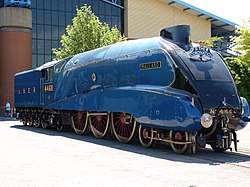
By the end of the 20th century, almost the only steam power still in regular worldwide use was operating on heritage railways.
Image source: Heritage railway

1841
After building the first known electric locomotive in 1837, chemist Robert Davidson constructed a larger battery-powered locomotive named Galvani. It was exhibited at the Royal Scottish Society of Arts Exhibition in 1841.
Image source: Robert Davidson (inventor)

Build a timeline like this one in minutes, for free. Start Yours →
This History of Locomotives timeline was generated with the help of AI, using information found on the internet.
We work hard to keep these timelines accurate, but mistakes do get through. If you spot one, email us at [email protected] and we'll fix it for future visitors.
Generate yours with AI or build it from scratch, for free.