-
Use Cases
-
Resources
-
Pricing
107000 BC
A 2003 study speculated that clothing may have developed approximately 107,000 years ago.
Image source: History of clothing and textiles
27000 BC
Textile clothing came to archaeological notice around 27,000 years ago, marking an important stage in the history of fabricated garments.
8000 BC
Textiles woven from vegetable fiber date back to approximately 8000 BC, demonstrating early use of plant materials in textile production.
7000 BC
Archaeologists have discovered actual textile fragments dating from approximately 7000 BC.
6500 BC
Surviving examples of nålebinding, a textile method that emerged after animal-skin textile use, have been found in Israel and date to about 6500 BC.
Image source: Nålebinding
5000 BC
Archaeological artifacts from around 5000 BC include net gauges, suggesting the development of specialized textile arts.
1970
Since the late 20th century, scholars have undertaken extensive studies of the development of textiles and clothing in prehistory.
Sep 2021
Scientists reported evidence from Moroccan deposits indicating that clothing was made between 90,000 and 120,000 years ago.
8000 BC
Evidence indicates that flax was cultivated in the Near East from approximately 8000 BC, providing a major fiber source for later linen production.
6000 BC
Cultivation of domesticated wild flax, probably imported from the Levant, is documented in Egypt as early as approximately 6000 BC.
5500 BC
Evidence exists for the production of linen cloth in Ancient Egypt during the Neolithic period, around 5500 BC.
5000 BC - 3000 BC
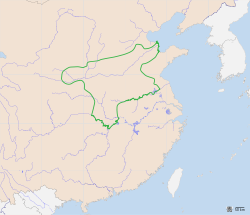
The earliest known evidence of silk production in China comes from Yangshao culture sites in Xia, Shanxi, where a cut Bombyx mori cocoon dates between 5000 and 3000 BC.
Image source: Silk
4000 BC
Fragments of primitive looms have been found at Hemudu culture sites in Yuyao, Zhejiang, dating to about 4000 BC.
Image source: Hemudu culture
3200 BC
Well-preserved linen textiles found in Judea's Cave of the Warrior date from approximately 3200 BC.
3000 BC
The breeding of sheep with woolly fleece rather than hair occurred much later than early flax cultivation, around 3000 BC.
Image source: Wool
2700 BC
Silk scraps discovered at a Liangzhu culture site at Qianshanyang in Huzhou, Zhejiang, date back to approximately 2700 BC.
1600 BC - 1046 BC
Fragments of silk have been recovered from royal tombs of China's Shang Dynasty.
Image source: Shang dynasty
1600 BC - 1100 BC
A horizontal ground loom was used before Egypt's New Kingdom, when a vertical two-beam loom was introduced, probably from Asia.
Image source: Loom
1000 BC - 300
The Japanese Yayoi period followed the earlier context described in the textile record and was associated with the development of rice cultivation.
Image source: Yayoi period
500 BC
In the 5th century BCE, the Greek historian Herodotus described Indian cotton as a wool exceeding sheep's wool in beauty and goodness.
Image source: Herodotus
300 BC - 300
Archaeologists discovered 90 spindle-whorl fragments in contexts dated from the 3rd century BC to the 3rd century AD, associated with early textile production in Myanmar.
Image source: Pyu city-states
400 - 1100
European dress changed gradually between 400 and 1100, while clothing remained relatively simple and broadly uniform.
1100 - 1300
Clothing in 12th- and 13th-century Europe remained simple for men and women and was relatively uniform across the subcontinent.
1200 - 1299
The 13th century saw major progress in dyeing and working wool, the most important material for European outerwear.
1350
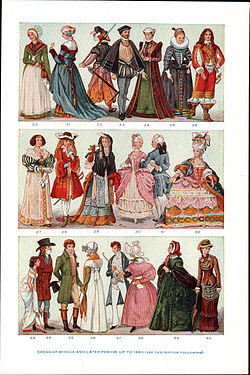
Costume historians identify the mid-14th century as the emergence of recognizable fashion in Europe, after which Western styles changed at an unusually rapid pace.
Image source: History of Western fashion
1350 - 1399
Draped garments and straight seams gave way to curved seams, tailoring, lacing, and buttons, allowing clothing to fit the human form more closely.
1350 - 1399
A fashion for mi-parti or parti-coloured men's garments made from two contrasting fabrics, one on each side, arose in the mid-14th century and became especially popular at the English court.
1400 - 1499
By the beginning of the 15th century, silk weaving was well established around the Mediterranean, and figured silks and silk velvets increasingly appeared in wealthy European dress.
1400 - 1499
Floral designs featuring pomegranate or artichoke motifs reached Europe from China and became dominant in Ottoman silk-producing cities before spreading to Italian and Iberian weavers.
1400 - 1499
As prosperity grew in the 15th century, urban middle classes and skilled workers began wearing more complex clothing that followed elite fashions at a distance.
1400 - 1499
National variations in European clothing increased during the 15th century.
1500 - 1599
During the 16th century, the ruff developed from a small neckline ruffle into increasingly large cartwheel-shaped collars.
Image source: Ruff (clothing)
1550 - 1599
Bobbin lace arose from passementerie in the mid-16th century, probably in Flanders.
1780 - 1799
At the end of the 18th century, wealthy Western men largely abandoned bright colors, elaborate shapes, and varied dress, leaving conspicuous adornment increasingly to women's clothing.
1500 - 1799
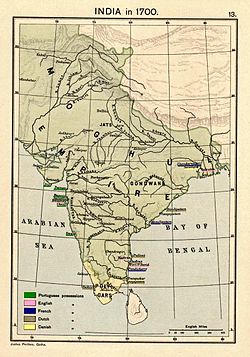
From the 16th through the 18th centuries, Mughal India was the most important center of manufacturing in international trade.
Image source: Mughal Empire
1700 - 1799
In the 18th century, Indian cotton textiles were major manufactured goods in world trade, consumed from the Americas to Japan and prominent in Atlantic, Indian Ocean, and European commerce.
1750
Up until 1750, India produced approximately 25 percent of the world's industrial output.
Image source: Economic history of India
1800 - 1899
Sewing machines emerged during the 19th century and streamlined the production of clothing.
Image source: Sewing machine
1810 - 1840
Between 1810 and 1840, development of a national market helped manufacturing expand, tripling the value of output.
1900 - 1929
In the early 20th century, workers in the United States clothing and textile industries became unionized.
1900 - 1999
The 20th century brought new applications for textiles, synthetic fibers, computerized manufacturing controls, and improved sensing and data-processing technologies.
1930 - 1970
Fibers invented between 1930 and 1970 included nylon, PTFE, polyester, Spandex, and Kevlar, expanding the properties and applications of textiles.
Image source: Synthetic fiber
1983
In 1983, Bonas Machine Company Ltd. marked an event in the continuing development of modern textile machinery.
1988
The first United States patent for a pick-and-place robot was awarded in 1988, reflecting increasing automation relevant to textile manufacturing.
Image source: Industrial robot
2000
Google developers recognized the need for image search after Jennifer Lopez's green dress became the most popular search query they had seen; Google Images was developed in response.
Image source: Google Images
2010
From 2010 onward, investment in textile recycling companies boomed as businesses sought scalable responses to global demand for recycling solutions.
Image source: Textile recycling
2013
The worldwide market for textile and apparel exports was valued at $772 billion in 2013 according to the United Nations Commodity Trade Statistics Database.
Image source: Textile industry
2016
In 2016, China was the largest apparel exporter at $161 billion, followed by Bangladesh, Vietnam, India, Hong Kong, Turkey, and Indonesia.
Jul 2022
In July 2022, Inditex backed Circ, a textile-to-textile recycling company, as part of the expansion of commercial textile recycling.
Or browse the full history timeline directory, with more than 2,500 topics.
This History of Textiles timeline was generated with the help of AI, using information found on the internet.
We work hard to keep these timelines accurate, but mistakes do get through. If you spot one, email us at [email protected] and we'll fix it for future visitors.
Generate yours with AI or build it from scratch, for free.
Export your timeline, add your own events, edit or remove AI-generated events, and much more
No credit card required.
Cancel anytime.
Cancel anytime.
You can create an unlimited number of timelines with up to 10 events on each one, customize how they look, export them to PDF, PNG, PowerPoint, CSV, and Excel, and share them with a link. Paid plans raise the event limit and add features like spreadsheet imports and collaborators.
Yes. You can cancel your subscription from your account page at any time, and you will not be charged again. Your subscription stays active for the rest of the period you already paid for.
Yes. We will email you a reminder before the annual renewal, and we will also email you a receipt.
Yes. You can email us within 15 days of any payment, and we will issue you a full refund.
Check out our pricing docs or send us an email anytime: [email protected].