-
Use Cases
-
Resources
-
Pricing
The history of mythology spans thousands of years, beginning with the earliest recorded myths of Mesopotamia and Egypt and evolving through Greek, Roman, Norse, and other cultural traditions. Myths served to explain natural phenomena, justify social structures, and convey moral and religious beliefs. The study of mythology has itself evolved, from ancient rationalization by philosophers like Euhemerus to modern academic approaches in anthropology, psychology, and comparative religion. More Less
2400 BC
% complete
The Osiris myth, central to ancient Egyptian religion, tells of the murder of Osiris by his brother Set, his resurrection by Isis, and his role as ruler of the underworld. The myth underpinned Egyptian beliefs about death, rebirth, and the afterlife, and was elaborated in texts such as the Pyramid Texts and the Book of the Dead.
Image source: Osiris myth
2100 BC
% complete
The Epic of Gilgamesh, one of the earliest known works of literature, emerged from ancient Mesopotamia. It recounts the adventures of the hero-king Gilgamesh, including his friendship with Enkidu and his quest for immortality after Enkidu's death. The epic contains a flood narrative that parallels later myths and profoundly influenced Mesopotamian religion and storytelling traditions.
Image source: Epic of Gilgamesh
1800 BC
% complete
The Babylonian creation epic Enuma Elish describes the rise of the god Marduk, who defeats the primordial goddess Tiamat and forms the world from her body. Recited at the Babylonian New Year festival, it established Marduk's supremacy in the pantheon and became a foundational text of Mesopotamian cosmology.
Image source: Enūma Eliš
1400 BC
% complete
The Hittites of Anatolia preserved cuneiform tablets recounting the Kumarbi cycle, in which the god Kumarbi overthrows Anu and is in turn challenged by the storm god Teshub. These succession myths, with their pattern of generations of gods overthrowing one another, are considered precursors to Greek myths such as the overthrow of Uranus by Cronus.
Image source: Kumarbi
600 AD - 900 AD
% complete
During the Classic period, Maya civilization flourished with rich cosmological mythology depicted in temple art and codices. Stories of the Hero Twins Hunahpu and Xbalanque, who defeated the lords of the underworld Xibalba, circulated orally and visually long before being recorded in the colonial-era Popol Vuh.
Image source: Maya civilization
1545 AD - 1590 AD
% complete
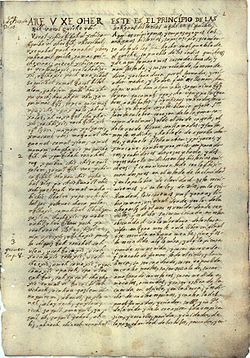
Franciscan missionary Bernardino de Sahagún worked with Nahua collaborators to compile the Florentine Codex, an encyclopedic record of Aztec religion, mythology, and culture. It preserved accounts of gods like Quetzalcoatl and Tezcatlipoca, the Five Suns creation myth, and rituals otherwise lost to conquest.
Image source: Florentine Codex
1550 AD
% complete
After the Spanish conquest, anonymous Quiché Maya scribes wrote down the Popol Vuh, the sacred book of the Maya people, using the Latin alphabet. It preserves accounts of the creation of humans from maize, the deeds of the Hero Twins, and the genealogy of Quiché kings, safeguarding indigenous mythology from destruction.
Image source: Popol Vuh
2000 BC - 1100 BC
% complete
In Bronze Age Crete and mainland Greece, Minoan and Mycenaean cultures developed religious practices featuring bull symbolism, goddess worship, and deities identifiable as early forms of Zeus, Poseidon, and Hera. Linear B tablets record offerings to these gods, providing the earliest evidence of the Greek pantheon.
Image source: Mycenaean Greece
750 BC
% complete
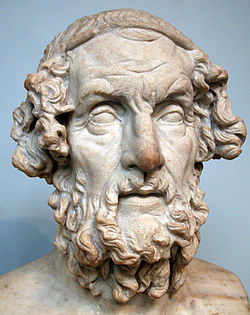
Traditionally attributed to the poet Homer, the Iliad and the Odyssey were composed around the 8th century BC. Drawing on centuries of oral tradition, they depict the Trojan War and its aftermath, featuring gods like Athena, Apollo, and Aphrodite intervening in human affairs. These epics became foundational texts of Greek culture and education.
Image source: Homer
700 BC
% complete
The poet Hesiod composed the Theogony, a systematic account of the origins and genealogies of the Greek gods. It describes the emergence of Chaos, the reign of Uranus and Cronus, and Zeus's establishment of cosmic order after defeating the Titans. The work also includes myths of Prometheus and Pandora.
Image source: Theogony
600 BC
% complete
The Eleusinian Mysteries, centered on the myth of Demeter and Persephone, were secret initiation rites held annually at Eleusis near Athens. Initiates were promised hopes of a blessed afterlife. The mysteries drew participants from across the Greek world for nearly two millennia until their suppression in late antiquity.
Image source: Eleusinian Mysteries
450 BC
% complete
The tragedy Prometheus Bound, traditionally attributed to Aeschylus, portrays the Titan Prometheus chained to a rock for giving fire to humanity and defying Zeus. The play transformed mythological material into profound meditations on tyranny, knowledge, and suffering, influencing Western conceptions of the rebel hero.
Image source: Prometheus Bound
300 BC
% complete
The Greek writer Euhemerus argued that the gods were originally historical kings and heroes who had been deified after death. His rationalizing approach, known as euhemerism, offered an early interpretive framework for mythology and influenced later Christian and Enlightenment critiques of pagan religion.
Image source: Euhemerism
29 BC - 19 BC
% complete
Commissioned during the reign of Augustus, Virgil's Aeneid recounts the journey of the Trojan hero Aeneas to Italy, where his descendants would found Rome. Blending Homeric models with Roman political ideology, the epic linked Rome's destiny to divine will and became the cornerstone of Latin literature.
Image source: Aeneid
8 AD
% complete
Ovid's Metamorphoses wove together some 250 myths into a continuous narrative from the creation of the world to the deification of Julius Caesar. Its vivid retellings of transformation stories became the primary conduit through which Greek and Roman mythology reached medieval and Renaissance Europe.
Image source: Metamorphoses
100 AD
% complete
The Bibliotheca, traditionally attributed to Apollodorus of Athens though likely written later, systematically summarized Greek myths from the origins of the gods through the Trojan War and its aftermath. It remains one of the most valuable handbooks of classical mythology surviving from antiquity.
Image source: Bibliotheca (Apollodorus)
160 AD
% complete
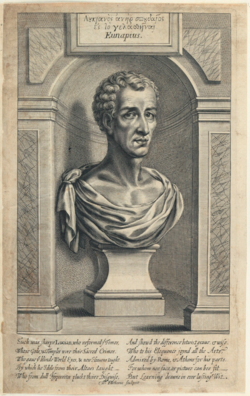
The Syrian-Greek satirist Lucian of Samosata wrote witty dialogues mocking the Olympian gods, portraying Zeus and his peers as vain, lustful, and ridiculous. Works like Dialogues of the Gods reflected growing skepticism toward traditional religion in the Roman Empire and anticipated modern literary treatments of myth.
Image source: Lucian
1500 BC - 1200 BC
% complete
The Rigveda, the oldest of the Hindu Vedas, was composed in Sanskrit by Indo-Aryan poets. Its hymns describe gods such as Indra, Agni, and Varuna, and contain early versions of cosmogonic myths. The Rigveda laid the foundation for later Hindu mythology, including the Puranas and epics.
Image source: Rigveda
500 BC - 100 BC
% complete
Attributed to the sage Valmiki, the Ramayana narrates Prince Rama's exile, the abduction of his wife Sita by the demon king Ravana, and her rescue with the help of Hanuman and the monkey army. One of India's great epics, it spread throughout Southeast Asia, inspiring countless regional retellings.
Image source: Ramayana
400 BC - 400 AD
% complete
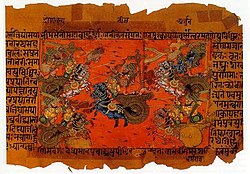
The Mahabharata grew over centuries into the world's longest epic poem, recounting the dynastic struggle between the Pandavas and Kauravas. Within it lies the Bhagavad Gita, where Krishna reveals divine teachings to the warrior Arjuna. The epic shaped Hindu ethics, theology, and mythology across Asia.
Image source: Mahabharata
712 AD
% complete
Compiled by Ō no Yasumaro at the command of Empress Genmei, the Kojiki is Japan's oldest extant chronicle. It preserves Shinto creation myths, including the story of Izanagi and Izanami and the sun goddess Amaterasu, whose grandson Ninigi's line leads to Emperor Jimmu, legitimizing the imperial dynasty.
Image source: Kojiki
720 AD
% complete
The Nihon Shoki, Japan's second-oldest chronicle, retold the nation's founding myths in Classical Chinese following the model of Chinese dynastic histories. Offering variant versions of many myths found in the Kojiki, it became the more authoritative text at the imperial court and shaped Japanese state mythology.
Image source: Nihon Shoki
700 AD - 1100 AD
% complete
Irish scribes committed to writing the Ulster Cycle, a body of heroic tales centered on the warrior Cú Chulainn and the cattle raid of Cooley (Táin Bó Cúailnge). Preserved in manuscripts like the Book of the Dun Cow, these sagas preserve pre-Christian Celtic mythology and heroic ideals.
Image source: Ulster Cycle
900 AD - 1200 AD
% complete
The poems of the Poetic Edda, preserved in 13th-century Icelandic manuscripts but rooted in older oral tradition, contain the core narratives of Norse mythology. They describe Odin's quest for wisdom, Thor's battles with giants, the death of Baldr, and the apocalyptic vision of Ragnarök.
Image source: Poetic Edda
1200 AD
% complete
The Four Branches of the Mabinogi, preserved in the White Book of Rhydderch and the Red Book of Hergest, form the core of medieval Welsh mythology. Their tales of Pwyll, Branwen, Manawydan, and Math preserve echoes of ancient Celtic gods reimagined as heroes and enchanters.
Image source: Mabinogion
1220 AD
% complete
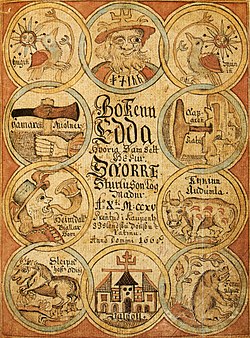
Icelandic scholar Snorri Sturluson composed the Prose Edda as a handbook for poets, preserving detailed accounts of Norse gods, heroes, and cosmology. Written after Iceland's conversion to Christianity, it carefully framed the old myths as historical allegory, ensuring their survival for posterity.
Image source: Prose Edda
1855 AD - 1863 AD
% complete
American writer Thomas Bulfinch published his popular retellings of classical, Norse, and other myths, collected posthumously as Bulfinch's Mythology. Aimed at general readers, it standardized accessible versions of ancient myths for English-speaking audiences and became a staple of education for over a century.
1856 AD
% complete
Oxford philologist Max Müller pioneered comparative mythology, arguing that myths originated as misunderstandings of natural phenomena encoded in Indo-European languages. His 'solar mythology' theory sparked scholarly debate and helped establish mythology as a serious academic discipline alongside linguistics and anthropology.
Image source: Comparative mythology
1890 AD - 1915 AD
% complete
Scottish anthropologist James George Frazer's The Golden Bough compared myths and rituals worldwide, proposing universal patterns of death-and-rebirth vegetation cults. Though later criticized methodologically, its sweeping comparative approach profoundly influenced literature, psychology, and the study of religion.
Image source: The Golden Bough
1912 AD
% complete
Swiss psychologist Carl Jung proposed that myths across cultures express archetypes arising from a shared collective unconscious. Figures like the Hero, the Great Mother, and the Trickster, he argued, recur universally in dreams and myths. Jungian depth psychology reshaped how scholars and artists interpreted mythological symbolism.
Image source: Jungian archetypes
1949 AD
% complete
Joseph Campbell articulated the monomyth, or hero's journey, a common narrative pattern he identified in myths worldwide: departure, initiation, and return. His synthesis influenced generations of writers and filmmakers, including George Lucas's Star Wars, and made comparative mythology widely popular.
Jun 1988 AD
% complete
The landmark PBS interview series between Joseph Campbell and journalist Bill Moyers introduced millions of viewers to the meaning and relevance of world mythology. Broadcast shortly after Campbell's death, it became a bestseller in book form and cemented Campbell's role as the most influential popularizer of myth studies.
Or browse the full history timeline directory, with more than 2,000 topics.
This History of Mythology timeline was generated with the help of AI, using information found on the internet.
We work hard to keep these timelines accurate, but mistakes do get through. If you spot one, email us at [email protected] and we'll fix it for future visitors.
Generate yours with AI or build it from scratch, for free.
Export your timeline, add your own events, edit or remove AI-generated events, and much more
No credit card required.
Cancel anytime.
Cancel anytime.
You can create an unlimited number of timelines with up to 10 events on each one, customize how they look, export them to PDF, PNG, PowerPoint, CSV, and Excel, and share them with a link. Paid plans raise the event limit and add features like spreadsheet imports and collaborators.
Yes. You can cancel your subscription from your account page at any time, and you will not be charged again. Your subscription stays active for the rest of the period you already paid for.
Yes. We will email you a reminder before the annual renewal, and we will also email you a receipt.
Yes. You can email us within 15 days of any payment, and we will issue you a full refund.
Check out our pricing docs or send us an email anytime: [email protected].