-
Use Cases
-
Resources
-
Pricing
Egyptian Mythology encompasses the collection of religious beliefs, deities, and narratives of ancient Egypt, spanning over three millennia. Centered on gods such as Ra, Osiris, Isis, and Anubis, it explained the cosmos, the Nile's cycles, and the afterlife, shaping one of the world's most influential ancient cultures. More Less
3100 BC
% complete
With unification around 3100 BC, the king became the focus of Egyptian religion, embedding the ideology of kingship deeply into Egyptian mythological thought.
Image source: Egyptian mythology
3100 BC
% complete
The unification of Egypt under the pharaohs at the end of the Predynastic Period around 3100 BC made the king the focus of Egyptian religion, and thus the ideology of kingship became an important part of mythology.
3100 BC - 2686 BC
% complete
During the Early Dynastic Period (3100–2686 BC), early sources emerged, but little about the gods' actions can be gleaned from these sources because they include minimal writing.
Image source: Early Dynastic Period of Egypt
3100 BC - 2686 BC
% complete
Sources from the Early Dynastic Period (3100–2686 BC) offer glimpses of religious ideas, but little about the gods' actions can be gleaned because they include minimal writing.
2181 BC
% complete
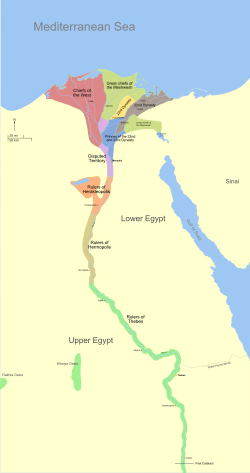
The end of the Old Kingdom around 2181 BC brought the breakdown of royal authority and national unity, an event many scholars believe inspired the myth of the sun god withdrawing into the sky.
Image source: First Intermediate Period of Egypt
2181 BC
% complete
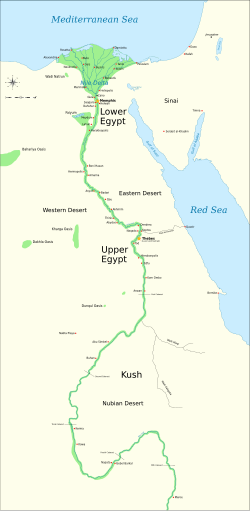
The myth of the sun god withdrawing into the sky, leaving humans to fight among themselves, is thought by many scholars to have been inspired by the collapse of royal authority at the end of the Old Kingdom.
2181 BC
% complete
Many scholars have suggested that the breakdown of royal authority and national unity at the end of the Old Kingdom inspired the myth of the sun god withdrawing into the sky, leaving humans to fight among themselves.
2181 BC
% complete
In the myth possibly inspired by the end of the Old Kingdom, the sun god withdraws into the sky, leaving humans to fight among themselves without divine order.
2686 BC - 2181 BC
% complete
In the Old Kingdom, Heliopolis served as the center of the most important theological systems, those of the sun god Ra and the creator god Atum.
Image source: Heliopolis (ancient Egypt)
2686 BC
% complete
The Old Kingdom (c. 2686–2181 BC) was a period of strong royal authority during which major theological systems flourished, most importantly the cults of Ra and Atum centered at Heliopolis.
Image source: Old Kingdom of Egypt
2686 BC - 2181 BC
% complete
During the Old Kingdom (2686–2181 BC), the most important of the emerging theological systems was the cults of Ra and Atum, centered at Heliopolis.
Image source: Ra
1070 BC
% complete
The Third Intermediate Period (1070–664 BC) saw the continuation and recording of older theological traditions, including creation accounts attributed to Ptah.
Image source: Third Intermediate Period of Egypt
1070 BC - 664 BC
% complete
A text from the Third Intermediate Period (1070–664 BC), whose content may be much older, describes the process of creation in detail and attributes it to the god Ptah.
Image source: Ptah
1070 BC - 664 BC
% complete
The Memphite text attributes creation to Ptah, whose close association with craftsmen makes him a suitable deity to give physical form to the original creative vision.
1070 BC - 664 BC
% complete
Because of his close association with craftsmen, Ptah was seen as a suitable deity to give physical form to the original creative vision, as described in the Third Intermediate Period text.
2400 BC
% complete
The Pyramid Texts are a collection of several hundred incantations inscribed in the interiors of pyramids beginning in the 24th century BC, forming a key source of Egyptian myth.
Image source: Pyramid Texts
2400 BC - 2181 BC
% complete
The Pyramid Texts, inscribed starting in the 24th century BC, preserved incantations intended to aid the deceased king, making them a crucial record of Old Kingdom mythology.
2400 BC - 2301 BC
% complete
Beginning in the 24th century BC, several hundred incantations were inscribed in the interiors of pyramids, preserving some of the earliest known Egyptian religious texts.
2181 BC - 2055 BC
% complete
The Coffin Texts, which developed from the Pyramid Texts during the First Intermediate Period, democratized funerary mythology by being available to non-royal Egyptians.
Image source: Coffin Texts
2181 BC - 2055 BC
% complete
During the First Intermediate Period (2181–2055 BC), the Pyramid Texts developed into the Coffin Texts, containing similar material but now accessible to non-royals.
2181 BC - 2055 BC
% complete
During the First Intermediate Period (2181–2055 BC), the Pyramid Texts developed into the Coffin Texts, which contain similar material and were available to non-royals.
2055 BC
% complete
Following the First Intermediate Period, the Coffin Texts continued to circulate, carrying forward the mythological material first recorded in the Pyramid Texts.
1650 BC
% complete
The Second Intermediate Period saw increased contact with the Levant, setting the stage for Canaanite deities to be adopted into Egyptian religion in later centuries.
Image source: Second Intermediate Period of Egypt
1550 BC
% complete
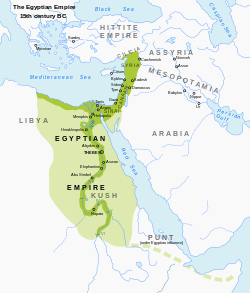
The New Kingdom (1550–1070 BC) was an era of Egyptian imperial expansion during which foreign deities were adopted into Egyptian religion.
Image source: New Kingdom of Egypt
1550 BC - 1070 BC
% complete
During the New Kingdom (1550–1070 BC), minor myths developed around deities like Yam and Anat who had been adopted from Canaanite religion.
Image source: Yam (god)
1550 BC - 1070 BC
% complete
Yam, a sea deity from Canaanite religion, featured in minor myths that developed in Egypt during the New Kingdom (1550–1070 BC).
1550 BC - 1070 BC
% complete
Anat, a war goddess adopted from Canaanite religion, became the subject of minor myths in Egypt during the New Kingdom period.
Image source: Anat
1550 BC - 1070 BC
% complete
In the New Kingdom, Egyptian religion absorbed deities such as Yam and Anat from Canaanite religion, and minor myths grew up around them.
Image source: Canaanite religion
500 BC - 100 AD
% complete
Writers like Herodotus and Diodorus Siculus described Egyptian religion in the last centuries of its existence, providing a final external source for Egyptian myth.
Image source: Herodotus
450 BC
% complete
Herodotus, visiting Egypt in the fifth century BC, described Egyptian religion, becoming one of the Greek writers whose accounts form a final source for Egyptian myth.
60 BC - 30 BC
% complete
Diodorus Siculus, a Greek historian, described Egyptian religion in its final centuries, contributing one of the last surviving accounts of Egyptian mythological beliefs.
Image source: Diodorus Siculus
Or browse the full history timeline directory, with more than 2,000 topics.
This Egyptian Mythology timeline was generated with the help of AI, using information found on the internet.
We work hard to keep these timelines accurate, but mistakes do get through. If you spot one, email us at [email protected] and we'll fix it for future visitors.
Generate yours with AI or build it from scratch, for free.
Export your timeline, add your own events, edit or remove AI-generated events, and much more
No credit card required.
Cancel anytime.
Cancel anytime.
You can create an unlimited number of timelines with up to 10 events on each one, customize how they look, export them to PDF, PNG, PowerPoint, CSV, and Excel, and share them with a link. Paid plans raise the event limit and add features like spreadsheet imports and collaborators.
Yes. You can cancel your subscription from your account page at any time, and you will not be charged again. Your subscription stays active for the rest of the period you already paid for.
Yes. We will email you a reminder before the annual renewal, and we will also email you a receipt.
Yes. You can email us within 15 days of any payment, and we will issue you a full refund.
Check out our pricing docs or send us an email anytime: [email protected].