-
Use Cases
-
Resources
-
Pricing
Greek Mythology is the body of stories and beliefs of ancient Greece concerning its gods, heroes, and the origins and nature of the world. Spanning from the Minoan and Mycenaean civilizations through the Classical period, it includes tales of Zeus and the Olympians, the Trojan War, and legendary figures like Heracles and Odysseus. These myths shaped Greek religion, art, literature, and culture, and continue to influence Western civilization today. More Less
1800 BC
% complete
The Greek myths were initially propagated in an oral-poetic tradition most likely by Minoan and Mycenaean singers starting in the 18th century BC, passing stories of gods and heroes from generation to generation long before they were ever written down.
Image source: Greek mythology
800 BC
% complete
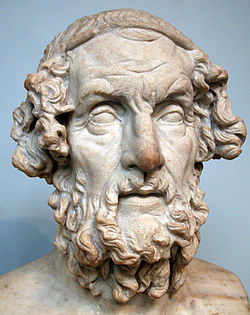
The myths of the heroes of the Trojan War and its aftermath became part of the oral tradition of Homer's epic poems, the Iliad and the Odyssey, which would become the foundational texts of Greek mythology for later generations.
Image source: Homer
800 BC - 701 BC
% complete
Geometric designs on pottery of the eighth century BC depict scenes from the Epic Cycle as well as the adventures of Heracles, providing some of the earliest visual evidence of Greek mythological narratives.
800 BC - 701 BC
% complete
Geometric designs on eighth-century BC pottery depict scenes from the Trojan cycle, showing that the great war myth was already a popular subject in visual art during this formative period.
800 BC
% complete
In some cases, the first known representation of a myth in geometric art predates its first known representation in late archaic poetry by several centuries, showing that visual artists preserved mythological traditions independently of poets.
500 BC - 401 BC
% complete
One of the scraps known as the Derveni Papyrus now proves that at least in the fifth-century BC a theogonic-cosmogonic poem of Orpheus was in existence, testifying to an alternative mystical tradition alongside mainstream myth.
Image source: Derveni papyrus
300 BC - 201 BC
% complete
Although Apollonius wrote his poem in the 3rd century BC, the composition of the story of the Argonauts is earlier than the Odyssey, which shows familiarity with the exploits of Jason; the wandering of Odysseus may have been partly founded on it.
Image source: Argonautica
100 AD
% complete
Myths are preserved in texts from the time of the Roman Empire by writers such as Plutarch, whose essays and biographies recorded and interpreted many mythological traditions that might otherwise have been lost.
Image source: Plutarch
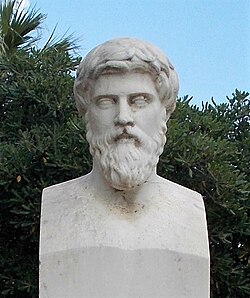
150 AD
% complete
Pausanias, writing under the Roman Empire, traveled Greece recording local legends, cults, and monuments, preserving an invaluable account of mythological traditions tied to specific places across the Greek world.
Image source: Pausanias (geographer)
200 AD
% complete
The surviving 2nd-century collection of Orphic Hymns is influenced by the theories of rationalism and the syncretizing trends of its age, blending older mystical traditions with contemporary religious thought.
Image source: Orphic Hymns
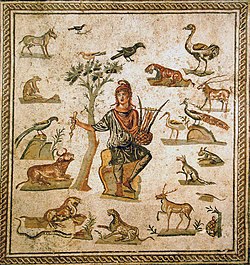
300 AD
% complete
An anonymous papyrus fragment, dated to the third century, vividly portrays Dionysus' punishment of the king of Thrace, Lycurgus, whose recognition of the new god came too late, resulting in horrific penalties that extended into the afterlife.
Image source: Lycurgus (son of Dryas)
400 AD
% complete
The Saturnalia of Macrobius Ambrosius Theodosius, written in the fifth century, is influenced by the theories of rationalism and syncretizing trends, helping transmit classical mythological lore into late antiquity.
Image source: Macrobius
600 BC - 501 BC
% complete
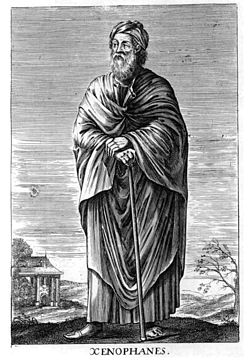
By the 6th century BC, radical philosophers began labeling the poets' tales as blasphemous lies. Xenophanes of Colophon complained that Homer and Hesiod attributed to the gods 'all that is shameful and disgraceful among men; they steal, commit adultery, and deceive one another.'
Image source: Xenophanes
500 BC - 401 BC
% complete
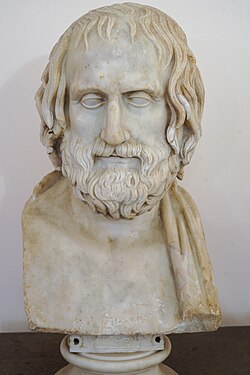
More sportingly, the 5th-century BC tragedian Euripides often played with the old traditions, mocking them and, through the voice of his characters, injecting notes of doubt about the traditional myths.
Image source: Euripides
430 BC - 400 BC
% complete
After the rise of philosophy, history, prose and rationalism in the late 5th century BC, the role of myth became less certain, and mythological genealogies gave place to a conception of history which tried to exclude the supernatural, such as the Thucydidean history.
400 BC
% complete
By the end of the fifth-century BC, poets had assigned at least one eromenos, an adolescent boy who was their sexual companion, to every important god except Ares, and to many legendary figures as well.
1700 - 1799
% complete
During the Enlightenment of the 18th century, a reaction against Greek myth spread throughout Europe, even as the myths continued to inspire dramatists and composers across the continent.
Image source: Age of Enlightenment
1154 - 1160
% complete
Twelfth-century author Benoît de Sainte-Maure described the Trojan War in his Roman de Troie (Romance of Troy, 1154–60), rewriting the standard version he found in Dictys and Dares for a medieval audience.
1183
% complete
Joseph of Exeter composed De Bello Troiano (On the Trojan War) in 1183, describing the war while rewriting the standard version found in Dictys and Dares, continuing the medieval fascination with Troy.
1380
% complete
The English imagination was fired by Greek mythology starting with Chaucer, whose works drew heavily on classical myth and helped establish a lasting tradition of Greek themes in English literature.
Image source: Geoffrey Chaucer
1590 - 1670
% complete
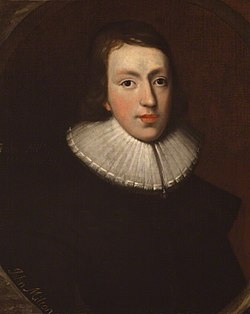
Continuing the English engagement with Greek myth, John Milton and William Shakespeare wove classical allusions and mythological figures throughout their poetry and drama, enriching English literature with ancient themes.
Image source: John Milton
1710 - 1791
% complete
Although during the Enlightenment reaction against Greek myth spread throughout Europe, the myths continued to provide an important source of raw material for dramatists, including those who wrote the libretti for many of Handel's and Mozart's operas.
1900 - 1930
% complete
The English imagination fired by Greek mythology, which began with Chaucer and continued through Shakespeare, reached into the 20th century with poet Robert Bridges, demonstrating the enduring vitality of the classical tradition in English letters.
Image source: Robert Bridges
1780 - 1800
% complete
The genesis of modern understanding of Greek mythology is regarded by some scholars as a double reaction at the end of the eighteenth century against 'the traditional attitude of Christian animosity', in which the Christian reinterpretation of myth as a 'lie' or fable had been retained.
1790 - 1800
% complete
By the end of the 18th century, Romanticism initiated a surge of enthusiasm for all things Greek, including Greek mythology, reversing centuries of ambivalence and launching a new era of appreciation.
Image source: Romanticism
1795
% complete
In Germany, by about 1795, there was a growing interest in Homer and Greek mythology, laying the groundwork for the country's later dominance in classical scholarship and philology.
1800 - 1899
% complete
The development of comparative philology in the 19th century, together with ethnological discoveries in the 20th century, established the science of myth, transforming the study of Greek mythology into a rigorous academic discipline.
Image source: Comparative mythology
1850 - 1899
% complete
American authors of the 19th century, such as Thomas Bulfinch, held that the study of the classical myths was essential to the understanding of English and American literature, making the myths accessible to general readers.
Image source: Thomas Bulfinch
1850 - 1899
% complete
Nathaniel Hawthorne, like fellow American author Thomas Bulfinch, held that the study of the classical myths was essential to understanding English and American literature, retelling the myths for young readers in works such as A Wonder-Book for Girls and Boys.
Image source: Nathaniel Hawthorne
1870 - 1890
% complete
The discovery of the Mycenaean civilization by the German amateur archaeologist Heinrich Schliemann in the nineteenth century helped explain many existing questions about Homer's epics and provided archaeological evidence for many mythological details about gods and heroes.
Image source: Heinrich Schliemann
1871
% complete
In 1871 Edward Burnett Tylor published his Primitive Culture, in which he applied the comparative method and tried to explain the origin and evolution of religion, profoundly influencing the anthropological study of myth.
Image source: Edward Burnett Tylor
1891
% complete
In 1891, a scholar claimed that 'the most important discovery which has been made during the nineteenth century concerning the ancient history of mankind' had been achieved, reflecting the era's excitement over advances in understanding humanity's mythological past.
1897
% complete
About 100 years after the German revival of interest, enthusiasm for Greek mythology was still alive when Hermann Steuding published his book Griechische und römische Götter- und Heldensage in 1897, a popular handbook of Greek and Roman divine and heroic legend.
1900 - 1931
% complete
The discovery of the Minoan civilization in Crete by the British archaeologist Arthur Evans in the twentieth century helped explain questions about Homer's epics and provided archaeological evidence for many of the mythological details about gods and heroes.
Image source: Arthur Evans
1900 - 1999
% complete
Together with the development of comparative philology in the 19th century, ethnological discoveries in the 20th century established the science of myth, giving scholars new tools to interpret Greek mythology within a global framework.
1990
% complete
Segal (1990) concludes that 'to interpret a myth Campbell simply identifies the archetypes in it,' summarizing Joseph Campbell's influential approach to mythological analysis and its reception among modern scholars.
2002
% complete
Burkert (2002) notes that 'the roster of heroes, again in contrast to the gods, is never given fixed and final form,' highlighting the fluid and evolving nature of heroic myth in the Greek tradition.
2002
% complete
According to Burkert (2002), Heracles is portrayed as a sacrificer, mentioned as a founder of altars, and imagined as a voracious eater himself; it is in this role that he appears in comedy, illustrating the god-hero's complex cultural functions.
Image source: Heracles
Or browse the full history timeline directory, with more than 2,000 topics.
This Greek Mythology timeline was generated with the help of AI, using information found on the internet.
We work hard to keep these timelines accurate, but mistakes do get through. If you spot one, email us at [email protected] and we'll fix it for future visitors.
Generate yours with AI or build it from scratch, for free.
Export your timeline, add your own events, edit or remove AI-generated events, and much more
No credit card required.
Cancel anytime.
Cancel anytime.
You can create an unlimited number of timelines with up to 10 events on each one, customize how they look, export them to PDF, PNG, PowerPoint, CSV, and Excel, and share them with a link. Paid plans raise the event limit and add features like spreadsheet imports and collaborators.
Yes. You can cancel your subscription from your account page at any time, and you will not be charged again. Your subscription stays active for the rest of the period you already paid for.
Yes. We will email you a reminder before the annual renewal, and we will also email you a receipt.
Yes. You can email us within 15 days of any payment, and we will issue you a full refund.
Check out our pricing docs or send us an email anytime: [email protected].