-
Use Cases
-
Resources
-
Pricing
Norse Mythology encompasses the religious beliefs, myths, and legends of the Scandinavian and Germanic peoples before Christianization. Centered on gods like Odin, Thor, and Loki, the nine realms of Yggdrasil, and the apocalyptic event of Ragnarök, these stories were preserved in medieval texts such as the Poetic Edda and Prose Edda and continue to influence modern literature, art, and popular culture. More Less
1853 - 1855
% complete
Karl Joseph Simrock published his Handbuch der deutschen Mythologie between 1853 and 1855, a German-language handbook surveying Germanic and Norse mythological traditions. It became a standard reference for 19th-century readers interested in the pre-Christian beliefs of the Germanic peoples.
Image source: Norse mythology
1875
% complete
Rasmus Anderson published his influential work on Norse mythology in 1875, bringing the myths of the Norse gods and heroes to a broader English-speaking audience. The book was later reprinted in 1992 by Dover Publications in Mineola, NY, demonstrating its enduring popularity among students of mythology.
1888
% complete
Jacob Grimm's monumental study of Germanic mythology reached English readers in 1888. His comparative approach connected Norse myths with wider Germanic traditions. The work was later reprinted in 2003 by Kessinger Publishing, with ISBNs including 0-7661-7742-4, and again in 2004 by Dover Publications.
1889
% complete
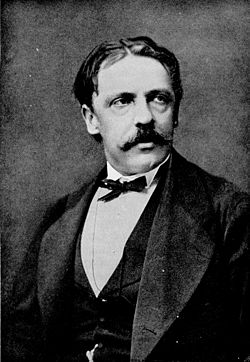
Viktor Rydberg's ambitious research into Teutonic mythology appeared in 1889, proposing systematic reconstructions of the Norse mythic corpus. The work has been reprinted multiple times, including by Elibron Classics in 2001 and Kessinger Publishing Company in 2004, reflecting continued scholarly interest.
Image source: Viktor Rydberg
1900
% complete
Sarah Powers Bradish published her collection of Old Norse stories in 1900, retelling tales of the Aesir, Vanir, and legendary heroes for English readers. Her work formed part of a wave of early 20th-century popularizations of Norse mythology in the English-speaking world.
1901
% complete
Hamilton Wright Mable published his retellings of Norse stories in 1901, adapting the ancient myths for younger and general audiences. The collection was reprinted in 1999 by Hippocrene Books in New York, showing the lasting appeal of these accessible retellings.
1909
% complete
A. and E. Keary published The Heroes of Asgard in 1909, a beloved retelling of Norse myths for children. The book was reprinted in 1979 by Pan Macmillan (ISBN 0-333-07802-0) and again in 1982 by Smithmark Pub, remaining a classic introduction to the Norse gods.
1912
% complete
Donald A. Mackenzie published his survey of Teutonic myth and legend in 1912, offering a comprehensive retelling of Norse and Germanic myths. The work was reprinted in 2003 by University Press of the Pacific, attesting to its continued usefulness as an accessible overview.
1920
% complete
Padraic Colum published The Children of Odin in 1920, an elegant retelling of Norse myths that has become a children's classic. The book was reprinted in 2004 by Aladdin (ISBN 0-689-86885-5), introducing generations of new readers to Odin, Thor, Loki, and the other Norse figures.
Image source: Padraic Colum
1927
% complete
Peter Andreas Munch's work on Norse mythology was published in 1927, presenting the myths of Scandinavia through a scholarly yet accessible lens. Munch was a pioneering Norwegian scholar whose studies helped establish Norse mythology as a serious academic subject.
Image source: Peter Andreas Munch
1955
% complete
Brian Branston's original hardback study of the gods of the North was published in 1955, offering a vivid account of Norse mythology and the culture that produced it. The work was later revised and reissued in 1980, extending its influence on popular understanding of the myths.
1963
% complete
Sigurd Bernhard Hustvedt published his scholarly study in 1963, contributing to the academic discourse on Norse mythology. His work examined the mythological traditions of Scandinavia and their transmission through medieval sources such as the Eddas.
1964
% complete
E. O. G. Turville-Petre published his major study of the religion and mythology of the North in 1964. The work was reprinted in 1975 by Greenwood Press in Westport, CN, and remains a foundational scholarly treatment of pre-Christian Scandinavian religion.
1967
% complete
Ingri and Edgar Parin d'Aulaire published their lavishly illustrated book of Norse myths in 1967. With striking artwork and engaging prose, it became one of the most beloved introductions to Norse mythology for children, alongside their earlier book of Greek myths.
Image source: Ingri and Edgar Parin d'Aulaire
1973
% complete
Georges Dumézil published his influential work in 1973, applying his trifunctional hypothesis to Indo-European mythologies, including the Norse pantheon. His theories about the division of gods into sovereign, warrior, and fertility functions profoundly shaped 20th-century mythology scholarship.
Image source: Georges Dumézil
1980
% complete
Brian Branston's work on the gods of the North appeared in a revised edition in 1980, updated from an earlier hardback edition of 1955. The study explored the mythology of the Norse and Anglo-Saxon peoples and their shared Germanic heritage.
1988
% complete
John Lindow published his handbook on Scandinavian mythology in 1988, offering a clear scholarly overview of the Norse myths and their sources. The work helped establish Lindow as one of the leading American authorities on Old Norse religion and literature.
Image source: John Lindow
1990
% complete
Penguin Books published a new edition of a major work on Norse mythology in 1990, making an important study of the myths widely available in paperback. The edition was later reissued in 1996 as Viking and Norse Mythology, reaching yet more readers.
1993
% complete
Rudolf Simek's Dictionary of Northern Mythology was published in 1993, providing detailed entries on figures, places, and concepts from Germanic and Norse myth. A new edition appeared in 2000 (ISBN 0-85991-513-1), cementing its status as a key scholarly reference.
Image source: Rudolf Simek
1994
% complete
Margaret Clunies Ross published the first volume of her major scholarly work in 1994, offering a sophisticated analysis of Old Norse myths and their social and literary contexts. Her research became essential reading in the academic study of Norse mythology.
1996
% complete
In 1996, an earlier study of Norse mythology was reissued under the title Viking and Norse Mythology, reflecting the growing public fascination with Viking culture in the late 20th century. This reissue followed a 1990 new edition published by Penguin Books.
1997
% complete
Andy Orchard published his Dictionary of Norse Myth and Legend in 1997, a comprehensive reference work covering the gods, heroes, creatures, and stories of Norse mythology. It quickly became a standard desk reference for students and enthusiasts alike.
Image source: Andy Orchard
1998
% complete
Jón Hnefill Aðalsteinsson published his study in 1998, examining aspects of Norse mythology and Icelandic folk tradition. As an Icelandic scholar, he brought valuable local perspective to the interpretation of the medieval Icelandic sources on the old religion.
Image source: Jón Hnefill Aðalsteinsson
1981
% complete
Kevin Crossley-Holland published his celebrated retelling of the Norse myths in 1981. Drawing directly on the Old Norse sources, his collection presented the stories of the gods, giants, and Ragnarök with both fidelity and literary grace, becoming a standard modern retelling.
Image source: Kevin Crossley-Holland
2000
% complete
Nora Louise Syran published her work in 2000, contributing to the modern literature on Norse mythology. Her writing joined a growing body of contemporary scholarship and retellings that kept the Norse myths alive for new audiences at the turn of the millennium.
2001
% complete
John Lindow published his comprehensive guide to Norse mythology in 2001, a widely used reference covering the myths, gods, and medieval sources. It remains one of the most frequently cited modern introductions to the subject in English.
2002
% complete
Neil S. Price published The Viking Way in 2002, a landmark archaeological and historical study of sorcery and magic in the Viking Age. The work examined seiðr and other practices, illuminating the religious world behind the myths recorded in the medieval sources.
2002
% complete
Eric Christiansen published his study in 2002, engaging with the history and interpretation of Norse mythological traditions. His work contributed to the ongoing scholarly conversation about how the myths were recorded, transmitted, and understood.
2003
% complete
Fredrik Svanberg published his study in 2003, engaging with Norse mythological themes and their cultural context. His work formed part of the early 21st-century wave of scholarship reassessing the Viking Age and its mythic legacy.
2007
% complete
Heather O'Donoghue published From Asgard to Valhalla in 2007, tracing the remarkable history of the Norse myths from their medieval origins through their reception in later literature, art, and popular culture, including their influence on modern fantasy and identity.
Image source: Heather O'Donoghue
2011
% complete
Christopher Abram published his study of Norse mythology in 2011, examining the medieval sources and the modern scholarly understanding of the myths. His accessible yet rigorous work surveyed the gods, cosmology, and the challenges of interpreting the Eddas.
2017
% complete
Neil Gaiman published his retelling of the Norse myths in 2017, bringing his signature storytelling style to tales of Odin, Thor, Loki, and Ragnarök. The bestselling book reached a vast new audience and sparked renewed popular interest in Norse mythology.
Image source: Norse Mythology (book)
Or browse the full history timeline directory, with more than 2,000 topics.
This Norse Mythology timeline was generated with the help of AI, using information found on the internet.
We work hard to keep these timelines accurate, but mistakes do get through. If you spot one, email us at [email protected] and we'll fix it for future visitors.
Generate yours with AI or build it from scratch, for free.
Export your timeline, add your own events, edit or remove AI-generated events, and much more
No credit card required.
Cancel anytime.
Cancel anytime.
You can create an unlimited number of timelines with up to 10 events on each one, customize how they look, export them to PDF, PNG, PowerPoint, CSV, and Excel, and share them with a link. Paid plans raise the event limit and add features like spreadsheet imports and collaborators.
Yes. You can cancel your subscription from your account page at any time, and you will not be charged again. Your subscription stays active for the rest of the period you already paid for.
Yes. We will email you a reminder before the annual renewal, and we will also email you a receipt.
Yes. You can email us within 15 days of any payment, and we will issue you a full refund.
Check out our pricing docs or send us an email anytime: [email protected].