-
Use Cases
-
Resources
-
Pricing
The History of Egyptian Art traces visual culture from prehistoric communities through the pharaonic, Greco-Roman, Coptic, Islamic, and modern periods. Egyptian artists created sculpture, painting, architecture, jewelry, and funerary objects shaped by religion, royalty, and ideas about the afterlife. More Less
6000 BC - 399
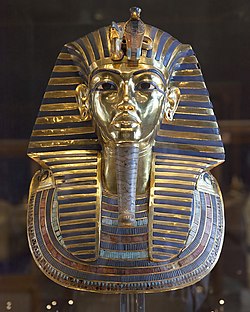
Ancient Egyptian art refers to art produced in Egypt from the 6th millennium BC through the 4th century AD, spanning Prehistoric Egypt, the pharaonic periods, and the Christianization of Roman Egypt.
Image source: Art of ancient Egypt
6000 BC - 3100 BC
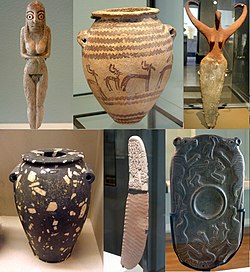
Pre-Dynastic Egypt corresponded to the Neolithic period of Egyptian prehistory and lasted from approximately 6000 BC until the beginning of the Early Dynastic Period around 3100 BC.
Image source: Prehistoric Egypt
6000 BC
Although the period from 9000 to 6000 BC left little archaeological evidence, Neolithic settlements began appearing throughout Egypt around 6000 BC, establishing communities that produced early material and artistic traditions.
6000 BC - 3100 BC
Jewelry made from gold, silver, copper, and faience is attested in the early Predynastic period. Additional materials and more varied techniques were introduced during the centuries preceding the First Dynasty.
Image source: Clothing in ancient Egypt
5000 BC - 4200 BC
The Merimde culture flourished in Lower Egypt from about 5000 to 4200 BC. It is known primarily from a large settlement at the edge of the Western Nile Delta.
Image source: Merimde culture
4500 BC - 4000 BC
A Predynastic cultural phase beginning around 4500 BC was sufficiently similar to neighboring traditions that many scholars regard the developments as one continuous period.
4400 BC - 4000 BC
The Badarian culture developed from about 4400 to 4000 BC and was named after the Badari site near Der Tasa. Its archaeological remains provide important evidence for early Egyptian craft production and funerary customs.
Image source: Badarian culture
4400 BC - 3000 BC
The Naqada culture lasted from approximately 4400 to 3000 BC and was named for the town of Naqada in Qena Governorate. It represents a major sequence in the development of Predynastic Egyptian art and society.
Image source: Naqada culture
4000 BC - 3500 BC
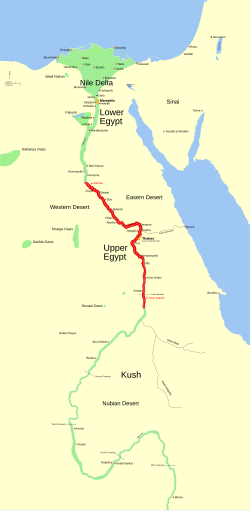
The Naqada I, or Amratian, culture lasted from about 4000 to 3500 BC and is associated with distinctive early pottery, burial objects, and symbolic imagery.
3500 BC - 3200 BC
The Naqada II, or Gerzean, culture flourished from about 3500 to 3200 BC. It was named after the site of Gerzeh and saw increasing artistic standardization and long-distance cultural connections.
Image source: Gerzeh culture
3200 BC - 3000 BC
Naqada III, from approximately 3200 to 3000 BC, is generally identified with the Protodynastic period, during which Egypt was unified and artistic conventions associated with kingship became more established.
Image source: Naqada III
3200 BC - 2701 BC
Hieroglyphic writing arose from proto-literate symbol systems during the Early Bronze Age, around the 32nd century BC. The first decipherable sentence in the Egyptian language dates to the Second Dynasty in the 28th century BC.
Image source: Egyptian hieroglyphs
3100 BC - 2686 BC
Beginning around 3100 BC, the Early Dynastic Period included Egypt's First and Second Dynasties and lasted until about 2686 BC, when the Old Kingdom began.
Image source: Early Dynastic Period (Egypt)
2680 BC
By Dynasty IV, around 2680–2565 BC, the idea of the ka statue was firmly established. Such statues served as physical repositories for the deceased person's life force.
2600 BC
As early as 2600 BC, the architect Imhotep used stone columns whose carved surfaces reflected organic forms such as bundled reeds, papyrus, lotus, and palm. Faceted cylindrical columns later became common in Egyptian architecture.
Image source: Imhotep
2050 BC - 1710 BC
The Middle Kingdom lasted from around 2050 to 1710 BC, beginning with Egypt's reunification under Mentuhotep II of the Eleventh Dynasty and ending with the close of the Twelfth Dynasty.
Image source: Middle Kingdom of Egypt
1600 BC - 1001 BC
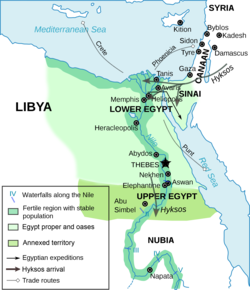
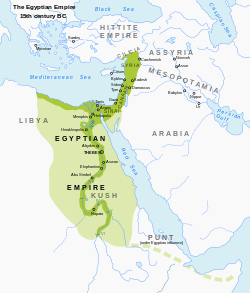
The New Kingdom, also called the Egyptian Empire, extended from the 16th to the 11th centuries BC and encompassed the Eighteenth, Nineteenth, and Twentieth Dynasties.
Image source: New Kingdom of Egypt
1473 BC - 1458 BC
A large portion of Pre-Amarna art and architecture was produced during the reign of the female king Hatshepsut, who led a widespread building campaign dedicated to the gods from 1473 to 1458 BC.
Image source: Hatshepsut
1100 BC - 399 BC
Portrait traditions originating in the late New Kingdom and intermediate period became increasingly common by the fourth century BC and continued into the Ptolemaic era.
525 BC
In 525 BC, the political state of Egypt was taken over by the Persians, nearly a century and a half into Egypt's Late Period. The change formed part of the political context for later artistic developments.
400 BC - 301 BC
Discoveries around the submerged ancient Egyptian city of Heracleion have revealed an unusually sensual, detailed, and feministic depiction of Isis from the fourth century BC. The work combines Egyptian and Hellenistic forms around the time of Alexander the Great's conquest of Egypt in 332–331 BC.
Image source: Heracleion
332 BC - 331 BC
Alexander the Great's conquest of Egypt in 332–331 BC helped initiate the combination of Egyptian and Hellenistic artistic forms that became characteristic of the Ptolemaic period.
200 BC - 101 BC
The artistic and political developments associated with powerful Ptolemaic queens predated the second century, when a series of queens exercised real power in Egypt.
Image source: Ptolemaic Kingdom
100 BC - 299
The portraits date from the Imperial Roman era, beginning in the late first century BC or early first century AD. Recent research suggests that their production ended around the middle of the third century.
100 BC - 399
Late uses of hieroglyphics continued during the Roman period and extended into the fourth century AD, marking the final phase of a writing system that had shaped Egyptian visual culture for millennia.
100 - 199
In the second century, Egyptian temple sculptures began reusing court models for their facial features, connecting traditional religious sculpture with contemporary royal representation.
100 - 199
During the second century, sculptures of priests often used a Hellenistic style to create individually distinctive portrait heads, reflecting the artistic interaction between Egyptian and Greek traditions.
1798
Enthusiasm for ancient Egyptian artistic styles is generally attributed to the excitement surrounding Napoleon's conquest of Egypt and, in Britain, Admiral Nelson's defeat of Napoleon at the Battle of the Nile in 1798.
Image source: French campaign in Egypt and Syria
1800 - 1899
Egyptian Revival art was a style in Western art, especially during the early nineteenth century, in which Egyptian motifs were applied to a wide variety of decorative-art objects.
Image source: Egyptian Revival architecture
1800 - 1929
Egyptian-inspired design remained part of American decorative arts throughout the nineteenth century and continued into the 1920s, even as its forms and popularity changed.
1800 - 1929
Over the nineteenth century, American taste evolved from highly ornamented decoration toward simpler, sparser designs. Ancient Egyptian artistic vocabulary was interpreted and adapted according to changing standards and motivations.
1809 - 1826
Publication of the French expedition's Description de l'Égypte began in 1809 and continued in a series through 1826. Its documentation of Egypt inspired decorative objects ranging from sphinx-legged sofas to tea sets painted with pyramids.
Image source: Description de l'Égypte
Or browse the full history timeline directory, with more than 2,500 topics.
This History of Egyptian Art timeline was generated with the help of AI, using information found on the internet.
We work hard to keep these timelines accurate, but mistakes do get through. If you spot one, email us at [email protected] and we'll fix it for future visitors.
Generate yours with AI or build it from scratch, for free.
Export your timeline, add your own events, edit or remove AI-generated events, and much more
No credit card required.
Cancel anytime.
Cancel anytime.
You can create an unlimited number of timelines with up to 10 events on each one, customize how they look, export them to PDF, PNG, PowerPoint, CSV, and Excel, and share them with a link. Paid plans raise the event limit and add features like spreadsheet imports and collaborators.
Yes. You can cancel your subscription from your account page at any time, and you will not be charged again. Your subscription stays active for the rest of the period you already paid for.
Yes. We will email you a reminder before the annual renewal, and we will also email you a receipt.
Yes. You can email us within 15 days of any payment, and we will issue you a full refund.
Check out our pricing docs or send us an email anytime: [email protected].