-
Use Cases
-
Resources
-
Pricing
Nokia is a Finnish multinational telecommunications and consumer electronics company founded in 1865. Originally a pulp mill near the town of Nokia, it diversified into rubber, cables, and electronics before becoming the world's largest mobile phone manufacturer in the late 1990s and early 2000s. After losing smartphone dominance to Apple and Android devices, Nokia sold its handset business to Microsoft in 2014 and refocused on networking infrastructure, becoming a key player in 5G technology. More Less
May 12, 1865
% complete
Mining engineer Fredrik Idestam established a wood pulp mill on the banks of the Tammerkoski rapids in Tampere, Finland, laying the foundation for what would later become the Nokia Corporation.
Image source: Nokia
1871
% complete
Idestam opened a larger mill by the Nokianvirta river near the town of Nokia, and with Leo Mechelin transformed the business into a share company named Nokia Ab in 1871.
1898
% complete
Arvid Wickström founded the Finnish Rubber Works in Helsinki, producing rubber boots and other products. The company would later adopt the Nokia name and become one of its three founding businesses.
1912
% complete
The Finnish Cable Works company was established in Helsinki, manufacturing telephone and electric cables. It became the third of the companies that eventually merged to form Nokia.
1967
% complete
Nokia Ab, Finnish Rubber Works, and Finnish Cable Works merged to form the Nokia Corporation, creating a conglomerate involved in rubber, cabling, electronics, and paper products.
1977
% complete
Kari Kairamo became CEO of Nokia and aggressively expanded the company's electronics and telecommunications divisions, transforming Nokia from an industrial conglomerate into a technology-focused enterprise.
Image source: Kari Kairamo
1982
% complete
Nokia introduced the Mobira Senator, one of its first car phones, marking the company's entry into mobile telephony through its Mobira division.
Image source: List of Nokia products
1984
% complete
Nokia acquired a majority stake in Finnish radio and TV manufacturer Salora, merging it with its own mobile operations to create Nokia-Mobira, strengthening its position in consumer telecommunications.
Image source: Salora Oy
Oct 1987
% complete
Soviet leader Mikhail Gorbachev was photographed using a Mobira Cityman phone during a visit to Helsinki, earning the handset the nickname 'Gorba' and boosting Nokia's international profile.
Image source: Mobira Cityman 900
Jan 1, 1992
% complete
Jorma Ollila became CEO of Nokia amid financial difficulties and made the pivotal decision to focus the company entirely on telecommunications, divesting unrelated businesses.
Image source: Jorma Ollila
Nov 1992
% complete
Nokia released the 1011, the first mass-produced GSM mobile phone, cementing the company's role as a pioneer of digital cellular communication.
Image source: Nokia 1011
1994
% complete
The Nokia 2110 debuted the famous Nokia Tune ringtone, based on Francisco Tárrega's 'Gran Vals', which became one of the most recognized sounds in the world.
Image source: Nokia 2110
1994
% complete
Nokia's shares were listed on the New York Stock Exchange, giving the Finnish company access to American capital markets and raising its global visibility.
1997
% complete
The Nokia 6110 shipped with the pre-installed Snake game, which became one of the most-played mobile games ever and a defining feature of Nokia handsets.
Image source: Snake (video game genre)
1998
% complete
Nokia overtook Motorola to become the world's largest manufacturer of mobile phones, a position it would hold for over a decade.
Mar 1999
% complete
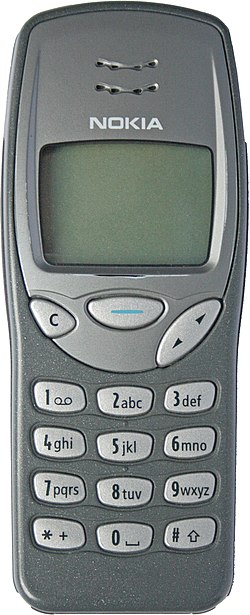
The Nokia 3210 launched with an internal antenna, customizable covers, and Snake II, selling around 160 million units and becoming one of the best-selling phones of all time.
Image source: Nokia 3210
2000
% complete
At the height of the dot-com boom, Nokia accounted for roughly two-thirds of the market capitalization of the Helsinki stock exchange and was among Europe's most valuable companies.
2003
% complete
The ultra-affordable Nokia 1100 sold approximately 250 million units, making it the best-selling mobile phone in history.
Image source: Nokia 1100
Mar 2007
% complete
The flagship Nokia N95 combined a 5-megapixel camera, GPS, and media playback, showcasing Nokia's Symbian-based smartphone leadership just before the iPhone era began.
Image source: Nokia N95
Jun 29, 2007
% complete
Apple's iPhone redefined the smartphone with its touchscreen interface and app ecosystem, beginning the erosion of Nokia's dominance in high-end mobile devices.
Image source: IPhone (1st generation)
Sep 23, 2008
% complete
The launch of Google's open-source Android operating system gave rival manufacturers a powerful platform, rapidly undermining Nokia's Symbian ecosystem.
Image source: Android (operating system)
Sep 21, 2010
% complete
Nokia appointed former Microsoft executive Stephen Elop as its first non-Finnish CEO, tasked with reversing the company's declining fortunes in smartphones.
Image source: Stephen Elop
Feb 11, 2011
% complete
Elop's internal 'burning platform' memo preceded the announcement that Nokia would adopt Microsoft's Windows Phone as its primary smartphone platform, abandoning Symbian and MeeGo development.
Image source: Microsoft Mobile
Nov 2011
% complete
The Lumia 800, the first flagship Nokia Windows Phone, received critical praise for its design but failed to significantly recover lost market share against iOS and Android.
Image source: Nokia Lumia 800
Feb 2012
% complete
The Nokia 808 PureView featured a groundbreaking 41-megapixel sensor, winning awards for camera innovation even as Symbian neared the end of its life.
Image source: Nokia 808 PureView
Sep 3, 2013
% complete
Microsoft agreed to acquire Nokia's mobile phone business for €5.44 billion, ending Nokia's role as a handset maker and marking a dramatic fall from its peak.
Apr 25, 2014
% complete
The sale of Nokia's device business to Microsoft closed, and interim CEO Risto Siilasmaa led the reshaped company focused on networks, mapping, and patent licensing.
Dec 2015
% complete
Nokia sold its HERE maps division to a consortium of Audi, BMW, and Daimler for €2.8 billion, further streamlining the company around network infrastructure.
Image source: Here Technologies
Jan 14, 2016
% complete
Nokia completed its €15.6 billion acquisition of Alcatel-Lucent, creating one of the world's largest telecommunications equipment vendors under new CEO Rajeev Suri.
Image source: Alcatel-Lucent
May 2016
% complete
Finnish startup HMD Global secured exclusive rights to use the Nokia brand on mobile phones, launching new Android-based Nokia-branded devices from 2017 onward.
Image source: HMD Global
2017
% complete
Refocused on telecoms infrastructure, 5G research, and patent licensing, Nokia stabilized financially and re-established itself as a leading global network equipment supplier.
Aug 1, 2020
% complete
Pekka Lundmark took over as CEO, pledging to accelerate Nokia's 5G strategy and restore its competitiveness against Ericsson and Huawei.
Image source: Pekka Lundmark
Oct 2020
% complete
NASA awarded Nokia's Bell Labs $14.1 million to deploy the first LTE/4G communications network on the Moon as part of the Artemis program.
Image source: Bell Labs
Or browse the full history timeline directory, with more than 2,000 topics.
This History of Nokia timeline was generated with the help of AI, using information found on the internet.
We work hard to keep these timelines accurate, but mistakes do get through. If you spot one, email us at [email protected] and we'll fix it for future visitors.
Generate yours with AI or build it from scratch, for free.
Export your timeline, add your own events, edit or remove AI-generated events, and much more
No credit card required.
Cancel anytime.
Cancel anytime.
You can create an unlimited number of timelines with up to 10 events on each one, customize how they look, export them to PDF, PNG, PowerPoint, CSV, and Excel, and share them with a link. Paid plans raise the event limit and add features like spreadsheet imports and collaborators.
Yes. You can cancel your subscription from your account page at any time, and you will not be charged again. Your subscription stays active for the rest of the period you already paid for.
Yes. We will email you a reminder before the annual renewal, and we will also email you a receipt.
Yes. You can email us within 15 days of any payment, and we will issue you a full refund.
Check out our pricing docs or send us an email anytime: [email protected].