-
Use Cases
-
Resources
-
Pricing
The history of tablets traces the evolution of portable computing devices with touchscreens, beginning with early pen-based computing experiments like the RAND Tablet and Alan Kay's Dynabook concept, through commercial attempts such as the Apple Newton and Microsoft Tablet PC, to the breakthrough success of the iPad in 2010 and the diverse Android and Windows tablet market that followed. More Less
1945
% complete
Vannevar Bush proposed the Memex, a data archiving device including handwriting input, in his influential essay 'As We May Think', envisioning a device for storing and linking information.
Image source: Memex

1951
% complete
In the 1951 novel Foundation, Isaac Asimov described the Calculator Pad, an early fictional depiction of a tablet-like device that helped promote the concept to a wider audience.
Image source: Foundation (Asimov novel)
1956
% complete
The first publicly demonstrated system using a tablet and handwriting recognition instead of a keyboard for working with a modern digital computer dates to 1956.
Image source: Tablet computer
1961
% complete
Stanislaw Lem described an Opton, a portable device with a screen 'linked directly, through electronic catalogs, to templates of every book on earth' in his 1961 novel Return from the Stars.
Image source: Return from the Stars
1968
% complete
Filmmaker Stanley Kubrick portrayed a flatscreen tablet device wirelessly playing a video broadcast, Arthur C. Clarke's NewsPad, in the 1968 film 2001: A Space Odyssey.
Image source: 2001: A Space Odyssey
1968
% complete
In 1968, Alan Kay envisioned a KiddiComp; while a PhD candidate he developed the concept as the Dynabook, outlined in his 1972 proposal 'A personal computer for children of all ages'.
Image source: Dynabook
1972
% complete
Alan Kay's 1972 paper 'A personal computer for children of all ages' outlined requirements for a conceptual portable educational device similar to a laptop or slate computer, with near eternal battery life.
1978
% complete
Douglas Adams' 1978 comedy The Hitchhiker's Guide to the Galaxy featured a guidebook-like electronic device, helping promote and disseminate the tablet concept to a wider audience.
Image source: The Hitchhiker's Guide to the Galaxy (radio series)
1983
% complete
Steve Jobs of Apple envisioned in a 1983 speech an 'incredibly great computer in a book that you can carry around with you and learn how to use in 20 minutes'.
Image source: History of tablet computers
1985
% complete
In 1985, as the home-computer market declined after years of strong growth, Dan Bricklin said that a successful home computer needed to be the size of and as convenient to carry as a spiral notebook.
Image source: Dan Bricklin
1986 - 1987
% complete
In 1986, Hindsight, a startup in Enfield CT, developed the Letterbug, an 8086-based tablet computer for the educational market. Prototypes were shown at trade shows in New England in 1987, but no production models ever came out.
1987
% complete
In 1987 Linus Technologies released the Write-Top, the first tablet computer with pen input and handwriting recognition. Around 1500 units were sold.
Image source: Linus Write-Top
1988
% complete
In 1988, Apple, as part of the 'Design the Personal Computer of the Year 2000' contest, awarded a project named TABLET, inspired by the Dynabook concept.
1988
% complete
In 1988, Hermann Hauser, co-founder of Acorn Computers, with Olivetti established the Active Book Company Ltd to develop an ARM based pen computer with GSM connectivity and a Smalltalk based touch OS. The company was bought by AT&T, and some technology was borrowed for its 1991 EO Personal Communicator.
Image source: Active Network, LLC
1989
% complete
In 1989, Grid Systems released the GridPad 1900, the first commercially successful tablet computer.
Image source: Grid Compass
1991
% complete
In 1991, AT&T released their first EO Personal Communicator, one of the first commercially available tablets. It ran GO Corporation's PenPoint OS on AT&T's own hardware, including their own AT&T Hobbit CPU.
Image source: EO Personal Communicator
1991
% complete
In 1991, the Atari ST-PAD Stylus was demonstrated but did not enter production.
Image source: Atari ST
Apr 1991
% complete
GO Corporation shipped the PenPoint OS for general availability and IBM announced the IBM 2125 pen computer, the first IBM model named 'ThinkPad', in April 1991.
Image source: GO Corporation
1992
% complete
NCR released model 3125 pen computer running MS-DOS, PenPoint OS or Pen Windows, offering flexible operating system support for pen computing.
Image source: NCR Voyix
1992
% complete
In 1992, Samsung introduced the PenMaster, adding to the growing lineup of pen-based computing devices.
Image source: Grid Systems
1993
% complete
The Compaq Concerto was released in 1993 with a Compaq-modified version of MS-DOS 6.2 and Windows 3.1, combining laptop and tablet functionality.
Image source: Compaq Concerto
1993
% complete
In 1993, Apple Computer released the Apple Newton, a personal digital assistant with a 6-inch screen weighing about 800 grams.
Image source: Apple Newton
1994
% complete
In 1994 media company Knight Ridder made a concept video of a tablet device with a color display and a focus on media consumption, remarkably prescient of later tablets.
Image source: Knight Ridder
1994 - 1997
% complete
In 1994, the European Union initiated the 'OMI-NewsPAD' project (EP9252), requiring a consumer device be developed for receipt and consumption of electronically delivered news and multimedia. The device was supplied for the Barcelona-based trial, which ended in 1997.
Image source: Acorn Computers
1996
% complete
In 1996, The Webbook Company announced the first Internet-based tablet, then referred to as a Web Surfboard, that would run Java and utilize a RISC processor.
Image source: Netbook
1996
% complete
In 1996, Fujitsu released the Stylistic 1000 tablet format PC, running Microsoft Windows 95 on a 100 MHz AMD486 DX4 CPU with 8 MB RAM, offering stylus input with optional keyboard and mouse.
Image source: Fujitsu Lifebook
1999
% complete
In 1999, Intel announced a StrongARM based touch screen tablet computer under the name WebPAD; the tablet was later re-branded as the 'Intel Web Tablet'.
Image source: Tablet computer
2000
% complete
PaceBlade developed the first device that met Microsoft's Tablet PC standard and received the 'Best Hardware' award at VAR Vision 2000.
2000
% complete
In 2000, Microsoft coined the term 'Microsoft Tablet PC' for tablet computers built to Microsoft's specification and running a licensed tablet-enhanced version of Windows, popularizing the term tablet PC. In 1999 Microsoft had assigned two experts from Xerox PARC to re-institute the decades-old tablet concept.
Image source: Microsoft Tablet PC
Apr 2000
% complete
In April 2000, Microsoft launched the Pocket PC 2000, utilising their touch capable Windows CE 3.0 operating system.
Image source: Pocket PC
2002
% complete
In 2002, original equipment manufacturers released the first tablet PCs designed to the Microsoft Tablet PC specification.
2003
% complete
PaceBlade received the 'Innovation des Jahres 2002/2003' award for the PaceBook Tablet PC from PC Professional Magazine at CeBIT.
2003
% complete
In 2003, Hitachi introduced the VisionPlate rugged tablet that was used as a point of sale device.
Image source: Hitachi
Apr 2008
% complete
In April 2008, as part of a larger federal court case, the gesture features of the Windows/Tablet PC operating system and hardware were found to infringe on a patent by GO Corp.
2007
% complete
Before the introduction of the iPad, Axiotron introduced the Modbook, a heavily modified Apple MacBook, Mac OS X-based tablet computer at Macworld in 2007.
Image source: Modbook
Jan 2009
% complete
In January 2009, HP purchased the Palm OS successor webOS to be their proprietary operating system running on the Linux kernel. In March 2011, HP announced plans for a version of webOS within Microsoft Windows for desktops and notebooks in 2012.
Image source: WebOS
2010
% complete
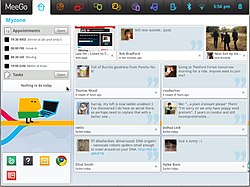
In 2010, Nokia and Intel combined the Maemo and Moblin projects to form MeeGo. Maemo, a Debian Linux based graphical user environment, had been developed for Nokia Internet Tablet devices (770, N800, N810 & N900).
Image source: MeeGo
2010
% complete
The tablet computer market was reinvigorated by Apple through the introduction of the iPad device in 2010. A WiFi-only model was released in April 2010, and a WiFi+3G model followed about a month later using a no-contract data plan from AT&T.
Image source: IPad (1st generation)
2010
% complete
Neofonie released the WeTab, a MeeGo-based slate tablet PC featuring an 11.6 inch multi-touch screen at 1366×768 pixels resolution.
Image source: WeTab
Jun 2010
% complete
The 5 inch Dell Streak was released in June 2010 as one of the early competitors to Apple's iPad not based on traditional PC architecture.
Image source: Dell Streak
Sep 2010
% complete
The original 7 inch Samsung Galaxy Tab and the Fusion5 X220 Tablet PC were both released in September 2010 as early competitors to Apple's iPad.
Image source: Samsung Galaxy Tab 7.0
Jan 2011
% complete
At the Consumer Electronics Show in January 2011, over 80 new tablets were announced to compete with the iPad. Dell also showcased the Streak 7 tablet at CES 2011.
Image source: Consumer Electronics Show
Mar 2011
% complete
Other than the Motorola Xoom, by the time most competitors released devices of comparable size and price to the original iPad, Apple in March 2011 had already released their second generation iPad 2.
Image source: Motorola Xoom
Jun 2011 - Aug 2011
% complete
Hewlett-Packard announced its TouchPad based on the WebOS system in June 2011. HP released the TouchPad and withdrew it in August 2011, a month later. On 18 August 2011, HP announced it would discontinue production of all webOS devices.
Image source: HP TouchPad
Sep 2011
% complete
In September 2011, Amazon.com announced the Kindle Fire, a 7-inch tablet deeply tied into their Kindle ebook service, Amazon Appstore, and other Amazon services for digital music, video, and other content.
Image source: Amazon Fire
Oct 2011
% complete
As of the release of iOS 5 in October 2011, iPads no longer required being plugged into a separate personal computer for initial activation and backups, eliminating one drawback of non-PC architecture-based tablets.
Image source: IOS 5
May 20, 2010
% complete
On 20 May 2010, IDC published a press release defining the term media tablet as personal devices with screens from 7 to 12 inches, lightweight ARM-based operating systems providing broad applications and connectivity. IDC predicted market growth from 7.6 million units in 2010 to more than 46 million units in 2014.
Mar 2, 2011
% complete
On 2 March 2011, Apple announced that 15 million iPads had been sold in three fiscal quarters of 2010, double the number that IDC then predicted. At the iPad 2 unveiling, Steve Jobs claimed the iPad held more than 90% market share.
Image source: IPad
Sep 22, 2011
% complete
On 22 September 2011, Gartner lowered their forecast for Android tablet sales by 28 percent, citing high prices, weak user interface and limited apps, while projecting Apple would command over 50% of the market until 2014. On 14 September, IDC reported iPad market share rose to 68.3% in Q2 2011, aided partly by RIM's PlayBook taking 4.9%.
Image source: Gartner
Dec 2011
% complete
A Strategy Analytics report showed Android's share of tablet computers rose sharply at the expense of Apple's iOS in Q4 2011, accounting for 39% of the global tablet market, up from 29% a year earlier. In August 2011, iPads still outsold rival tablets by eight to one.
2013
% complete
According to IDC, Android held 63% of all 'media tablet' sales in 2013 and rising, while Apple's iPad fell from 83% of sales in 2010 to 28% market share in 2013, with Windows also rising in market share.
Or browse the full history timeline directory, with more than 2,000 topics.
This History of Tablets timeline was generated with the help of AI, using information found on the internet.
We work hard to keep these timelines accurate, but mistakes do get through. If you spot one, email us at [email protected] and we'll fix it for future visitors.
Generate yours with AI or build it from scratch, for free.
Export your timeline, add your own events, edit or remove AI-generated events, and much more
No credit card required.
Cancel anytime.
Cancel anytime.
You can create an unlimited number of timelines with up to 10 events on each one, customize how they look, export them to PDF, PNG, PowerPoint, CSV, and Excel, and share them with a link. Paid plans raise the event limit and add features like spreadsheet imports and collaborators.
Yes. You can cancel your subscription from your account page at any time, and you will not be charged again. Your subscription stays active for the rest of the period you already paid for.
Yes. We will email you a reminder before the annual renewal, and we will also email you a receipt.
Yes. You can email us within 15 days of any payment, and we will issue you a full refund.
Check out our pricing docs or send us an email anytime: [email protected].