-
Use Cases
-
Resources
-
Pricing
Seattle, located in Washington State on Puget Sound, was founded in the early 1850s and named after Chief Si'ahl of the Duwamish tribe. It grew rapidly as a lumber town, boomed during the Klondike Gold Rush, hosted the 1962 World's Fair, and later became a global hub for technology companies like Boeing, Microsoft, and Amazon. More Less
May 1792
% complete
George Vancouver was the first European to visit the Seattle area in May 1792 during his 1791-95 expedition to chart the Pacific Northwest.
Image source: George Vancouver
Sep 25, 1851
% complete
The founding of Seattle is usually dated from the arrival of the Denny Party scouts on September 25, 1851.
Image source: Denny Party
Sep 27, 1851
% complete
Luther Collins, Henry Van Asselt, and the Maple family founded a farming settlement on what is currently the Seattle neighborhood of Georgetown on September 27, 1851.
Image source: History of Seattle
Apr 1852
% complete
In April 1852, Arthur A. Denny and Luther Collins were named the first commissioners of King County after its creation in 1852.
Image source: King County, Washington
Jan 25, 1856
% complete
Settlement occurred against a background of sometimes rocky relations with the local Native American population, including a nominally pitched battle, the Battle of Seattle, on January 25, 1856.
Image source: Battle of Seattle (1856)
Jan 14, 1865
% complete
Seattle was incorporated as a town on January 14, 1865.
1867
% complete
In 1867, a young French Canadian Catholic priest named Francis X. Prefontaine arrived, helping establish the city's early Catholic community.
Image source: Francis X. Prefontaine
Jan 18, 1867
% complete
The town's charter was voided January 18, 1867, in response to questionable activities of the town's elected leaders.
Dec 2, 1869
% complete
Seattle was re-incorporated on December 2, 1869, beginning its growth as a proper city.
1870
% complete
Seattle saw its first bathtub with plumbing in 1870, an early sign of modernization in the growing frontier town.
Jul 14, 1873
% complete
On July 14, 1873, the Northern Pacific Railway announced that it had chosen the then-village of Tacoma over Seattle as the Western terminus of its transcontinental railroad, dealing a blow to Seattle's ambitions.
Image source: Northern Pacific Railway
1883
% complete
In 1883 Chinese laborers played a key role in the first effort at digging the Montlake Cut to connect Lake Union's Portage Bay to Lake Washington's Union Bay.
Image source: Montlake Cut
1884
% complete
The Great Northern Railway finally came to Seattle in 1884, winning Seattle a place in competition for freight, though it would be 1906 before the city acquired a major rail passenger terminal.
Image source: Great Northern Railway (U.S.)
Jun 6, 1889
% complete
The early Seattle era came to a stunning halt with the Great Seattle Fire of June 6, 1889, which destroyed much of the city's central business district and prompted a massive rebuilding effort.
Image source: Great Seattle Fire
Jul 1897
% complete
The Klondike gold rush started in 1896 after gold was discovered in Canada's Klondike region in August 1896, but reached Seattle in July 1897 when the steamer Portland arrived at Schwabacher's Wharf. This was the largest boom for Seattle proportional to its size, ending the economic woes since the Panic of 1893.
Image source: Klondike Gold Rush
1909
% complete
Seattle trumpeted and celebrated its rise with the Alaska-Yukon-Pacific Exposition of 1909, though the city's rapid growth had led to much questioning of the social order.
Image source: Alaska–Yukon–Pacific Exposition
1911 - 1917
% complete
The 1911–1917 construction of the Lake Washington Ship Canal included two major cuts (the Montlake Cut and the Fremont Cut), four bascule bridges, and the Government Locks (now Hiram M. Chittenden Locks).
Image source: Lake Washington Ship Canal
1911
% complete
Before 1911, Seattle's waterfront was a confused jumble of private rail lines and docks. The efficient new port system later allowed Seattle to expand after 1945 with Sea-Tac airport and become one of the first Pacific Coast ports to move to containerized shipping, expanding business with Asia.
Image source: Port of Seattle
1924
% complete
In 1924, Seattle's Sand Point Airfield was the endpoint of the first aerial circumnavigation of the world.
Image source: Naval Station Puget Sound
1969 - 1971
% complete
Due to declining Vietnam War military spending, the slowing space program, the recession of 1969-1970, cancellation of the SST, and Boeing's $2 billion debt building the 747, Commercial Airplane Group fell from 83,700 employees in 1968 to 20,750 in 1971, and housing vacancy rates rose to 16% from 1% in 1967.
Image source: Boeing
1973
% complete
After 1973, Seattle was in good company for its recession, since the rest of the country was also experiencing the energy crisis.
Image source: 1973 oil crisis
1882
% complete
In 1882, Seattle printers formed the Seattle Typographical Union Local 202, the start of a wave of labor organizing. Dockworkers followed in 1886, cigarmakers in 1887, tailors in 1889, brewers and musicians in 1890, and even newsboys unionized in 1892.
Image source: Labor history of the United States
1885 - 1886
% complete
In 1885–1886, whites—sometimes in combination with Indians—complaining of overly cheap labor competition, drove the Chinese settlers from Seattle, Tacoma, and other Northwest cities.
Image source: Seattle riot of 1886
1919
% complete
Most dramatically, in 1919, a dispute over post-war lowering of waterfront wages spread to become the Seattle General Strike, one of the first city-wide general strikes in American history.
Image source: Seattle General Strike
1919 - 1920
% complete
Seattle mayor Ole Hanson became a prominent figure in the First Red Scare, and made an unsuccessful attempt to ride that backlash to the White House in an unsuccessful bid for the Republican nomination for the presidential election of 1920.
Image source: Ole Hanson
Jul 5, 1920
% complete
On Monday, July 5, 1920, a Pageant of Democracy was performed in Woodland Park as part of Fourth of July celebrations, put on by the Central Labor Council.
1930 - 1932
% complete
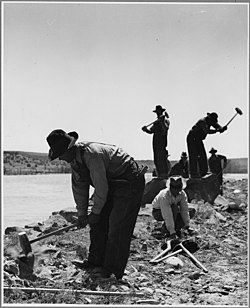
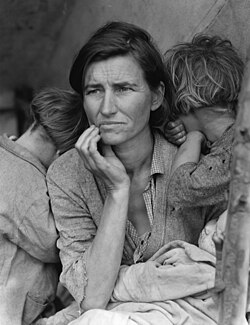
The Depression hit Seattle hard: the city issued 2,538 permits for housing construction in 1930, but only 361 in 1932.
Image source: Great Depression
1934
% complete
During the Maritime Strike of 1934, Smith Cove was nearly a battle zone; shippers were scared to the point where Seattle lost most of its Asian trade to Los Angeles.
Image source: 1934 West Coast waterfront strike
1901
% complete
The progressive school board hired a new superintendent in 1901, Frank B. Cooper, ushering in reforms in Seattle's public schools.
Image source: Frank B. Cooper
1903
% complete
The Seattle Symphony was founded in 1903, becoming one of the city's most important arts institutions.
Image source: Seattle Symphony
1909
% complete
Matthews (1867–1940) of Seattle's First Presbyterian Church addressed Seattle business leaders in 1909. With 10,000 members, his was the largest Presbyterian Church in the country, and he was selected the denomination's national moderator in 1912.
Image source: University Presbyterian Church (Seattle)
1910
% complete
In 1910, Seattle voters approved a referendum to create a development plan for the whole city.
Image source: History of Seattle 1900–1940
1919
% complete
Australian painter Ambrose Patterson arrived in 1919; over the next few decades Mark Tobey, Morris Graves, Kenneth Callahan, Guy Irving Anderson, and Paul Horiuchi established themselves as nationally known artists. Bandleader Vic Meyers kept speakeasies jumping through Prohibition, and by mid-century the Skid Road jazz scene launched careers including Ray Charles and Quincy Jones.
1940 - 1950
% complete
Most African American workers came to Seattle as shipyard employees, and by summer 1942 the National Youth Administration brought the first group of blacks to work for Boeing. Of 18,862 federal employees in Seattle in 1945, 1,019 were black, and between 1940 and 1950 Seattle's black population grew 413 percent, from 3,789 to 15,666.
1962
% complete
Seattle attempted to counter the decline of its downtown and the area immediately to the north by hosting the Century 21 Exposition, the 1962 World's Fair.
Image source: Century 21 Exposition
1971
% complete
A 'Keep the Market' initiative led by architect Victor Steinbrueck passed in 1971, pushing for adaptive reuse of the historic market district, which had fallen into derelict status after the war despite largely being built after the Fire of 1889.
Image source: Pike Place Market
1979
% complete
In 1979, Bill Gates and Paul Allen, founders of Microsoft, moved their small company from New Mexico to the suburbs of their native Seattle. By 1985 sales were over $140 million, by 1990 $1.18 billion, and by 1995 Microsoft was the world's most profitable corporation.
Image source: Microsoft
Nov 30, 1999
% complete
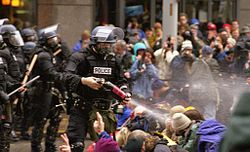
Seattle's bid to host the World Trade Organization Ministerial Conference of 1999 did not play out as planned. Instead, the city became the site of the first great street confrontation between the anti-globalization movement and the WTO on November 30, 1999.
Image source: 1999 Seattle WTO protests
2001
% complete
In 2001 the central city was the site of rioting, mixed with partying and racially motivated violence against European Americans in the Seattle Mardi Gras riot.
Image source: Seattle Mardi Gras riot
May 2015
% complete
Seattle along with other west coast cities experienced politically inspired confrontations and violence during the May Day marches in 2015.
Image source: May Day
2023
% complete
In 2023, Seattle became the first city in the United States to ban discrimination based on caste.
Or browse the full history timeline directory, with more than 2,000 topics.
This History of Seattle timeline was generated with the help of AI, using information found on the internet.
We work hard to keep these timelines accurate, but mistakes do get through. If you spot one, email us at [email protected] and we'll fix it for future visitors.
Generate yours with AI or build it from scratch, for free.
Export your timeline, add your own events, edit or remove AI-generated events, and much more
No credit card required.
Cancel anytime.
Cancel anytime.
You can create an unlimited number of timelines with up to 10 events on each one, customize how they look, export them to PDF, PNG, PowerPoint, CSV, and Excel, and share them with a link. Paid plans raise the event limit and add features like spreadsheet imports and collaborators.
Yes. You can cancel your subscription from your account page at any time, and you will not be charged again. Your subscription stays active for the rest of the period you already paid for.
Yes. We will email you a reminder before the annual renewal, and we will also email you a receipt.
Yes. You can email us within 15 days of any payment, and we will issue you a full refund.
Check out our pricing docs or send us an email anytime: [email protected].