-
Use Cases
-
Resources
-
Pricing
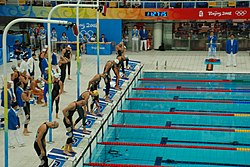
Swimming has been practiced by humans for thousands of years, with evidence dating back to prehistoric times. From its role in ancient civilizations and military training to the establishment of competitive swimming in the 19th century and its inclusion in the modern Olympics, swimming evolved into one of the world's most popular sports and recreational activities. More Less
4000 BC
% complete
The most famous ancient drawings of swimmers were found in the Kebir desert and are estimated to be from around 4000 BC.
Image source: History of swimming
3000 BC
% complete
The Nagoda bas-relief also shows swimmers dating back to 3000 BC, further documenting the antiquity of swimming in human culture.
2800 BC
% complete
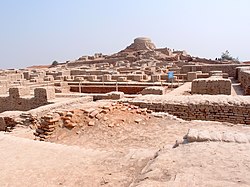
The Indian palace Mohenjo Daro from 2800 BC contains a swimming pool sized 12 m by 7 m, one of the earliest known pools.
Image source: Mohenjo-daro
2000 BC
% complete
An Egyptian tomb from 2000 BC shows a variant of front crawl. Written references to swimming also date back to ancient times, with the earliest as early as 2000 BC.
1538
% complete
In 1538, Nikolaus Wynmann, a Swiss–German professor of languages, wrote the earliest known complete book about swimming, Colymbetes, sive de arte natandi dialogus et festivus et iucundus lectu (The Swimmer, or A Dialogue on the Art of Swimming and Joyful and Pleasant to Read).
1587
% complete
In 1587, Everard Digby also wrote a swimming book, claiming that humans could swim better than fish.
Image source: Everard Digby (scholar)
1595
% complete
In 1595, Christopher Middleton wrote 'A short introduction for to learn to swim', the first published guide recording drawings and examples of different swimming styles.
1600 - 1867
% complete
From 1600 to 1867, during the Edo period in Japan, swimming increased in popularity and saw the development of swim schools.
Image source: Edo period
1603
% complete
In 1603, Emperor Go-Yozei of Japan declared that schoolchildren should swim, promoting swimming education nationwide.
Image source: Emperor Go-Yōzei
1696
% complete
In 1696, the French author Melchisédech Thévenot wrote The Art of Swimming, describing a breaststroke very similar to the modern breaststroke.
1798
% complete
In 1798, GutsMuths wrote Kleines Lehrbuch der Schwimmkunst zum Selbstunterricht (Small study book of the art of swimming for self-study), recommending the use of a 'fishing rod' device to aid in learning to swim.
Image source: Johann Christoph Friedrich GutsMuths
1828
% complete
In 1828, the first indoor swimming pool, St George's Baths, was opened to the public.
Image source: Joe Fortes
1837
% complete
By 1837, the National Swimming Society was holding regular swimming competitions in six artificial swimming pools built around London.
Image source: Swimming (sport)
1844
% complete
In 1844 a swimming competition was held in London with the participation of two Native Americans, who demonstrated faster strokes unfamiliar to British swimmers.
1844 - 1873
% complete
Subsequently, the British continued to swim only breaststroke until 1873, when new strokes began to be introduced.
Image source: Breaststroke
1873
% complete
On his return to England in 1868, John Trudgen successfully debuted the new stroke in 1873 and won a local competition in 1875, popularizing what became known as the trudgen stroke.
1875
% complete
Captain Matthew Webb was the first man to swim the English Channel between England and France in 1875. His feat was not replicated or surpassed for the next 36 years, until Bill Burgess made the crossing in 1911.
Image source: Matthew Webb
1880
% complete
By 1880, when the first national governing body, the Amateur Swimming Association, was formed, there were already over 300 regional clubs in operation across Britain.
Image source: Swim England
1882 - 1896
% complete
Other European countries also established swimming federations: Germany in 1882, France in 1890 and Hungary in 1896.
Image source: World Aquatics
1889
% complete
The first European amateur swimming competitions were held in 1889 in Vienna.
1892
% complete
The world's first women's swimming championship was held in Scotland in 1892.
1901
% complete
Lane in 1901 swam 100 yards (91 m) in 1:00.0, an improvement of about ten seconds compared to the breaststroke record.
Image source: Freestyle swimming
1902
% complete
Richmond used this stroke in 1902 at an International Championships in England to set a new world record by outswimming all Trudgen swimmers over the 100 yards (91 m) in 0:58.4.
Image source: Front crawl
1847
% complete
Nancy Edberg popularized women's swimming in Stockholm from 1847. Her public swimming exhibitions from 1856 with her students were likely among the first public exhibitions of women swimming in Europe.
Image source: Nancy Edberg
1904
% complete
Swimming as a rescue procedure in the United States had its start in the early 1900s after the 1904 General Slocum disaster, when a fire started onboard an excursion boat and more than 1,000 people, most unable to swim, drowned.
Image source: PS General Slocum
1911
% complete
As of 1911, in order for a Boy Scout to earn the title of First Class Scout, they had to swim 50 yards. In 1912, to accommodate those with health problems, the swimming portion was removed from the First Class Scout requirements.
Image source: Scouting in the United States
1914
% complete
Longfellow contacted the American Red Cross in 1914 and helped create their first water safety trainings. By 1922, national aquatic schools were added to the program to train first aid instructors and water safety officials.
Image source: American Red Cross
Jul 16, 1966
% complete
On July 16, 1966, the leader of China, 73-year-old Mao Zedong, swam in the Yangtze River as a way to encourage support for his authority, and encouraged others to practice Maoism.
Image source: Baiji
Jun 1972
% complete
Title IX, signed into law in June 1972 by President Richard Nixon, ensured equal protections against discrimination in sports based upon sex in programs that received federal funding. Despite this, the NCAA did not host its first Women's Swimming Championship until 1982.
Image source: Title IX
1896
% complete
Swimming was part of the first modern Olympic games held in 1896 in Athens; however, due to a lack of funds, the event was moved to a nearby bay of Piraeus.
Image source: Swimming at the 1896 Summer Olympics
1908
% complete
In 1908, the world swimming association, Fédération Internationale de Natation (FINA), was formed to govern international aquatic sports.
1912
% complete
In both America and England, women in the 1910s and 1920s pushed back against restrictions on swimwear. These swimming suffragettes changed public opinion on women's involvement in swimming, including the admission of women in the 1912 Summer Olympics in Stockholm, competing in freestyle races.
Image source: Swimming at the 1912 Summer Olympics
2021
% complete
Prior to the 2020 Tokyo Olympics, the 1,500m freestyle was not a women's event despite being in circulation since the 2001 World Championships. In 2021, the women's 1,500m freestyle and men's 800m freestyle were added, with events including 50–1500m freestyle, 100/200m backstroke, breaststroke, butterfly, individual medleys, and relays including the mixed 4x100m medley.
Image source: Swimming at the 2020 Summer Olympics
Jan 2023
% complete
In January 2023, the name of the world governing body for swimming was changed from FINA to World Aquatics.
Or browse the full history timeline directory, with more than 2,000 topics.
This History of Swimming timeline was generated with the help of AI, using information found on the internet.
We work hard to keep these timelines accurate, but mistakes do get through. If you spot one, email us at [email protected] and we'll fix it for future visitors.
Generate yours with AI or build it from scratch, for free.
Export your timeline, add your own events, edit or remove AI-generated events, and much more
No credit card required.
Cancel anytime.
Cancel anytime.
You can create an unlimited number of timelines with up to 10 events on each one, customize how they look, export them to PDF, PNG, PowerPoint, CSV, and Excel, and share them with a link. Paid plans raise the event limit and add features like spreadsheet imports and collaborators.
Yes. You can cancel your subscription from your account page at any time, and you will not be charged again. Your subscription stays active for the rest of the period you already paid for.
Yes. We will email you a reminder before the annual renewal, and we will also email you a receipt.
Yes. You can email us within 15 days of any payment, and we will issue you a full refund.
Check out our pricing docs or send us an email anytime: [email protected].