-
Use Cases
-
Resources
-
Pricing
The history of tanks traces the development of armored fighting vehicles from their debut in World War I, when the British Mark I first saw combat in 1916, through the rapid innovations of World War II, the Cold War arms race, and today's advanced main battle tanks. Tanks transformed land warfare by combining firepower, armor protection, and mobility on the battlefield. More Less
Dec 1903
% complete
H.G. Wells published the short story 'The Land Ironclads,' which imagined armored, machine-gun-armed land vehicles crossing trenches. The story is often credited with anticipating the concept of the tank and influenced later thinking about armored warfare.
Image source: The Land Ironclads
Feb 1915
% complete
First Lord of the Admiralty Winston Churchill established the Landships Committee to develop armored vehicles capable of crossing trenches and breaking through enemy lines. The committee oversaw early experiments that led directly to the first British tanks.
Image source: Landship Committee
Sep 1915
% complete
Built by William Foster & Co. of Lincoln, England, Little Willie was the first completed prototype tank in history. Although it was never used in combat due to its poor trench-crossing ability, it proved that tracked armored vehicles were feasible.
Image source: Little Willie
Jun 1916
% complete
The Mark I became the world's first combat tank, produced in 'male' (cannon) and 'female' (machine gun) variants. Its rhomboid shape and track frames were designed to cross wide trenches and crush barbed wire on the Western Front.
Image source: British heavy tanks of the First World War
Sep 15, 1916
% complete
The British Army deployed 32 Mark I tanks in combat for the first time during the Battle of the Somme at Flers-Courcelette. Despite mechanical failures and limited numbers, the tanks shocked German troops and demonstrated the potential of armored warfare.
Image source: Battle of Flers–Courcelette
Apr 16, 1917
% complete
France became the second nation to use tanks in combat when it deployed the Schneider CA1 assault tank during the Nivelle Offensive. The vehicle suffered from poor armor and vulnerability to artillery but marked France's entry into armored warfare.
Image source: Schneider CA1
Nov 20, 1917
% complete
The Battle of Cambrai saw the British launch history's first massed tank attack, using over 400 tanks to breach the Hindenburg Line without preliminary bombardment. The initial breakthrough stunned the Germans, though gains were later reversed.
Image source: Battle of Cambrai (1917)
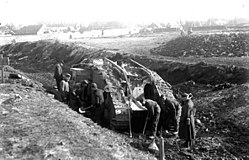
Mar 21, 1918
% complete
Germany deployed the A7V, its first and only domestically produced tank of World War I, during the Spring Offensive. Only about 20 were built; cumbersome and slow, they nonetheless took part in the first tank-versus-tank battle at Villers-Bretonneux in April 1918.
Image source: A7V
May 1918
% complete
The French Renault FT pioneered the modern tank layout: a fully rotating turret on top, engine at the rear, and crew compartment at the front. Light, cheap, and mass-produced in thousands, it is widely regarded as the most influential tank design in history.
Image source: Renault FT
1919
% complete
British officer J.F.C. Fuller drafted 'Plan 1919,' envisioning massive mechanized offensives led by tanks deep into enemy territory. His writings, along with those of B.H. Liddell Hart, profoundly shaped interwar armored doctrine in Britain, Germany, and the Soviet Union.
Image source: J. F. C. Fuller
1929
% complete
The Red Army formalized its 'deep battle' doctrine, calling for simultaneous attacks across the entire depth of enemy defenses using massed tanks, aircraft, and paratroopers. It became one of the most sophisticated theories of mechanized warfare of the era.
Image source: Deep operation
Jul 1934
% complete
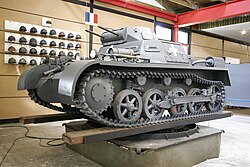
Nazi Germany secretly began producing the Panzer I light tank, violating the Treaty of Versailles. Armed only with machine guns, it served as a training and development platform that enabled Germany to build the panzer divisions that would dominate early World War II.
Image source: Panzer I
May 10, 1940 - Jun 25, 1940
% complete
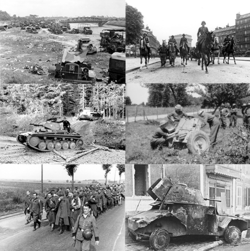
Germany's invasion of France showcased the power of concentrated panzer divisions employing blitzkrieg tactics. Tanks like the Panzer III and IV, coordinated closely with aircraft and motorized infantry, shattered Allied defenses in six weeks and revolutionized military thinking worldwide.
Image source: Battle of France
Sep 1940
% complete
The Soviet Union began mass-producing the T-34, combining sloped armor, a powerful 76mm gun, wide tracks, and excellent mobility. Widely considered the best all-around tank of World War II, it decisively countered German armor on the Eastern Front.
Image source: T-34
Jun 22, 1941
% complete
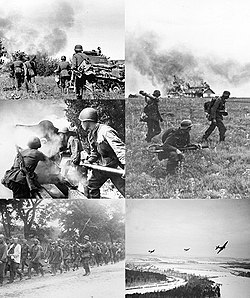
Germany invaded the Soviet Union with over 3,000 tanks in the largest armored offensive in history. While initially successful, the campaign exposed German logistical weaknesses and brought the formidable Soviet T-34 and KV-1 tanks into large-scale combat.
Image source: Operation Barbarossa
1942
% complete
The U.S. M4 Sherman became the most widely produced American tank of World War II, with nearly 50,000 built. Reliable, mechanically sound, and available in huge numbers, it equipped American, British, Soviet, and other Allied forces across every theater.
Image source: M4 Sherman
Sep 1942
% complete
Germany introduced the Tiger I heavy tank near Leningrad, featuring thick armor and the lethal 88mm gun. Though expensive and mechanically unreliable, it dominated Allied tanks in direct engagements and gained a fearsome reputation.
Image source: Tiger I
Jul 1943
% complete
Germany deployed the Panther medium tank at Kursk, designed as a response to the Soviet T-34. Combining sloped armor, a high-velocity 75mm gun, and good mobility, many historians consider it one of the best tanks of World War II despite reliability issues.
Image source: Panther tank
Jul 12, 1943
% complete
The Battle of Kursk featured the largest armored clash ever fought, including the massive engagement at Prokhorovka involving hundreds of tanks. The Soviet victory ended German offensive capability on the Eastern Front and cemented Soviet armored superiority.
Image source: Battle of Kursk
Apr 1944
% complete
Named after Joseph Stalin, the IS-2 heavy tank mounted a devastating 122mm gun and heavy armor. It spearheaded Soviet assaults into Germany and proved highly effective against German fortifications and heavy tanks during the final campaigns of the war.
Image source: IS-2
May 1945
% complete
Britain's Centurion arrived too late for combat in Europe but became one of the most successful tank designs ever. Continuously upgraded over decades, it served in Korea, the Middle East, Vietnam, and India-Pakistan wars, bridging wartime and modern tank design.
Image source: Centurion (tank)
1947
% complete
The Soviet T-54 and its improved variant the T-55 became the most-produced tanks in history, with roughly 100,000 built. Simple, rugged, and cheap, they equipped dozens of nations and became the archetypal Cold War main battle tank.
Image source: T-54/T-55 operators and variants
1950 - 1953
% complete
British Centurion tanks of the 8th King's Royal Irish Hussars fought effectively alongside American forces in the Korean War, demonstrating the superiority of Western main battle tank designs over North Korean and Chinese armor in harsh conditions.
1960
% complete
The United States adopted the M60 Patton as its primary main battle tank, armed with a 105mm gun. It served through the Cold War, saw extensive use by Israel in the Yom Kippur War, and remained in some militaries' inventories well into the 21st century.
Image source: M60 tank
Jun 5, 1967 - Jun 10, 1967
% complete
Israeli armored formations executed rapid, decisive thrusts against Egyptian, Jordanian, and Syrian forces, showcasing how combined arms maneuver could achieve swift victory. The war made Israel a leading innovator in tank tactics and later indigenous tank design.
Image source: Six-Day War
Oct 6, 1973 - Oct 25, 1973
% complete
Egyptian forces armed with Soviet Sagger anti-tank guided missiles and RPGs inflicted heavy losses on Israeli armor, demonstrating that infantry-carried missiles could threaten tanks. The war spurred major advances in tank armor, including reactive armor development.
Image source: Yom Kippur War
1979
% complete
West Germany fielded the Leopard 2, widely regarded as one of the finest main battle tanks in the world. With a 120mm smoothbore gun, advanced fire control, and composite armor, it set the standard followed by NATO allies and has been exported widely.
Image source: Leopard 2
1980
% complete
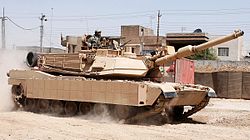
The United States introduced the M1 Abrams, powered by a gas turbine engine and protected by Chobham composite armor. Later armed with a 120mm gun, it proved dominant in the Gulf War and remains the backbone of American armored forces today.
Image source: M1 Abrams
Jan 17, 1991 - Feb 28, 1991
% complete
During Operation Desert Storm, M1 Abrams and Challenger 1 tanks devastated Iraqi armor in battles like 73 Easting and Medina Ridge, destroying hundreds of Soviet-designed tanks with minimal losses. Thermal sights and superior ammunition gave coalition forces a decisive edge.
Image source: Gulf War
1993
% complete
Russia introduced the T-90, incorporating a 125mm gun, advanced explosive reactive armor, and active protection systems. It became Russia's primary export tank and saw combat in Syria and Ukraine, representing the evolution of Soviet-era designs into the modern era.
Image source: T-90
Mar 20, 2003
% complete
American M1 Abrams tanks led the charge to Baghdad, engaging Iraqi armor and providing crucial urban firepower support. The campaign demonstrated the continued relevance of tanks in modern asymmetric conflicts, where they served as mobile protected firepower platforms.
Image source: Iraq War
May 9, 2015
% complete
Russia revealed the T-14 Armata during Victory Day parades, featuring an unmanned turret, crew capsule with enhanced protection, and extensive automation. Hailed as potentially the first fourth-generation tank, its production has been limited by cost and technical challenges.
Image source: T-14 Armata
Feb 24, 2022
% complete
The full-scale Russian invasion of Ukraine saw some of the largest tank battles since World War II. Drones, precision munitions, and Western-supplied weapons like the Javelin inflicted heavy losses on armor, prompting intense debate about the future role of tanks in modern warfare.
Image source: Russo-Ukrainian War
Or browse the full history timeline directory, with more than 2,000 topics.
This History of Tanks timeline was generated with the help of AI, using information found on the internet.
We work hard to keep these timelines accurate, but mistakes do get through. If you spot one, email us at [email protected] and we'll fix it for future visitors.
Generate yours with AI or build it from scratch, for free.
Export your timeline, add your own events, edit or remove AI-generated events, and much more
No credit card required.
Cancel anytime.
Cancel anytime.
You can create an unlimited number of timelines with up to 10 events on each one, customize how they look, export them to PDF, PNG, PowerPoint, CSV, and Excel, and share them with a link. Paid plans raise the event limit and add features like spreadsheet imports and collaborators.
Yes. You can cancel your subscription from your account page at any time, and you will not be charged again. Your subscription stays active for the rest of the period you already paid for.
Yes. We will email you a reminder before the annual renewal, and we will also email you a receipt.
Yes. You can email us within 15 days of any payment, and we will issue you a full refund.
Check out our pricing docs or send us an email anytime: [email protected].