-
Resources
-
Pricing
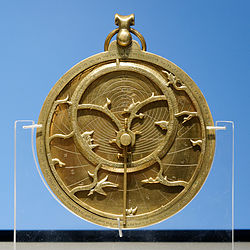
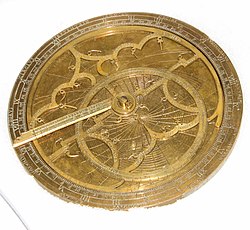
The astrolabe is an ancient astronomical instrument used to model the sky, measure altitude, tell time, and support navigation. Developed from Greek mathematical astronomy and significantly refined by scholars in the Islamic world, it remained influential in Europe and beyond for centuries. More Less
Build a timeline like this one in minutes, for free. Start Yours →
Part of our collection of invention and technology timelines.
650 - 670
During the mid-seventh century, the Mesopotamian bishop Severus Sebokht wrote a treatise on the astrolabe in the Syriac language, helping transmit and develop knowledge of the instrument in the Christian communities of the Middle East.
650 - 670
The mid-seventh-century Syriac treatise by Severus Sebokht is a distinct record of astrolabe knowledge written outside the Greek and Arabic traditions and associated with a Mesopotamian bishop.
750
The eighth-century mathematician Muhammad al-Fazari is credited as the first person to build an astrolabe in the Islamic world, marking an important stage in the instrument's adoption by Islamic astronomers.
800 - 899
A shadow square appears on the backs of some astrolabes during the ninth century. Muslim astrologists developed this feature, whereas devices in the Ancient Greek tradition featured only altitude scales on their backs.
Image source: Astrolabe
900 - 999
A tenth-century scientist named al-Qummi mentioned an etymology for the word astrolabe. The proposed etymology was later rejected by al-Khwarizmi.
900 - 999
The tenth-century astronomer ʿAbd al-Raḥmān al-Ṣūfī wrote a text of 386 chapters on the astrolabe. The work reportedly described more than 1,000 applications for the instrument's various functions.
1235
Abi Bakr of Isfahan invented the geared mechanical astrolabe in 1235, adding mechanical gearing to the long tradition of astronomical instruments.
1328
Ibn al-Sarraj of Aleppo, also known as Ahmad bin Abi Bakr and active around 1328, designed a universal astrolabe. Historian David A. King described it as the most sophisticated astronomical instrument of the entire Medieval and Renaissance periods.
990 - 999
The astrolabe was almost certainly first brought north of the Pyrenees by Gerbert of Aurillac, the future Pope Sylvester II. Before the turn of the eleventh century, it was integrated into the quadrivium at the school in Reims, France.
Image source: Pope Sylvester II
1000 - 1099
The Destombes astrolabe, made from brass in Portugal during the eleventh century, is identified as the first known metal astrolabe in Western Europe.
1000 - 1099
During the eleventh century, Herman Contractus of Reichenau Abbey examined the use of the astrolabe in his work Mensura Astrolai.
1000 - 1099
The brass Destombes astrolabe from eleventh-century Portugal marks a significant stage in Western European metal instrument making and is the earliest known metal astrolabe in that region.
1250 - 1299
In the last half of the thirteenth century, Peter of Maricourt wrote Nova compositio astrolabii particularis, a treatise on the construction and use of a universal astrolabe.
1330
Richard of Wallingford's clock, dating to around 1330, consisted essentially of a star map rotating behind a fixed rete, a configuration similar to that of an astrolabe.
Image source: Richard of Wallingford
1391 - 1399
The English author Geoffrey Chaucer compiled A Treatise on the Astrolabe for his son during the late fourteenth century. The work was mainly based on a text by Messahalla or Ibn al-Saffar.
Image source: A Treatise on the Astrolabe
1394 - 1460
The use of the balesilha was promoted by Prince Henry of Portugal, who lived from 1394 to 1460, in connection with navigation for Portugal.
1400 - 1436
In the fifteenth century, French instrument maker Jean Fusoris began remaking and selling astrolabes in his Paris shop, alongside portable sundials and other popular scientific devices.
1420
An astrolabe designed by Antonius de Pacento and made by Dominicus de Lanzano was dated 1420. It represents a notable example of early fifteenth-century European craftsmanship.
1500 - 1599
Four identical sixteenth-century astrolabes made by Georg Hartmann provide some of the earliest evidence of batch production through division of labor.
Image source: Georg Hartmann
1500 - 1599
The survival of four identical astrolabes made by Georg Hartmann offers early evidence that astrolabe manufacture could be organized through repeated production and division of labor rather than solely as one-off craftsmanship.
1513
In the sixteenth century, Johannes Stöffler published Elucidatio fabricae ususque astrolabii, a manual explaining the construction and use of the astrolabe.
Image source: Johannes Stöffler
1370
In 1370, Jain astronomer Mahendra Suri wrote Yantrarāja, identified as the first Indian treatise on the astrolabe. Suri composed the manual in 1370 CE.
1370
Mahendra Sūri composed his manual on the astrolabe in 1370 CE, establishing an important Sanskrit-language contribution to the instrument's scholarly history in India.
1370 - 1382
The publication of Yantrarāja in 1370 and Malayendu Sūri's commentary in 1382 established the early documented sequence of Indian astrolabe scholarship.
1370 - 1900
Over the centuries after the publication of Mahendra Sūri's Yantrarāja in 1370, several other Sanskrit manuals on the astrolabe were composed.
1382
Mahendra Sūri's student Malayendu Sūri composed a commentary on Yantrarāja in 1382, extending the Indian scholarly tradition surrounding the astrolabe.
1540
Gopirāja wrote one of the known commentaries on Yantrarāja in 1540, continuing interpretation of Mahendra Sūri's astrolabe manual.
1842
Yajñeśvara wrote another known commentary on Yantrarāja in 1842, demonstrating the long afterlife of the Indian astrolabe text.
1612
Greek painter Ieremias Palladas incorporated a sophisticated astrolabe into his 1612 painting depicting Catherine of Alexandria.
Image source: Ieremias Palladas
1985
In 1985, Swiss watchmaker Ludwig Oechslin designed and built an astrolabe wristwatch in conjunction with Ulysse Nardin, adapting the instrument's astronomical display to a modern timepiece.
Image source: Ludwig Oechslin
Build a timeline like this one in minutes, for free. Start Yours →
Or browse the full history timeline directory, with more than 2,500 topics.
This History of the Astrolabe timeline was generated with the help of AI, using information found on the internet.
We work hard to keep these timelines accurate, but mistakes do get through. If you spot one, email us at [email protected] and we'll fix it for future visitors.
Generate yours with AI or build it from scratch, for free.
Export your timeline, add your own events, edit or remove AI-generated events, and much more
No credit card required.
15-day money-back guarantee.
You can create an unlimited number of timelines with up to 10 events on each one, customize how they look, export them to PDF, PNG, PowerPoint, CSV, and Excel, and share them with a link. Timelines made with Timeline Maker AI keep every event the generator created, and you can add up to 5 events of your own. Paid plans remove the event limit, add spreadsheet imports and hide Preceden's branding, and the higher-priced plan also adds collaborators, a custom logo and a custom domain.
Yes. You can cancel your subscription from your account page at any time, and you will not be charged again. Your subscription stays active for the rest of the period you already paid for.
Yes. We email you a reminder 15 days before your annual renewal, and we email you a receipt after every payment.
Yes. You can email us within 15 days of any payment, and we will issue you a full refund.
Check out our pricing docs or send us an email anytime: [email protected].