-
Use Cases
-
Resources
-
Pricing
7000 BCE
Neolithic builders at sites such as Çatalhöyük used lime-based plasters and mortars made by heating limestone and mixing the resulting lime with water and mineral fillers. These materials established the basic chemical principle behind later cementitious construction.
7000 BCE
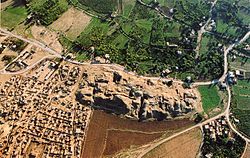
Early inhabitants of Jericho used lime plaster for floors and surfaces. The work demonstrates that controlled burning of limestone and rehydration of lime were practiced thousands of years before hydraulic cement was developed.
Image source: Tell es-Sultan
3000 BCE
Ancient Egyptian builders used gypsum and lime mortars in monumental construction, including pyramids, temples, and tombs. These binders helped level masonry and fill joints even though they generally did not harden underwater.
Image source: Ancient Egyptian architecture
2600 BCE
Builders in the Indus Valley used lime-based mortars and waterproofing materials in wells, baths, drains, and reservoirs. Their carefully engineered water infrastructure illustrates the early importance of cementitious materials in urban construction.
Image source: Indus Valley Civilisation
2000 BCE
Minoan builders on Crete employed lime mortars and layered waterproof floor systems in palaces and baths. Their techniques combined mineral binders with aggregate and surface treatments to resist persistent moisture.
Image source: Minoan civilization
500 BCE
Greek builders used lime mortars mixed with crushed pottery, brick, and volcanic materials. These pozzolanic additions improved strength and water resistance and anticipated the more sophisticated hydraulic concretes developed by Roman engineers.
Image source: Ancient Greek architecture

1000 - 1500
Medieval builders increasingly used naturally hydraulic limestones and pozzolanic additives for foundations, bridges, ports, and damp masonry. These materials could set in moist conditions and formed an important bridge between Roman practice and modern cement.
300 BCE
Roman builders developed opus caementicium, a composite of lime mortar, aggregate, and volcanic pozzolana. The material could harden in damp environments and enabled construction on a scale and with forms that traditional cut-stone masonry could not easily achieve.
Image source: Roman concrete
22 BCE - 10 BCE
Herod the Great's harbor at Caesarea Maritima used large quantities of Roman hydraulic concrete. Underwater placement of pozzolanic concrete allowed engineers to create breakwaters, quays, and foundations in the Mediterranean Sea.
Image source: Caesarea Maritima
100 - 300
Across the Roman Mediterranean, engineers used hydraulic concrete for piers, fish tanks, baths, bridges, and harbor works. Seawater exposure often strengthened the material through continuing mineral reactions within the concrete.
118 - 128
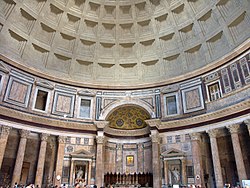
The reconstructed Pantheon demonstrated the structural possibilities of Roman concrete. Its enormous unreinforced dome used progressively lighter aggregates toward the oculus, reducing weight while producing one of antiquity's most enduring architectural spaces.
Image source: Pantheon, Rome
206 - 216
The Baths of Caracalla employed concrete vaults, domes, and walls on a monumental scale. Their construction illustrates how Roman concrete supported complex public buildings with large covered interiors and extensive hydraulic systems.
Image source: Baths of Caracalla
476 - 1000
After the western Roman Empire fragmented, the large-scale production and systematic use of Roman pozzolanic concrete declined in much of Europe. Builders continued to use lime mortar, but the specialized infrastructure and knowledge supporting imperial concrete construction became less common.
532 - 537
The Byzantine builders of Hagia Sophia continued Roman concrete traditions in a vast domed structure. Lightweight masonry, mortar, and concrete-like construction helped carry the central dome and its surrounding vaults.
Image source: Hagia Sophia
1756
While rebuilding the Eddystone Lighthouse, John Smeaton tested limestones and discovered that clay-bearing limestone produced a lime capable of setting underwater. His experiments helped establish the relationship between raw-material composition and hydraulic performance.
Image source: John Smeaton
1796
James Parker patented a quick-setting hydraulic cement made by calcining naturally occurring nodules known as septaria. Sold as Roman cement, it became an important commercial binder in Britain and Europe before Portland cement dominated the market.
1811
Edgar Dobbs and William Frost developed and patented improved hydraulic cements in Britain. Their work reflected growing efforts to manufacture a consistent artificial binder rather than rely only on naturally occurring cement stones.
1824
Joseph Aspdin patented Portland cement, naming it for its resemblance to Portland stone. The product was initially made on a modest scale, but the patent established the name and concept that would become central to modern concrete.
Image source: Portland cement
1825 - 1843
The Thames Tunnel used hydraulic cement and masonry to construct a passage beneath the river. Its demanding underwater conditions demonstrated the value of water-resistant binders in major civil engineering works.
Image source: Thames Tunnel
1825
William Aspdin established an early Portland cement works at Northfleet in Kent. His manufacturing experiments moved the material toward higher-temperature burning and stronger, more reliable clinker-based cement.
1840 - 1850
William Aspdin improved Portland cement manufacture by producing harder, more thoroughly burned clinker. Although early production remained variable, these developments helped lead toward the cement chemistry and industrial processes used today.
1848
Joseph-Louis Lambot created a small boat made from cement mortar reinforced with an iron mesh. His experiment is widely regarded as an early example of reinforced concrete and showed how metal could compensate for concrete's weakness in tension.
Image source: Joseph Monier
1853
François Coignet used iron-reinforced concrete in walls, floors, and structural demonstrations in France. He publicized the material as an economical and fire-resistant alternative to conventional construction.
1867
Joseph Monier patented systems combining iron reinforcement with concrete, initially for horticultural containers and later for beams, pipes, and bridges. His patents helped spread the commercial idea of reinforced concrete across Europe.
1892
François Hennebique patented a practical reinforced-concrete system in which steel bars were arranged to resist tension and tied into beams, columns, and slabs. The integrated frame accelerated the adoption of reinforced concrete in buildings and bridges.
1902 - 1903
The Ingalls Building in Cincinnati became the first reinforced-concrete skyscraper. Designed by architect Elzner & Anderson and engineer G. E. L. W. Ransome, it demonstrated that reinforced concrete could support a tall urban office structure.
1918
Duff Abrams published experimental research showing a strong relationship between water–cement ratio and concrete strength. His law became a foundation of mix design because excess water generally increases workability while reducing hardened strength and durability.
1928
Eugène Freyssinet patented a practical prestressed-concrete system. By tensioning steel tendons before or after concrete hardened, prestressing reduced cracking and enabled longer spans, thinner members, and more efficient bridges.
1930
Commercial ready-mix concrete plants expanded during the early twentieth century, with a notable early facility operating in Baltimore in 1930. Centralized batching improved consistency and allowed concrete to be delivered to increasingly large construction sites.
1935
Hoover Dam required more than three million cubic meters of concrete and pioneered large-scale cooling methods to control heat from cement hydration. Its construction demonstrated the logistical and thermal challenges of massive concrete structures.
Image source: Hoover Dam
1940 - 1970
Postwar engineering organizations formalized testing, mix proportions, reinforcement practices, and structural design codes. Standardization made concrete performance more predictable and supported its rapid use in housing, infrastructure, dams, and industrial construction.
Image source: Concrete
1950 - 1970
Architects and engineers such as Félix Candela, Pier Luigi Nervi, and Eduardo Torroja used reinforced concrete shells, folded plates, and experimental forms to cover large spaces with relatively little material. Their work highlighted concrete's ability to create both structural and expressive geometries.
1970 - 1990
Advances in chemical admixtures, silica fume, fly ash, slag, and aggregate control produced high-performance concretes with much greater strength, lower permeability, and improved durability. These materials enabled taller buildings, longer bridges, and more demanding infrastructure.
1988
Researchers in Japan developed self-compacting concrete, which flows around reinforcement and fills formwork without mechanical vibration. Its use improved surface quality, reduced construction noise, and made dense or complex reinforcement easier to place.
1990
Ultra-high-performance concrete combined very low water–binder ratios, optimized fine particles, fibers, and high-range water reducers. The resulting material offered exceptional compressive strength, toughness, and durability for bridges, façades, and specialized structures.
2004 - 2010
The Burj Khalifa used high-strength reinforced concrete in its lower superstructure, including a buttressed-core system designed for extreme height and wind demands. The project demonstrated the role of advanced concrete technology in supertall construction.
Image source: Burj Khalifa
2014 - 2020
Construction researchers and companies developed robotic extrusion systems capable of printing cementitious walls and structural components layer by layer. The technology aimed to reduce formwork, labor, waste, and construction time while enabling customized geometries.
2015 - 2020
Growing concern over cement-related carbon dioxide emissions drove research into calcined clays, limestone blends, supplementary cementitious materials, alternative binders, carbon curing, and carbon capture. These approaches sought to reduce the climate impact of concrete while preserving performance.
Or browse the full history timeline directory, with more than 2,500 topics.
This History of Concrete timeline was generated with the help of AI, using information found on the internet.
We work hard to keep these timelines accurate, but mistakes do get through. If you spot one, email us at [email protected] and we'll fix it for future visitors.
Generate yours with AI or build it from scratch, for free.
Export your timeline, add your own events, edit or remove AI-generated events, and much more
No credit card required.
Cancel anytime.
Cancel anytime.
You can create an unlimited number of timelines with up to 10 events on each one, customize how they look, export them to PDF, PNG, PowerPoint, CSV, and Excel, and share them with a link. Paid plans raise the event limit and add features like spreadsheet imports and collaborators.
Yes. You can cancel your subscription from your account page at any time, and you will not be charged again. Your subscription stays active for the rest of the period you already paid for.
Yes. We will email you a reminder before the annual renewal, and we will also email you a receipt.
Yes. You can email us within 15 days of any payment, and we will issue you a full refund.
Check out our pricing docs or send us an email anytime: [email protected].