-
Use Cases
-
Resources
-
Pricing
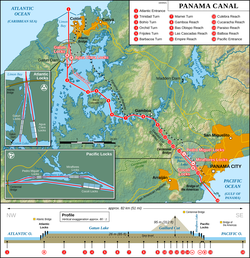
The Panama Canal is a 50-mile artificial waterway connecting the Atlantic and Pacific Oceans across the Isthmus of Panama. First attempted by France in the 1880s, the project was completed by the United States and opened in 1914, revolutionizing global maritime trade. The canal remained under U.S. control until it was transferred to Panama on December 31, 1999, and its capacity was expanded with new locks completed in 2016. More Less
Sep 25, 1513
% complete
Spanish explorer Vasco Núñez de Balboa became the first European to see the Pacific Ocean after crossing the Isthmus of Panama, demonstrating the narrowness of the land bridge and inspiring centuries of dreams about a canal connecting the Atlantic and Pacific.
Image source: Vasco Núñez de Balboa
1534
% complete
Holy Roman Emperor Charles V ordered a survey of the Isthmus of Panama to determine the feasibility of a canal that would allow Spanish ships to avoid the long voyage around South America, marking the first serious study of an interoceanic canal.
Image source: Panama Canal
Jan 28, 1855
% complete
The Panama Railway, the world's first transcontinental railroad, was completed across the Isthmus of Panama. It proved invaluable during the California Gold Rush and later provided crucial infrastructure and experience for canal builders.
Image source: Panama Canal Railway
1879
% complete
Ferdinand de Lesseps, fresh from his triumph building the Suez Canal, formed the Compagnie Universelle du Canal Interocéanique to build a sea-level canal across Panama, buoyed by international congress support in Paris.
Image source: History of the Panama Canal
Feb 1, 1881
% complete
The French began excavation for a sea-level canal through the rugged Panamanian terrain. The project was plagued by tropical diseases, landslides, engineering miscalculations, and enormous financial costs.
Image source: Attempts to build a canal across Nicaragua
1882 - 1889
% complete
Mosquito-borne diseases killed more than 20,000 workers during the French effort, as the link between mosquitoes and disease transmission was not yet understood, making the jungle camps deadly.
Dec 15, 1888
% complete
The Panama Canal Company went bankrupt after spending over $280 million and losing roughly 20,000 lives. The ensuing financial scandal, known as the Panama scandals, rocked French politics and implicated numerous officials.
Image source: Panama scandals
1902
% complete
Following the Spooner Act authorizing the purchase, the United States agreed to buy the French company's assets and equipment in Panama for $40 million, setting the stage for American canal construction.
Image source: Hay–Herrán Treaty
Nov 18, 1903
% complete
Signed shortly after Panama's independence from Colombia, the treaty granted the United States perpetual control of a ten-mile-wide Canal Zone in exchange for payments to Panama, becoming a lasting source of tension between the two nations.
Image source: Hay–Bunau-Varilla Treaty
1904 - 1914
% complete
Colonel William C. Gorgas led massive sanitation campaigns, draining swamps, fumigating homes, and screening windows, which dramatically reduced yellow fever and malaria deaths among canal workers.
Image source: William C. Gorgas
Jul 26, 1905 - Apr 1, 1907
% complete
Stevens transformed the project by prioritizing sanitation, housing, and rail logistics. His decision to build a lock canal rather than a sea-level canal proved decisive for the project's success.
Image source: John Frank Stevens
Apr 1, 1907
% complete
Army engineer George Washington Goethals assumed overall charge of the canal effort, overseeing the massive excavation of Gaillard Cut, dam construction, and lock building until completion in 1914.
Image source: George Washington Goethals
1913
% complete
The Gatun Dam, then the largest earth dam in the world, impounded the Chagres River to create Gatun Lake, at the time one of the largest artificial lakes on Earth and the heart of the canal's lock system.
Image source: Gatun Dam
May 20, 1913
% complete
After years of battling landslides, workers finished excavating the Culebra Cut (later Gaillard Cut), the nine-mile mountain passage that was the most difficult section of the entire canal route.
Image source: Culebra Cut
Aug 3, 1914
% complete
The cargo ship SS Cristobal made the first complete ocean-to-ocean transit of the Panama Canal, testing the locks and channels just weeks before the official opening.
Image source: SS Panama (1939)
Aug 15, 1914
% complete
The Panama Canal opened with the transit of the SS Ancon, revolutionizing global shipping by cutting the voyage between New York and San Francisco from around 13,000 miles to under 5,500 miles.
1935
% complete
The Madden Dam (now Alajuela Dam) was built upstream on the Chagres River to control flooding and store additional water for the canal's operation, addressing seasonal water level fluctuations.
Image source: Madden Dam
Sep 1942 - Feb 1943
% complete
Major landslides in Gaillard Cut forced the closure of the canal for several months, highlighting the ongoing geological challenges of maintaining the waterway during its critical wartime role.
Jan 9, 1964
% complete
Anti-American riots broke out when Panamanian students attempted to raise their flag in the Canal Zone, leaving over 20 dead and galvanizing international pressure for renegotiation of canal treaties.
Sep 7, 1977
% complete
Panamanian leader Omar Torrijos and US President Jimmy Carter signed treaties guaranteeing Panama's eventual full control of the canal and ending the perpetual US occupation of the Canal Zone.
Image source: Torrijos–Carter Treaties
Oct 1, 1979
% complete
Under the new treaties, the Panama Canal Zone ceased to exist as a US territory, with joint administration beginning and a gradual transfer of operations to Panamanian authorities underway.
Image source: Panama Canal Zone
Dec 20, 1989 - Jan 31, 1990
% complete
The United States invaded Panama to depose dictator Manuel Noriega, who had threatened the neutrality of the canal. The invasion occurred while the transfer process under the Torrijos–Carter Treaties continued.
Image source: United States invasion of Panama
Dec 31, 1999
% complete
The United States transferred full control of the Panama Canal to Panama, fulfilling the terms of the Torrijos–Carter Treaties. The newly created Panama Canal Authority took over operations.
Image source: Panama Canal Authority
Oct 22, 2006
% complete
Panamanians voted overwhelmingly in favor of a $5.25 billion expansion project to add a third set of larger locks capable of accommodating post-Panamax vessels.
Image source: Panama Canal expansion project
Sep 2007
% complete
Work commenced on the expansion program, including new Pacific and Atlantic lock complexes, widened and deepened navigation channels, and dredging of Gatun Lake and Gaillard Cut.
2014
% complete
As the neared completion, the canal prepared to receive New Panamax ships up to 366 meters long and 49 meters wide, vastly increasing the size of vessels it could handle.
Image source: Panamax
Jun 26, 2016
% complete
The expanded Panama Canal officially opened with the Chinese container ship Cosco Shipping Panama making the inaugural transit through the new Agua Clara and Cocoli locks.
Oct 30, 2019
% complete
The Hong Kong-registered container ship Ever Fortune became the one millionth vessel to pass through the Panama Canal since its opening in 1914, a milestone in the waterway's century of service.
Jul 2023 - 2024
% complete
Severe drought linked to El Niño lowered Gatun Lake levels, forcing the Panama Canal Authority to cut daily transits and impose draft restrictions, disrupting global shipping and raising tolls.
Image source: Panama Canal
Or browse the full history timeline directory, with more than 2,000 topics.
This Panama Canal timeline was generated with the help of AI, using information found on the internet.
We work hard to keep these timelines accurate, but mistakes do get through. If you spot one, email us at [email protected] and we'll fix it for future visitors.
Generate yours with AI or build it from scratch, for free.
Export your timeline, add your own events, edit or remove AI-generated events, and much more
No credit card required.
Cancel anytime.
Cancel anytime.
You can create an unlimited number of timelines with up to 10 events on each one, customize how they look, export them to PDF, PNG, PowerPoint, CSV, and Excel, and share them with a link. Paid plans raise the event limit and add features like spreadsheet imports and collaborators.
Yes. You can cancel your subscription from your account page at any time, and you will not be charged again. Your subscription stays active for the rest of the period you already paid for.
Yes. We will email you a reminder before the annual renewal, and we will also email you a receipt.
Yes. You can email us within 15 days of any payment, and we will issue you a full refund.
Check out our pricing docs or send us an email anytime: [email protected].