-
Resources
-
Pricing
The history of the sextant traces the development of a precise optical instrument used to measure angles between celestial objects and the horizon, transforming maritime navigation and scientific observation. More Less
Build a timeline like this one in minutes, for free. Start Yours →
Part of our collection of invention and technology timelines.
1500
European mariners used the cross-staff to measure the altitude of the Sun or a star above the horizon. Its requirement that observers look toward the Sun and its dependence on the observer's eye position encouraged the development of safer and more precise reflective instruments.
Image source: Backstaff
1594
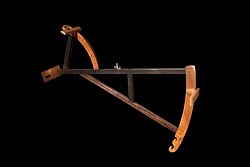
John Davis described the backstaff in his 1594 work Seaman's Secrets. By allowing navigators to face away from the Sun while measuring its altitude, the instrument improved comfort and practicality, although it was still limited by the accuracy of direct angular scales.
1699
Isaac Newton designed a reflecting quadrant around 1699. His concept used mirrors to bring the image of a celestial body down to the horizon, anticipating the central principle of later octants and sextants, but the design was not promptly published or widely adopted.
Image source: Isaac Newton
1731
Philadelphia glazier Thomas Godfrey independently developed a reflecting quadrant at roughly the same time as John Hadley. The parallel invention demonstrates that the practical advantages of optical reflection were becoming apparent in both European and American instrument-making communities.
May 13, 1731
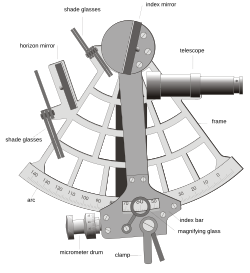
John Hadley presented a reflecting quadrant, later known as the octant, to the Royal Society. Its index mirror and horizon mirror allowed a navigator to superimpose a celestial body on the horizon while reading an angle far larger than the instrument's physical arc.
1734
The Royal Society awarded Hadley the Copley Medal for his reflecting quadrant. Recognition helped promote the octant as a major improvement over the cross-staff, backstaff, and other earlier altitude instruments.
1742
Newton's reflecting-quadrant design was published after his death in the Royal Society's records. The account helped establish that reflection could make precise altitude measurement more compact and convenient than large nonreflecting instruments.
Image source: Reflecting instrument
1757
Instrument makers expanded the octant's practical angular range by enlarging its arc to one-sixth of a circle and strengthening its frame. This new form became known as the sextant because its 60-degree arc could measure angles up to 120 degrees through double reflection.
Image source: Sextant
1757
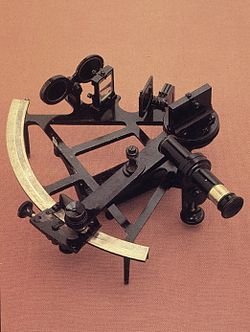
John Bird is credited with making one of the earliest known sextants in 1757. The instrument's larger arc improved the ability to measure lunar distances and angles between celestial bodies, though early examples remained expensive and relatively specialized.
1730 - 1769
During the middle decades of the eighteenth century, octants became increasingly common aboard European ships. Their mirrors, compact size, and roughly doubled angular range made celestial observations faster and more practical at sea.
1730 - 1779
The improved precision of reflecting instruments made lunar-distance observations more feasible. Navigators could measure the angle between the Moon and a star and use predicted lunar motion to determine Greenwich time and longitude.
1760 - 1899
Sextants became central to the lunar-distance technique. A navigator measured the Moon's angular separation from a selected star or planet, corrected the observation for refraction and parallax, and compared it with astronomical tables to obtain longitude.
1761
John Harrison's successful sea trials of H4 showed that a portable timekeeper could preserve Greenwich time at sea. Chronometers eventually complemented sextant observations, replacing the lunar-distance method for many navigators while retaining the sextant as the instrument for measuring altitude.
Image source: Marine chronometer
1765 - 1811
As Astronomer Royal, Nevil Maskelyne promoted lunar distances, improved navigational tables, and supervised the Nautical Almanac. His work helped establish the sextant as part of a systematic method for determining longitude at sea.
Image source: Nevil Maskelyne
1767
The first Nautical Almanac was published for 1767 under the supervision of Nevil Maskelyne. Its predicted lunar distances and other astronomical data made sextant-based navigation more accessible and standardized for mariners.
Image source: Nautical almanac
1768 - 1779
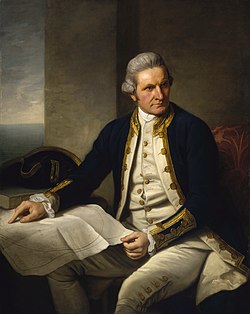
James Cook and his navigators used octants, sextants, lunar distances, and marine timekeepers during voyages in the Pacific. Their observations contributed to more accurate charts and demonstrated the value of reflective instruments in long-distance exploration.
Image source: James Cook
1800 - 1859
As marine chronometers became more available and affordable, navigators increasingly determined longitude by comparing chronometer time with local time obtained from a sextant altitude. Sextants remained essential, but lunar-distance observations became less common.
1802
Nathaniel Bowditch published The New American Practical Navigator, a major practical guide to celestial navigation. Its tables and instructions helped American mariners use sextants, chronometers, and navigational calculations more consistently.
1810 - 1999
Sextant work became a regular part of Royal Navy navigation instruction and examination. Naval training established procedures for taking sights, applying corrections, keeping chronometer time, and plotting a position from lines of position.
Image source: Royal Navy
1837
Thomas Hubbard Sumner demonstrated that a single sextant observation, combined with an assumed position and accurate time, could produce a line on which the vessel lay. The method made celestial navigation more practical when a complete fix was not immediately available.
1870 - 1999
Nautical almanacs increasingly provided standardized data and methods for reducing sextant observations. Tables shortened the arithmetic needed to account for refraction, semidiameter, parallax, and the geometry of the observer's assumed position.
1875
The intercept method, associated with Marcq Saint-Hilaire, simplified plotting a celestial line of position by comparing an observed altitude with a calculated altitude. It became a standard way to turn sextant sights into navigational fixes.
1750
John Bird constructed a major mural quadrant for the Royal Observatory, Greenwich. Although not a hand-held sextant, the project demonstrated the period's growing emphasis on precision angular measurement and helped refine techniques later applied to marine instruments.
Image source: John Bird (astronomer)
1750 - 1759
English instrument maker John Bird advanced precision engraving and graduation of astronomical scales. His methods enabled makers to produce more accurate octants and later sextants, reducing errors caused by poorly divided arcs.
1770 - 1899
London instrument makers, including Ramsden, Troughton, and later Cary, expanded production of high-quality sextants. Improved brass frames, silvered scales, optical filters, and vernier mechanisms made the instruments more reliable for professional navigation.
1770 - 1899
Jesse Ramsden developed dividing engines capable of accurately graduating astronomical and navigational scales. More precise graduations reduced instrumental error and helped make sextants dependable scientific and maritime tools.
1777
Ramsden produced improved sextant designs using refined optical and mechanical construction. His instruments exemplified the transition from individually crafted reflecting quadrants to standardized, high-precision marine sextants.
1780 - 1835
Edward Troughton became one of Britain's leading makers of sextants and related instruments. His work improved frames, scales, verniers, and sighting arrangements, contributing to the broad professional adoption of sextants in the Royal Navy and merchant shipping.
1790 - 1859
Durable brass and later other metal-frame sextants increasingly replaced wooden and ivory-framed instruments. Metal construction resisted warping and allowed larger, more rigid instruments suitable for accurate lunar distances and demanding naval service.
1810 - 1849
Telescopic sights became increasingly common on precision sextants during the nineteenth century. A telescope improved the visibility and centering of stars and the Sun's limb, supporting more accurate observations than a simple sighting tube or pin.
1820 - 1999
Manufacturers refined adjustable horizon glasses and mirror systems to make optical alignment easier to check and correct. These improvements helped navigators manage index error and obtain clearer coincident images in changing light conditions.
1910 - 1939
Lightweight aluminum alloys began to be used in some marine and aviation sextants. Lower weight was especially valuable in aircraft, while manufacturers continued to address the metal's expansion and rigidity through improved design and calibration.
1938
The U.S. Navy Mark III became a widely recognized precision marine sextant design. Its robust frame, optical system, shades, and micrometer drum reflected the mature form of the professional sextant used through much of the twentieth century.
1940 - 1979
Micrometer-drum mechanisms became standard on high-grade sextants, allowing fine angular adjustments and easier reading than older verniers. The design improved speed and repeatability, particularly for moving ships and aircraft.
1910 - 1949
Bubble sextants adapted the marine sextant principle for aircraft by replacing the visible sea horizon with a bubble artificial horizon. They enabled navigators to take celestial sights over clouds or land during long-distance flights.
1939 - 1945
During World War II, sextants were used aboard warships, merchant vessels, submarines, and aircraft. They provided an independent means of navigation when radio signals were unavailable, unreliable, jammed, or deliberately avoided.
1960 - 1979
Space navigation experiments and equipment adapted optical angle measurement for determining spacecraft orientation and position. Although electronic systems dominated operational spaceflight, sextant-like concepts provided an independent backup and influenced autonomous navigation research.
1980 - 2099
Electronic navigation systems, particularly GPS, sharply reduced the need for routine celestial navigation in commercial shipping and aviation. Sextants nevertheless remained important as backup equipment and as a way to navigate independently of satellites.
Image source: Global Positioning System
1980 - 2099
Electronic calculators and computer programs simplified the mathematical reduction of sextant observations. Navigators could obtain lines of position quickly while still relying on the optical measurement and error-correction principles developed over two centuries.
Image source: Celestial navigation
2000 - 2025
Despite the dominance of GPS and integrated bridge systems, many vessels continue to carry sextants and nautical almanacs for training, traditional practice, and emergency navigation. The instrument remains valued because it depends on celestial bodies rather than terrestrial infrastructure.
Build a timeline like this one in minutes, for free. Start Yours →
Or browse the full history timeline directory, with more than 2,500 topics.
This History of the Sextant timeline was generated with the help of AI, using information found on the internet.
We work hard to keep these timelines accurate, but mistakes do get through. If you spot one, email us at [email protected] and we'll fix it for future visitors.
Generate yours with AI or build it from scratch, for free.
Export your timeline, add your own events, edit or remove AI-generated events, and much more
No credit card required.
15-day money-back guarantee.
You can create an unlimited number of timelines with up to 10 events on each one, customize how they look, export them to PDF, PNG, PowerPoint, CSV, and Excel, and share them with a link. Timelines made with Timeline Maker AI keep every event the generator created, and you can add up to 5 events of your own. Paid plans remove the event limit, add spreadsheet imports and hide Preceden's branding, and the higher-priced plan also adds collaborators, a custom logo and a custom domain.
Yes. You can cancel your subscription from your account page at any time, and you will not be charged again. Your subscription stays active for the rest of the period you already paid for.
Yes. We email you a reminder 15 days before your annual renewal, and we email you a receipt after every payment.
Yes. You can email us within 15 days of any payment, and we will issue you a full refund.
Check out our pricing docs or send us an email anytime: [email protected].