
-
Use Cases
-
Resources
-
Pricing
The Great Barrier Reef, located off the coast of Queensland, Australia, is the world's largest coral reef system. Its history spans hundreds of thousands of years of coral growth, tens of millennia of Aboriginal and Torres Strait Islander stewardship, European exploration in the 18th century, and ongoing environmental challenges including climate change and conservation initiatives. More Less
1768
% complete
In 1768, French explorer Louis de Bougainville encountered the Great Barrier Reef during his Pacific voyage, but he did not explore it, leaving its full extent unknown to Europeans.
Image source: Great Barrier Reef
1770
% complete
The first European to discover the Great Barrier Reef was James Cook in 1770, who sailed and mapped the east coast of Australia aboard HMS Endeavour.
Jun 11, 1770
% complete
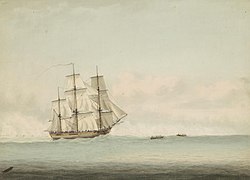
On 11 June 1770, Cook's ship, HMS Endeavour, ran aground on a shoal south of the present-day location of Cooktown, sustaining considerable damage that required seven weeks to repair.
Image source: HMS Endeavour
1791 - 1850
% complete
More than 20 ships were recorded lost in the reef region between 1791 and 1850, highlighting the navigational hazards posed by the reef's many shoals and coral formations.
Aug 29, 1791
% complete
One of the most famous wrecks on the reef was HMS Pandora, which sank on 29 August 1791, killing 35 men. The Pandora had been sent to capture the Bounty mutineers.
Image source: HMS Pandora (1779)
1802
% complete
It was Matthew Flinders who named the Great Barrier Reef, after his more detailed mapping of it in 1802 during his circumnavigation of Australia.
Image source: Matthew Flinders
1815 - 1860
% complete
Surveys between 1815 and 1860 by Phillip Parker King in the Mermaid, Francis Price Blackwood in HMS Fly, Owen Stanley in the Rattlesnake, and Henry Mangles Denham in the Herald led to considerable navigational improvements, outlining the contrasting advantages and perils of the Inner Route and the Outer Route.
1800 - 1900
% complete
Because the reef had no atolls, it was largely unstudied throughout the 19th century, as scientific attention at the time focused primarily on coral atoll formation.
1922
% complete
In 1922, the Great Barrier Reef Committee began carrying out much of the early scientific research on the reef, marking the start of systematic study of its ecology and geology.
1981
% complete
It supports a wide diversity of life and was selected as a UNESCO World Heritage Site in 1981, recognizing its outstanding universal value as the world's largest coral reef system.
1983
% complete
The Queensland Museum has led archaeological excavations at the wreck site of HMS Pandora since 1983, recovering artefacts from one of the reef's most famous shipwrecks.
1997
% complete
CNN labelled the Great Barrier Reef one of the Seven Natural Wonders of the World in 1997, affirming its global significance among natural landmarks.
2006
% complete
The Queensland National Trust named the Great Barrier Reef a state icon of Queensland in 2006, cementing its status as an emblematic natural treasure of the state.
2007
% complete
Australian World Heritage places included the Great Barrier Reef in its list in 2007, further formalizing recognition of the reef within Australia's heritage framework.
Nov 2014
% complete
In November 2014, Google launched Google Underwater Street View in 3D of the Great Barrier Reef, allowing people around the world to virtually explore the reef's underwater landscapes.
Image source: Google Street View
2020
% complete
A previously undiscovered reef, 500 metres tall and 1.5 km wide at the base, was found in the northern area of the Great Barrier Reef in 2020.
2022
% complete
The Australian Institute of Marine Science conducts annual surveys of the Great Barrier Reef's status, and the 2022 report showed the greatest recovery in 36 years, with the northern and central parts having the highest coral cover since monitoring began, though southern cover decreased.
Image source: Australian Institute of Marine Science
1972
% complete
The Australian government has had the goal of protecting the World Heritage Site since 1972 when they created The Australian Institute of Marine Science to conduct marine research.
1975
% complete
Royal Commissions disallowed oil drilling in the Great Barrier Reef, and in 1975 the Government of Australia created the Great Barrier Reef Marine Park and prohibited various activities through the Great Barrier Reef Marine Park Act.
Image source: Great Barrier Reef Marine Park
1999
% complete
In 1999, the Australian Parliament passed the Environment Protection and Biodiversity Conservation Act, which improved the operation of national environmental law by providing guidance about regional biodiversity conservation priorities.
Image source: Environment Protection and Biodiversity Conservation Act 1999
2001
% complete
In 2001, the GBRMPA released a report about the declining water quality in the Great Barrier Reef and detailed the importance of this issue for the reef's long-term health.
Oct 2003
% complete
In response to the 2001 water quality report, the Australian and Queensland governments launched a joint initiative in 2003 containing 65 actions built on previous legislation. Their immediate goal was to halt and reverse the decline in water quality entering the reef by 2013.
Jul 2004
% complete
As of July 2004, approximately one-third of the Great Barrier Reef Marine Park became protected from species removal of any kind, including fishing, without written permission, following a new zoning plan widely acclaimed as a new global benchmark for marine ecosystem conservation.
Jul 1, 2004
% complete
In July 2004, a new zoning plan took effect for the entire Marine Park. At the time, it was the largest Marine Protected Area in the world, although in 2006 the new Northwestern Hawaiian Islands National Monument became larger.
2006
% complete
In 2006, a review of the Great Barrier Reef Marine Park Act of 1975 recommended no further zoning plan changes until 2013, and that every five years a peer-reviewed outlook report should be published examining the reef's health, management, and environmental pressures.
2009
% complete
In 2009, the water quality plan was updated following the 2008 Reefocus summit. The updated version focused on strategic priority areas and actions to achieve 2013 goals, including a 50% reduction in nitrogen and phosphorus loads by 2013 and a 20% reduction in sediment load by 2020.
2011
% complete
Four traditional owners groups agreed to cease the hunting of dugongs in the area in 2011 due to their declining numbers, partially accelerated by seagrass damage from Cyclone Yasi.
Mar 2015
% complete
In March 2015, the Australian and Queensland governments formed a 35-year plan titled 'Reef 2050 Plan' proposing measures for the long-term management of pollution, climate change and other threats until 2050. Critics note it does not address climate change, the root cause of the problem.
2018
% complete
In 2018, Humane Society International filed a lawsuit against the government of Queensland to stop shark culling in the Great Barrier Reef, after Queensland's 'shark control' program killed about 50,000 sharks from 1962 to 2018 and 84,000 marine animals overall from 1962 to 2015.
Image source: Shark culling
2018
% complete
As part of the Reef 2050 plan, an AUD$443 million grant was given to the Great Barrier Reef Foundation in 2018 to fund protection and restoration efforts.
Image source: Great Barrier Reef Foundation
2018
% complete
The Reef 2050 Water Quality Improvement Plan was announced in 2018 in order to help transition local communities, agricultural organizations and industries to more sustainable practices.
2019
% complete
The Great Barrier Reef Marine Park Act 1975 stipulates an Outlook Report on the Reef's health, pressures, and future every five years. The last report was published in 2019.
Image source: Great Barrier Reef Marine Park
1996
% complete
As of 1996, 27 islands on the Great Barrier Reef supported resorts. In that year most tourism in the region was domestically generated, with the most popular visiting times during the Australian winter.
Mar 2013
% complete
A Deloitte report published by the Great Barrier Reef Marine Park Authority in March 2013 states that the Reef's 2,000 kilometres of coastline attracts tourism worth A$6.4 billion annually and employs more than 64,000 people.
1998 - 2006
% complete
Mass coral bleaching events due to marine heatwaves occurred in the summers of 1998, 2002 and 2006, foreshadowing the increasingly frequent bleaching crises that would follow.
Image source: Coral bleaching
2000
% complete
In 2000, an outbreak contributed to a loss of 66% of live coral cover on sampled reefs in a study by the Reef Research Centre, demonstrating the impact of predatory outbreaks on coral health.
Apr 3, 2010
% complete
On 3 April 2010, the bulk coal carrier Shen Neng 1 ran aground on Douglas Shoals, spilling up to four tonnes of oil into the water and causing extensive damage to the reef.
Image source: Jia Yong
Oct 2012
% complete
According to a study published in October 2012 by the Proceedings of the National Academy of Sciences, the reef has lost more than half its coral cover since 1985, with two-thirds of the loss occurring from 1998.
Dec 2013 - Jan 31, 2014
% complete
In December 2013, environment minister Greg Hunt approved a plan for dredging to create three shipping terminals as part of a coalport construction. On 31 January 2014, the GBRMPA issued a dumping permit allowing three million cubic metres of sea bed from Abbot Point to be unloaded in the waters of the Marine Park.
Image source: Abbot Point
Mar 2016
% complete
A March 2016 report stated that coral bleaching was more widespread than previously thought, seriously affecting the northern parts of the reef as a result of warming ocean temperatures.
Image source: Coral bleaching
Oct 2016
% complete
In October 2016, Outside published an obituary for the Great Barrier Reef; the article was criticised for being premature and hindering efforts to bolster the resilience of the reef.
Mar 2017
% complete
In March 2017, the journal Nature published a paper showing that huge sections of an 800-kilometre (500 mi) stretch in the northern part of the reef died in the course of 2016 due to high water temperatures, attributed to the effects of global climate change.
Jul 2017
% complete
In July 2017, UNESCO published a draft decision expressing serious concern about the impact of coral bleaching on the Great Barrier Reef, warning Australia it would not meet the targets of the Reef 2050 report without considerable work to improve water quality.
2018
% complete
The percentage of baby corals being born on the Great Barrier Reef dropped drastically in 2018, with scientists describing it as the early stage of a 'huge natural selection event unfolding', caused by deaths of mature breeding adults in the 2016–17 bleaching events.
2020
% complete
In 2020, a study found that the Great Barrier Reef has lost more than half of its corals since 1995 due to warmer seas driven by climate change, reaffirming earlier findings of dramatic coral decline.
Feb 2020 - Apr 2020
% complete
A widespread coral bleaching event occurred in the summer of 2020, adding to previous events in 1998, 2002, 2006, 2016 and 2017, with coral bleaching expected to become an annual occurrence.
Mar 2022
% complete
In March 2022, another mass bleaching event was confirmed, raising further concerns about the future of the reef system, especially considering possible effects of the El Niño weather phenomenon.
Or browse the full history timeline directory, with more than 2,000 topics.
This History of the Great Barrier Reef timeline was generated with the help of AI, using information found on the internet.
We work hard to keep these timelines accurate, but mistakes do get through. If you spot one, email us at [email protected] and we'll fix it for future visitors.
Generate yours with AI or build it from scratch, for free.
Export your timeline, add your own events, edit or remove AI-generated events, and much more
No credit card required.
Cancel anytime.
Cancel anytime.
You can create an unlimited number of timelines with up to 10 events on each one, customize how they look, export them to PDF, PNG, PowerPoint, CSV, and Excel, and share them with a link. Paid plans raise the event limit and add features like spreadsheet imports and collaborators.
Yes. You can cancel your subscription from your account page at any time, and you will not be charged again. Your subscription stays active for the rest of the period you already paid for.
Yes. We will email you a reminder before the annual renewal, and we will also email you a receipt.
Yes. You can email us within 15 days of any payment, and we will issue you a full refund.
Check out our pricing docs or send us an email anytime: [email protected].