-
Use Cases
-
Resources
-
Pricing
The Great Lakes—Superior, Michigan, Huron, Erie, and Ontario—hold the largest surface freshwater system on Earth. Formed by retreating glaciers over 10,000 years ago, they have sustained Indigenous civilizations for millennia, enabled European exploration and fur trade, fueled American and Canadian industrialization through shipping and steel production, and today face ongoing challenges of pollution, invasive species, and ecological restoration. More Less
1679
% complete
Caught in a storm while trading furs between Green Bay and Michilimacinac, Le Griffon was lost with all hands aboard. Its wreck may have been found in 2004, and a wreck in a different location was also claimed in 2014 to be Le Griffon.
Image source: Le Griffon
1860
% complete
The largest loss of life in a shipwreck out on the lakes may have been that of Lady Elgin, wrecked in 1860 with the loss of around 400 lives on Lake Michigan.
Image source: PS Lady Elgin
1915
% complete
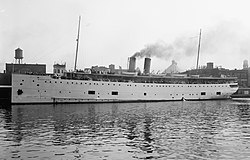
In an incident at a Chicago dock in 1915, the SS Eastland rolled over while loading passengers, killing 844 people.
Image source: SS Eastland
1918
% complete
Still missing are the two last warships to sink in the Great Lakes, the French minesweepers Inkerman and Cerisoles, which vanished in Lake Superior during a blizzard in 1918. Water level fluctuations in the lakes have been recorded since this year as well.
Image source: Great Lakes
Nov 10, 1975
% complete
The largest and last major freighter wrecked on the lakes was the SS Edmund Fitzgerald, which sank on November 10, 1975, just over 17 miles offshore from Whitefish Point on Lake Superior. It was later popularized in Gordon Lightfoot's 1976 story song.
Image source: SS Edmund Fitzgerald
2007
% complete
In 2007, the Great Lakes Shipwreck Historical Society announced it had found the wreckage of Cyprus, a 420-foot ore carrier that sank during a Lake Superior storm on October 11, 1907, during its second voyage while hauling iron ore.
2008
% complete
In 2008, deep sea divers in Lake Ontario found the wreck of the 1780 Royal Navy warship HMS Ontario in what has been described as an 'archaeological miracle.'
Image source: HMS Ontario (1780)
2021
% complete
The Wisconsin Shipwreck Coast National Marine Sanctuary was established in 2021 in the waters of Lake Michigan off Wisconsin, protecting dozens of historic shipwrecks.
Image source: Wisconsin Shipwreck Coast National Marine Sanctuary
Aug 7, 1679
% complete
The brigantine Le Griffon, commissioned by René-Robert Cavelier, Sieur de La Salle, was built at Cayuga Creek near the southern end of the Niagara River and became the first known sailing ship to travel the upper Great Lakes on August 7, 1679.
1824
% complete
Barges from middle North America were able to reach the Atlantic Ocean from the Great Lakes when the Welland Canal opened in 1824.
Image source: Welland Canal
1825
% complete
The Erie Canal opened in 1825, allowing barges from middle North America to reach the Atlantic Ocean via the Great Lakes, and spurring intensive population growth in the region.
Image source: Erie Canal
1844 - 1857
% complete
From 1844 through 1857, palace steamers carried passengers and cargo around the Great Lakes in style.
1848
% complete
By 1848, with the opening of the Illinois and Michigan Canal at Chicago, direct access to the Mississippi River was possible from the lakes.
Image source: Illinois and Michigan Canal
2002
% complete
In 2002, 162 million net tons of dry bulk cargo were moved on the Lakes, underscoring their continuing role as a commercial shipping artery.
1800 - 1850
% complete
In the early 19th century, the government of Upper Canada introduced legislation prohibiting the use of weirs and nets at the mouths of Lake Ontario's tributaries to protect fish populations.
1801
% complete
By 1801, the New York Legislature found it necessary to pass regulations curtailing obstructions to the natural migrations of Atlantic salmon from Lake Erie into their spawning channels.
1812 - 1820
% complete
McCullough wrote that the fishing industry of the Great Lakes got its start on the American side of Lake Ontario in Chaumont Bay, near the Maumee River on Lake Erie, and on the Detroit River at about the time of the War of 1812.
1831
% complete
In 1831, Alexander MacGregor from Goderich, Ontario found whitefish and herring in abundant supply around the Fishing Islands.
1850
% complete
Concerns by the mid-19th century included obstructions in the rivers which prevented salmon and lake sturgeon from reaching their spawning grounds.
1875
% complete
The Wisconsin Fisheries Commission noted a reduction of roughly 25% in general fish harvests by 1875, an early sign of overfishing pressure on the lakes.
1879 - 1899
% complete
Between 1879 and 1899, reported whitefish harvests declined from some 24.3 million pounds (11 million kg) to just over 9 million pounds (4 million kg).
1900
% complete
By 1900, commercial fishermen on Lake Michigan were hauling in an average of 41 million pounds of fish annually.
1938
% complete
By 1938, Wisconsin's commercial fishing operations were motorized and mechanized, generating jobs for more than 2,000 workers, and hauling 14 million pounds per year.
1972
% complete
The Great Lakes: An Environmental Atlas and Resource Book (1972) noted: 'Only pockets remain of the once large commercial fishery.' Later improvements in the 1970s and 1980s enabled growth of a large recreational fishery.
2011
% complete
The last commercial fisherman left Milwaukee in 2011 because of overfishing and anthropogenic changes to the biosphere.
1818
% complete
Signed after the War of 1812, the Rush–Bagot Treaty, along with the later Treaty of Washington, eventually led to a complete disarmament of naval vessels in the Great Lakes.
Image source: Rush–Bagot Treaty
1872
% complete
In 1872, a treaty gave access to the St. Lawrence River, further opening the Great Lakes to international shipping traffic.
1909
% complete
The International Joint Commission was established in 1909 to help prevent and resolve disputes relating to the use and quality of boundary waters, and to advise Canada and the United States on water resource questions.
Image source: International Joint Commission
1986
% complete
Under the Water Resources Development Act of 1986, diversion of water from the Great Lakes Basin requires the approval of all eight Great Lakes governors through the Great Lakes Commission, which rarely occurs.
Image source: Great Lakes Compact
1998
% complete
In 1998, the Canadian company Nova Group won approval from the Province of Ontario to withdraw 158,000,000 U.S. gallons of lake water, sparking concern over diversions from the basin.
Dec 13, 2005
% complete
On December 13, 2005, the Governors and Premiers signed two agreements to protect the Great Lakes Basin, the first of which is between all ten jurisdictions.
Oct 3, 2008
% complete
President George W. Bush signed Great Lakes restoration funding legislation on October 3, 2008, laying groundwork for the Great Lakes Restoration Initiative, which received $300 million in the Fiscal Year 2012 budget.
Image source: Cameron Davis (lawyer)
Jan 5, 2021
% complete
The Great Lakes Restoration Initiative Act of 2019 passed as Pub. L. 116–294 on January 5, 2021, reauthorizing the program through Fiscal Year 2026.
1884
% complete
In 1884, the New York Fish Commission determined that the dumping of sawmill waste (chips and sawdust) had impacted fish populations.
1972
% complete
Legislation signed under President Richard Nixon in 1972, along with the bi-national Great Lakes Water Quality Agreement signed by Canada and the U.S., marked a key turning point in protecting the lakes' water quality.
Image source: Great Lakes Areas of Concern
1994
% complete
The first of 43 'Great Lakes Areas of Concern' to be formally de-listed through successful cleanup was Ontario's Collingwood Harbour in 1994; Severn Sound followed in 2003.
2011
% complete
Blue-green algae, or cyanobacteria blooms, have been problematic on Lake Erie since 2011, with a severity index of 10 that year and a record 10.5 in 2015.
Image source: Lake Erie
Aug 2019
% complete
In early August 2019, satellite images depicted a bloom stretching up to 1,300 square kilometers on Lake Erie, with the heaviest concentration near Toledo, Ohio; water quality testing was underway that month.
2020 - 2021
% complete
A cleanup project captured 74,000 pieces of trash using new technology between 2020 and 2021; however, it does not claim to catch up with 22 million pounds (10.0 kt) of plastic that ends up in the Great Lakes every year.
1954
% complete
The Great Lakes have been observed to help intensify storms, such as Hurricane Hazel in 1954, demonstrating the lakes' influence on regional weather systems.
Image source: Hurricane Hazel
1996
% complete
In 1996, a rare tropical or subtropical storm was observed forming in Lake Huron, dubbed the 1996 Lake Huron cyclone — an unusual meteorological event for the region.
Image source: 1996 Lake Huron cyclone
2011
% complete
The 2011 Goderich, Ontario tornado moved onshore as a tornadic waterspout, another example of the Great Lakes helping intensify storms.
2013
% complete
Recent lake levels include record low levels in 2013 in Lakes Superior, Erie, and Michigan-Huron, followed by record high levels in 2020 in the same lakes.
1986
% complete
The ruffe, a small percid fish from Eurasia, became the most abundant fish species in Lake Superior's Saint Louis River within five years of its detection in 1986.
Image source: Ruffe
1988
% complete
Since the 19th century, an estimated 160 new species have entered the Great Lakes ecosystem; the zebra mussel was first discovered in 1988, followed by the quagga mussel in 1989, causing severe economic and ecological impacts.
Image source: Zebra mussel
2000
% complete
Since 2000, the invasive quagga mussel has smothered the bottom of Lake Michigan almost from shore to shore, with numbers estimated at 900 trillion.
Image source: Quagga mussel
2007
% complete
The Fish and Wildlife Service estimated in 2007 that the economic impact of the zebra mussel could be about $5 billion over the next decade.
2012 - 2019
% complete
Although a drop of lake water may contain 1 million bacteria cells and 10 million viruses, only since 2012 has there been a long-term study of the lakes' micro-organisms; more than 160 new species were discovered between 2012 and 2019.
Or browse the full history timeline directory, with more than 2,000 topics.
This History of the Great Lakes timeline was generated with the help of AI, using information found on the internet.
We work hard to keep these timelines accurate, but mistakes do get through. If you spot one, email us at [email protected] and we'll fix it for future visitors.
Generate yours with AI or build it from scratch, for free.
Export your timeline, add your own events, edit or remove AI-generated events, and much more
No credit card required.
Cancel anytime.
Cancel anytime.
You can create an unlimited number of timelines with up to 10 events on each one, customize how they look, export them to PDF, PNG, PowerPoint, CSV, and Excel, and share them with a link. Paid plans raise the event limit and add features like spreadsheet imports and collaborators.
Yes. You can cancel your subscription from your account page at any time, and you will not be charged again. Your subscription stays active for the rest of the period you already paid for.
Yes. We will email you a reminder before the annual renewal, and we will also email you a receipt.
Yes. You can email us within 15 days of any payment, and we will issue you a full refund.
Check out our pricing docs or send us an email anytime: [email protected].