-
Resources
-
Pricing
The history of translation traces how people have interpreted languages, cultures, religions, literature, and knowledge across civilizations, from antiquity to the digital age. More Less
Build a timeline like this one in minutes, for free. Start Yours →
1274 BCE
The Treaty of Kadesh between the ancient Egyptian and Hittite empires is an early example of a bilingual diplomatic document. Its parallel textual traditions demonstrate the practical importance of translation in international relations.
Image source: Egyptian–Hittite peace treaty
200 BC - 101 BC
The Roman adapter Terence discussed the translator's role as a bridge for carrying values between cultures. His work on Greek comedies illustrates how translation could involve adaptation and cultural mediation as well as linguistic transfer.
100 BC - 1 BC
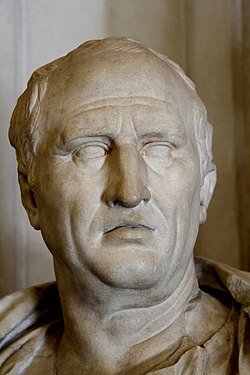
In 1st-century-BCE Rome, Cicero and Horace famously cautioned against translating word for word. Their position helped establish equivalence as a central concept in translation and supported flexibility in reproducing meaning rather than mechanically copying individual words.
Image source: Cicero
1000 - 1099
The Tangut Empire used newly invented block printing and strong governmental support to translate extensive volumes. Contemporary accounts describe the emperor, his mother, and scholars of several nationalities contributing to the effort.
Image source: Western Xia

300 BC - 1 BC
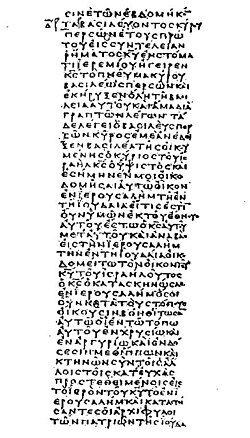
The Septuagint, a collection of Jewish Scriptures translated from Hebrew into early Koine Greek in Alexandria, was produced between the 3rd and 1st centuries BCE. It became the first important translation in the Western tradition.
Image source: Septuagint
300 BC - 201 BC
One of the earliest recorded Western translation projects rendered books of the biblical Old Testament from Hebrew into Koine Greek. The work made Jewish scriptures accessible to Greek-speaking communities and influenced later Christian textual traditions.
800 - 899
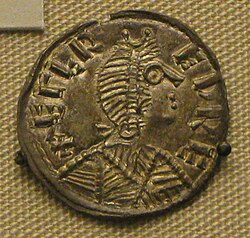
The 9th-century English king Alfred the Great commissioned Anglo-Saxon translations of Bede's Ecclesiastical History and Boethius' Consolation of Philosophy. His program made important works available in a vernacular language.
Image source: Alfred the Great
1300 - 1399
In the 14th century, Geoffrey Chaucer made important English translations and adaptations from Italian, French, and Latin. His works included material from Boccaccio, the Roman de la Rose, and Boethius, helping develop English literary style.
Image source: Geoffrey Chaucer
1382
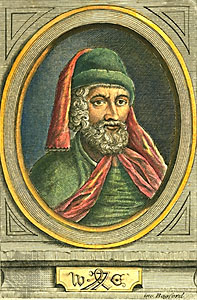
The Wycliffe Bible, produced around 1382, was the first great English translation of the Bible. Its language demonstrated both the possibilities and the limitations of an English prose tradition that was still developing.
Image source: Wycliffe's Bible
1415 - 1428
The Council of Constance declared John Wycliffe a heretic in 1415 and ordered his works and remains destroyed. The order was carried out in 1428, when his corpse was exhumed, burned, and its ashes cast into the River Swift.
Image source: John Wycliffe
1453
Shortly before the fall of Constantinople in 1453, the Byzantine scholar Georgius Gemistus Pletho arrived at the court of Cosimo de' Medici in Florence. His presence helped open a new period in the history of translation in Renaissance Italy.
Image source: Gemistos Plethon
1477
William Caxton's Dictes or Sayengis of the Philosophres, published in 1477, translated an 11th-century Egyptian text into English through Latin and French. It exemplifies the layered transmission of works across several languages.
Image source: William Caxton
1522
Martin Luther translated the New Testament into German in 1522. He is credited with being the first European to posit that translation is satisfactory only when directed toward the translator's own language.
1523 - 1526
The first major Tudor translations included Lord Berners' English version of Froissart's Chronicles from 1523–25 and William Tyndale's New Testament, first produced in 1525–26. These works advanced English prose and religious translation.
Image source: English Reformation
1526
William Tyndale's New Testament, published in 1526 and later revised, became one of the foundational English Bible translations. Its influence extended to the Authorized Version of 1611, although Tyndale was later convicted of heresy and executed.
Image source: William Tyndale
1943
In 1943, A. J. B. Higgins showed that among early Christian authors, both the understanding and the text of a devotional verse had undergone considerable changes. His work illustrates the interpretive problems involved in transmitting religious texts.
400 - 499
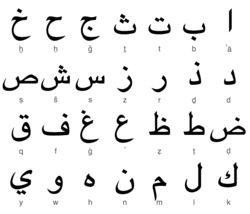
Translation into Arabic expanded after the creation of Arabic script in the 5th century. Its importance grew further with the rise of Islam and Islamic empires, which connected Arabic-speaking societies with diverse intellectual and religious traditions.
Image source: Arabic script
600 - 699
Greek and Coptic texts appear to have begun being translated into Arabic as early as the late 7th century, possibly through Syriac intermediaries. These efforts helped establish Arabic as a major language for transmitting earlier knowledge.
700 - 799
The second Abbasid Caliph funded a translation bureau in Baghdad in the 8th century. This institutional support contributed to the flourishing of Arabic translation and the transmission of Greek, Roman, Persian, and other works.
Image source: House of Wisdom
1000 - 1099
From the middle of the 11th century, European scholars began translating Arabic versions of lost Greek and Roman works into European languages. These projects drew on Arabic knowledge of classical texts and intensified contacts between Islamic and European intellectual traditions.
1100 - 1199
The establishment of the Toledo School of Translators in Spain helped accelerate the movement of scientific, philosophical, and classical learning from Arabic into European languages. Toledo became a major center of cross-cultural translation.
Image source: Toledo School of Translators
1200 - 1299
King Alfonso X of Castile promoted translation during the 13th century by founding a Schola Traductorum, or School of Translation, in Toledo. His patronage supported the circulation of knowledge among Arabic, Hebrew, Latin, and vernacular communities.
Image source: Alfonso X of Castile
1813
The establishment of the Madrasat al-Alsun, or School of Tongues, in Egypt in 1813 revived the translation of foreign works for publication in Arabic. It formed part of a broader Arabic translation movement.
1820 - 1873
The Egyptian cleric Rifaa al-Tahtawi contributed greatly to the Islamic Enlightenment. After spending five years in Paris in the late 1820s, he returned to Cairo and became a leading figure in Egypt's modern translation movement.
Image source: Rifa'a at-Tahtawi
1830 - 1839
With the encouragement of Muhammad Ali, al-Tahtawi became head of Egypt's new school of languages and initiated a program translating roughly two thousand European and Turkish volumes. The subjects ranged from geography and geometry to Voltaire, the Marseillaise, and the Code Napoléon.
1880 - 1908
Between 1880 and 1908, more than six hundred newspapers and periodicals were founded in Egypt. This publishing expansion popularized a translation movement that had begun earlier in the century with military, medical, and Enlightenment texts.
1600 - 1699
A 17th-century French critic coined the phrase les belles infidèles to suggest that a translation could be faithful or beautiful, but not both. The phrase captured a long-running tension between fidelity and stylistic elegance.
1600 - 1699
In the second half of the 17th century, John Dryden sought to make Virgil speak in words he might have written had he been living and English. This approach emphasized natural literary effect over strict verbal correspondence.
Image source: John Dryden
1672
In 1672, John Dryden objected to a phrase by Ben Jonson and helped establish a proscription against preposition stranding. His intervention shows how translators could influence the evolution of language and literary style.
1700 - 1799
Throughout the 18th century, ease of reading became the dominant watchword of translators. The period also saw many translators move beyond translation proper into adaptation, continuing a practice especially associated with earlier periods.
1700 - 1799
Since Johann Gottfried Herder in the 18th century, it has been considered axiomatic in translation theory that one translates toward one's own language. The principle formalized a tendency associated earlier with Martin Luther.
Image source: Johann Gottfried Herder
1783
In 1783, the Polish poet and grammarian Onufry Kopczyński argued that assiduous reading, together with listening to spoken language, offered a more comprehensive guide to a language than dictionaries alone.
1790
Alexander Tytler's Essay on the Principles of Translation, published in 1790, emphasized that assiduous reading provides a more comprehensive guide to a language than dictionaries. The work contributed to the development of systematic translation criticism.
1813
In his 1813 lecture On the Different Methods of Translation, Friedrich Schleiermacher distinguished between moving the writer toward the reader through transparency and moving the reader toward the author through fidelity to the source text's foreignness.
Image source: Friedrich Schleiermacher
1847
Edmund Chojecki's 1847 Polish translation of Jan Potocki's French novel The Saragossa Manuscript preserved fragments whose original French manuscript was later lost. The case demonstrates how back-translations can preserve otherwise vanished texts.
1859
Edward FitzGerald's 1859 Rubaiyat of Omar Khayyam became an outstanding 19th-century translation. Its Oriental flavor came partly from Persian names and Biblical echoes, even though much of its material departed from the Persian original.
1871
In 1871, Benjamin Jowett established a new translation pattern by rendering Plato in simple, straightforward language. His example anticipated the later 20th-century shift toward accuracy as the principal criterion of translation.
1899
Lin Shu's first major translation, Past Stories of the Camellia-woman of Paris, based on Alexandre Dumas fils's La Dame aux Camélias, was published in 1899. Although Lin knew no foreign languages, he worked with his friend Wang Shouchang, who had studied in France.
1921
In 1921, Joseph Conrad attempted to translate Bruno Winawer's Polish play The Book of Job into English. Because Conrad had long had little contact with everyday spoken Polish, he predictably missed many nuances of contemporary Polish.
1946
In 1946, Ezra Pound advised the young poet W. S. Merwin that translation was the best teacher he would ever have. Merwin later described translation as an impossible and unfinishable art, reflecting its creative and interpretive demands.
Image source: W. S. Merwin
1959
In his 1959 paper On Linguistic Aspects of Translation, Roman Jakobson declared that poetry is untranslatable by definition. His claim became a major reference point in debates over whether poetic form and meaning can be transferred between languages.
Image source: Roman Jakobson
1964
Vladimir Nabokov published an English translation of Alexander Pushkin's Eugene Onegin in prose in 1964. Like Jakobson, he considered rhymed and metrical poetry fundamentally untranslatable and prioritized literal accuracy over reproducing the original verse form.
Image source: Eugene Onegin
1997
In his 1997 book Le Ton beau de Marot, Douglas Hofstadter argued that translating a poem requires conveying as much as possible of its literal meaning and its formal structure, including meter, rhyme, and alliteration.
1999
In 1999, Douglas Hofstadter published his own verse translation of Eugene Onegin. The project contrasted with Nabokov's prose version and reflected Hofstadter's belief that a good translation should convey a poem's literal meaning, form, and structure as fully as possible.
2010
By 2010, web-based human translation had been gaining popularity as a relatively fast and accurate way to translate business communications, legal documents, medical records, and software localization. It developed alongside, rather than simply replacing, machine translation.
Image source: Translation
2014
Meytal Radzinski launched the Women in Translation campaign in 2014 to address the underrepresentation of women authors in translated literature. The campaign brought visibility to gender disparities in international publishing and translation.
2015 - 2019
In 2015, the Oregon Shakespeare Festival commissioned professional translations of the entire Shakespeare canon, including disputed works such as Edward III, into contemporary vernacular English. In 2019, the translated canon was presented in a month-long series of staged readings.
2015
As of 2015, the international market for science-fiction translations showed an increasing presence of source languages other than English. This development reflected a broader diversification of translated literature and international publishing.
Image source: Science fiction
2018
As of 2018, professional translator Mark Polizzotti argued that machine translation systems such as Google Translate were unlikely to threaten human translators soon. He maintained that machines would not easily grasp nuance and connotation.
Image source: Machine translation
Build a timeline like this one in minutes, for free. Start Yours →
Or browse the full history timeline directory, with more than 2,500 topics.
This History of Translation timeline was generated with the help of AI, using information found on the internet.
We work hard to keep these timelines accurate, but mistakes do get through. If you spot one, email us at [email protected] and we'll fix it for future visitors.
Generate yours with AI or build it from scratch, for free.
Export your timeline, add your own events, edit or remove AI-generated events, and much more
No credit card required.
15-day money-back guarantee.
You can create an unlimited number of timelines with up to 10 events on each one, customize how they look, export them to PDF, PNG, PowerPoint, CSV, and Excel, and share them with a link. Timelines made with Timeline Maker AI keep every event the generator created, and you can add up to 5 events of your own. Paid plans remove the event limit, add spreadsheet imports and hide Preceden's branding, and the higher-priced plan also adds collaborators, a custom logo and a custom domain.
Yes. You can cancel your subscription from your account page at any time, and you will not be charged again. Your subscription stays active for the rest of the period you already paid for.
Yes. We email you a reminder 15 days before your annual renewal, and we email you a receipt after every payment.
Yes. You can email us within 15 days of any payment, and we will issue you a full refund.
Check out our pricing docs or send us an email anytime: [email protected].