-
Use Cases
-
Resources
-
Pricing
Yangon, formerly known as Rangoon, is Myanmar's largest city and its former capital. Founded around the ancient town of Dagon near the sacred Shwedagon Pagoda, the city was transformed by the British into a major colonial port after their conquest of Burma in 1852. Renamed Yangon in 1989, it remains the country's economic and cultural hub despite losing capital status to Naypyidaw in 2005. More Less
1300
% complete
Dagon became an important pilgrimage pagoda town starting in the 14th century, during the Hanthawaddy kingdom, drawing devotees to the Shwedagon Pagoda from across the region.
Image source: Yangon
1364 - 1392
% complete
Notable governors of Dagon included Princess Maha Dewi, who ruled the town from 1364 to 1392. Her grandniece Shin Saw Pu later became the only female queen regnant in Burmese history.
1460 - 1471
% complete
Queen Saw Pu built a palace next to the Shwedagon Pagoda in the town in 1460 and spent her semi-retired life at that palace until she died in 1471.
1755
% complete
In 1755, King Alaungpaya, founder of the Konbaung dynasty, captured Dagon, added settlements around it, and called the enlarged town 'Yangon', meaning 'End of Strife'.
1823
% complete
The estimated population of Yangon in 1823 was about 30,000, making it a modest but growing trading settlement before the British conquests.
1824 - 1826
% complete
The British captured Yangon during the First Anglo-Burmese War (1824–26), but returned the city to Burmese rule after the war ended.
Image source: First Anglo-Burmese War
1841
% complete
The city was destroyed by a fire in 1841, requiring extensive rebuilding before the coming colonial transformation of the following decade.
1852
% complete
The British captured Yangon and all of Lower Burma in the Second Anglo-Burmese War of 1852, and subsequently transformed Yangon into the commercial and political hub of British Burma.
Image source: Second Anglo-Burmese War
1857
% complete
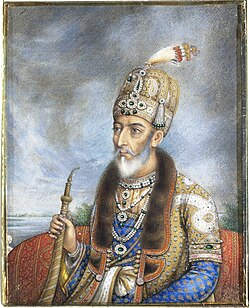
After the Indian Rebellion of 1857, the British sent Bahadur Shah II, the last Mughal emperor, to Yangon to live in exile, where he died years later.
Image source: Bahadur Shah Zafar
1885
% complete
Yangon became the capital of all British-ruled Burma after the British captured Upper Burma in the Third Anglo-Burmese War of 1885.
Image source: Third Anglo-Burmese War
1900
% complete
By the early 20th century, Yangon had public services and infrastructure on par with London, reflecting its status as the commercial heart of British Burma.
1920
% complete
Three nationwide strikes against British rule in 1920, 1936, and 1938 all began in Yangon, demonstrating the city's role as the centre of nationalist activism.
1942 - 1945
% complete
Yangon was under Japanese occupation (1942–45) during World War II, and incurred heavy damage from fighting between Japanese forces and the Allies.
Image source: Japanese occupation of Burma
May 1945
% complete
The city was retaken by the Allies in May 1945, ending the Japanese occupation and paving the way for Burma's eventual independence.
Image source: Battle of Meiktila and Mandalay
Jan 1927
% complete
First-class cricket was played in the city in January 1927 when the touring Marylebone Cricket Club played Burma and the Rangoon Gymkhana.
1961
% complete
Yangon hosted the 1961 South East Asian Games, showcasing the newly independent nation's capital, and hosted the games again in 1969.
Image source: SEA Games
2014
% complete
According to the 2014 census, Yangon had a population of 5.16 million, confirming its status as Myanmar's largest city and economic hub.
Image source: Yangon
1948
% complete
Soon after Burma's independence in 1948, many colonial-era names of streets and parks were changed to more nationalistic Burmese names.
Jan 4, 1948
% complete
Yangon became the capital of the Union of Burma on 4 January 1948 when the country gained independence from British rule.
1962 - 1988
% complete
During Ne Win's isolationist rule (1962–88), Yangon's infrastructure deteriorated through poor maintenance and did not keep up with its growing population.
Image source: Ne Win
1974
% complete
Yangon was the centre of major anti-government protests in 1974, 1988 and 2007, with streets seeing bloodshed each time as protesters were gunned down by the government.
Aug 1988
% complete
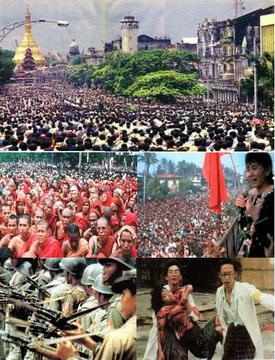
The 8888 Uprising resulted in the deaths of hundreds, if not thousands, of Burmese civilians, many of them in Yangon, where hundreds of thousands of people flooded into the streets of the former capital city.
Image source: 8888 Uprising
1989
% complete
In 1989, the military junta changed the city's English name from Rangoon to 'Yangon', along with many other changes in English transliteration of Burmese names.
1950 - 1999
% complete
The city's population grew sharply after 1948 as many people moved into the newly built satellite towns of North Okkalapa, South Okkalapa, and Thaketa in the 1950s and East Dagon, North Dagon and South Dagon in the 1990s.
1996
% complete
In 1996, the Yangon City Development Committee created a Yangon City Heritage List of old buildings and structures that cannot be modified or torn down without approval, protecting about 200 notable colonial-period buildings.
Image source: Yangon City Heritage List
2012
% complete
In 2012, the city of Yangon imposed a 50-year moratorium on demolition of buildings older than 50 years, further protecting its rich architectural heritage.
2003
% complete
Within Yangon city limits, it has been illegal to drive motorcycles since 2003, a regulation unique among major Asian cities of its size.
Image source: Yangon International Airport
May 2003
% complete
In May 2003, a ban on using car horns was implemented in six townships of Downtown Yangon to reduce noise pollution; in April 2004 it was expanded to cover the entire city.
2017
% complete
In 2017 the government of Japan provided more than US$200 million in finance to assist with developing and maintaining the Yangon circular railway line, purchasing new carriages and upgrading signalling.
Image source: Yangon Circular Railway
Jan 16, 2017
% complete
On 16 January 2017, as part of public transport reforms, the city bus network system Yangon Bus Service (YBS) was created by the Yangon Region Transport Authority, consolidating hundreds of private bus lines.
Image source: Yangon Bus Service
Oct 2017
% complete
In October 2017, a New Yangon Water Bus was launched, providing ferry services along the Yangon River as an alternative commuting option for residents.
May 20, 2021
% complete
On 20 May 2021, the Yangon Region Transport Authority (YRTA) was reorganised as the Yangon Region Transport Committee (YRTC) to oversee public transport reforms.
May 7, 2005
% complete
On 7 May 2005, a series of coordinated bombings occurred in the city of Yangon, killing and wounding dozens in one of the deadliest attacks in recent Myanmar history.
Image source: May 2005 Yangon bombings
Nov 2005
% complete
In November 2005, the military government designated Naypyidaw, 320 kilometres north of Yangon, as the new administrative capital, moving much of the government to the newly developed city.
Image source: Naypyidaw
Sep 2007
% complete
The Saffron Revolution of September 2007 saw monks and civilians protest in Yangon's streets; the crackdown drew international condemnation and sharply reduced foreign visitors to the city.
Image source: Saffron Revolution
May 2008
% complete
In May 2008, Cyclone Nargis made landfall as a Category 4 cyclone, hitting Yangon and becoming the worst cyclone on record in the country with catastrophic damage and loss of life.
Image source: Cyclone Nargis
Dec 1, 2009
% complete
Since 1 December 2009, high-density polyethylene plastic bags have been banned by city authorities in an effort to reduce waste and flooding.
2020
% complete
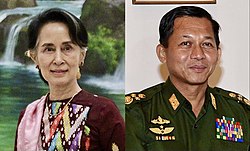
In the 2020s, life in Yangon was greatly affected by the COVID-19 pandemic and the 2021 coup d'état, which triggered mass protests met with deadly force.
Image source: 2021 Myanmar coup d'état
2022
% complete
In 2022, the districts of Yangon Region were reorganised, giving Yangon city nine newly formed districts, as well as parts of the newly formed Twante District.
Image source: Yangon Region
Or browse the full history timeline directory, with more than 2,000 topics.
This History of Yangon timeline was generated with the help of AI, using information found on the internet.
We work hard to keep these timelines accurate, but mistakes do get through. If you spot one, email us at [email protected] and we'll fix it for future visitors.
Generate yours with AI or build it from scratch, for free.
Export your timeline, add your own events, edit or remove AI-generated events, and much more
No credit card required.
Cancel anytime.
Cancel anytime.
You can create an unlimited number of timelines with up to 10 events on each one, customize how they look, export them to PDF, PNG, PowerPoint, CSV, and Excel, and share them with a link. Paid plans raise the event limit and add features like spreadsheet imports and collaborators.
Yes. You can cancel your subscription from your account page at any time, and you will not be charged again. Your subscription stays active for the rest of the period you already paid for.
Yes. We will email you a reminder before the annual renewal, and we will also email you a receipt.
Yes. You can email us within 15 days of any payment, and we will issue you a full refund.
Check out our pricing docs or send us an email anytime: [email protected].