-
Use Cases
-
Resources
-
Pricing
The internal combustion engine is a heat engine that generates power by burning fuel inside a combustion chamber. Its development transformed transportation, industry, agriculture, and global commerce. More Less
Build a timeline like this one in minutes, for free. Start Yours →
1791
In 1791, John Barber developed the gas turbine, an early concept related to continuous-combustion power generation and an important precursor to later turbine engines.
Image source: Gas turbine

1794
In 1794, Robert Street patented an internal combustion engine that was also the first such engine to use liquid fuel. He built an engine around the same time.
1798
In 1798, John Stevens built the first American internal combustion engine, extending experimental engine development in the United States.
Image source: John Stevens (inventor, born 1749)

1807
In 1807, French inventors Nicéphore Niépce and Claude Niépce ran the Pyréolophore, a prototype internal combustion engine that used controlled dust explosions. Napoleon Bonaparte granted it a patent.
Image source: Pyréolophore

1808
In 1808, De Rivaz fitted his internal combustion invention to a primitive working vehicle, described as the world's first automobile powered by an internal combustion engine.
Image source: François Isaac de Rivaz

1823
In 1823, Samuel Brown patented the first internal combustion engine to be applied industrially, marking a transition from experimental devices toward practical machinery.
Image source: Samuel Brown (engineer)

1850
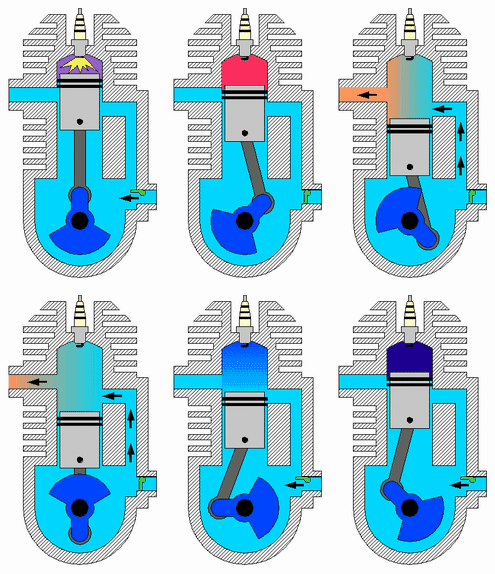
The first commercially successful internal combustion engines were invented in the mid-19th century, marking the transition of the technology from experimental machines to viable commercial products.
Image source: Internal combustion engine

1854
In 1854, Italian inventors Eugenio Barsanti and Felice Matteucci obtained UK certification for their invention, titled “Obtaining Motive Power by the Explosion of Gases.”
Image source: Eugenio Barsanti

1857
Between 1857 and 1859, Barsanti and Matteucci obtained a patent in Piedmont for the same internal combustion engine design.
1857
In 1857, the Great Seal Patent Office granted Barsanti and Matteucci patent No. 1655 for an improved apparatus for obtaining motive power from gases.
Build a timeline like this one in minutes, for free. Start Yours →
This Internal Combustion Engine timeline was generated with the help of AI, using information found on the internet.
We work hard to keep these timelines accurate, but mistakes do get through. If you spot one, email us at [email protected] and we'll fix it for future visitors.
Generate yours with AI or build it from scratch, for free.