
-
Resources
-
Pricing
The Iran Hostage Crisis was a 444-day diplomatic standoff after Iranian militants seized the U.S. embassy in Tehran and held American hostages. More Less
Build a timeline like this one in minutes, for free. Start Yours →
Oct 1, 1979 - Dec 31, 1979
The Canadian government secretly issued an Order in Council allowing Canadian passports to be issued to some American citizens so they could escape Iran.
Nov 1979
Six American diplomats evaded capture during the embassy occupation and were sheltered while Canadian and American officials developed a plan to get them out of Iran.
Image source: Canadian Caper
Nov 19, 1979 - Nov 20, 1979
Thirteen hostages were released on November 19 and 20, 1979. The releases reduced the number of people held during the continuing embassy standoff.
Image source: Iran hostage crisis
Jan 1980
The Canadian government and the CIA prepared a cover story identifying the six escaped diplomats as members of a film crew. Canadian passports supported the covert exfiltration plan.
Jan 28, 1980
In a joint covert operation, two CIA agents and the six American diplomats boarded a Swissair flight to Zürich, Switzerland, using Canadian passports and the film-crew cover story.
Jan 28, 1980
The six American diplomats were rescued in the operation later known as the Canadian Caper. The operation was carried out by the Canadian government and the CIA.
Jul 1980
Richard Queen, one of the white male hostages, was released in July 1980 after becoming seriously ill. His illness was later diagnosed as multiple sclerosis.
Jan 20, 1981
Following the signing of the Algiers Accords, the remaining American hostages were released on January 20, 1981, bringing the 444-day Iran hostage crisis to an end.
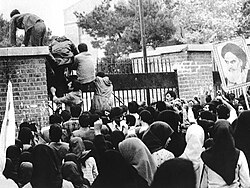
Nov 4, 1979
Iranian student unions loyal to Ayatollah Khomeini organized a demonstration that erupted into an all-out conflict outside the walled compound of the U.S. Embassy in Tehran. The occupation began with 66 Americans taken hostage, while 52 were ultimately held for the duration of the crisis.
Nov 4, 1979
The embassy occupation was intended to pressure the United States to return the Shah to Iran for trial. The hostage-takers also demanded an American apology for interference in Iranian affairs, including the 1953 overthrow of Prime Minister Mohammad Mosaddegh, and the release of frozen Iranian assets.
Nov 4, 1979 - Jan 19, 1981
The remaining 52 hostages were held for up to 444 days. Their prolonged captivity made the crisis a defining international and domestic political issue for the United States.
Nov 20, 1979
After the releases of November 19–20, the remaining group continued to be held in Iran. The crisis ultimately centered on the 52 hostages who remained captive until January 1981.
Jul 1980
Charles A. Jones Jr. was the only African-American hostage not released in the earlier group of releases and remained among those held during the continuing crisis.
Nov 1980 - Jan 1981
The hostages' final holding area was the Teymur Bakhtiar mansion in Tehran. There, they were eventually provided with tubs, showers, and hot and cold running water.
Nov 12, 1979
President Jimmy Carter applied economic pressure by ending U.S. oil imports from Iran during the hostage crisis.
Nov 14, 1979
Under Executive Order 12170, the Office of Foreign Assets Control froze approximately $8 billion in Iranian assets held in the United States.
Apr 10, 1980
Secretary of State Cyrus Vance, struggling with gout, went to Florida on April 10 for a long weekend during the period when the rescue operation was being planned.
Image source: Operation Eagle Claw
Apr 24, 1980
As negotiations failed to secure the release of the remaining hostages, President Carter approved Operation Eagle Claw, a U.S. military rescue attempt.
Apr 24, 1980
Late in the afternoon, eight RH-53D helicopters flew from the aircraft carrier USS Nimitz toward a remote road serving as an airstrip in Iran's Great Salt Desert near Tabas.
Apr 24, 1980
Operation Eagle Claw failed during the rescue attempt near Tabas. The unsuccessful mission did not free the hostages and became a major political setback for President Carter.
May 1980
The Joint Chiefs of Staff commissioned a Special Operations review group of six senior military officers in response to the failed rescue attempt.
Sep 1980
The beginning of Iraq's invasion of Iran in September 1980 spurred the Iranian government to negotiate with the United States through an initiative mediated by Algeria.
Oct 1, 1980 - Jan 1981
Algeria mediated negotiations between Iran and the United States as the two governments worked through the remaining issues preventing the hostages' release.
Jan 19, 1981
The United States and Iran signed the Algiers Accords, completing negotiations and establishing the framework under which the remaining hostages would be released.
Nov 21, 1979
A crowd of more than 1,000 Pakistani rioters, inspired by the Iran hostage crisis, attacked and burned the U.S. Embassy in Islamabad.
Dec 1979
During the weeks leading up to Christmas, high school students made cards that were delivered to the American hostages.
Jan 1980
CBS Evening News anchor Walter Cronkite began ending each program by announcing how many days the hostages had been held, making the continuing crisis a recurring feature of American television news.
Apr 25, 1980
In a televised address, President Carter explained the failed rescue operation and accepted responsibility. The address further damaged his political popularity and prospects for reelection.
Nov 1980
Political analysts cited the unresolved hostage standoff as a major factor in the downfall of Jimmy Carter's presidency and his landslide loss in the 1980 presidential election.
Build a timeline like this one in minutes, for free. Start Yours →
Or browse the full history timeline directory, with more than 2,500 topics.
This Iran Hostage Crisis timeline was generated with the help of AI, using information found on the internet.
We work hard to keep these timelines accurate, but mistakes do get through. If you spot one, email us at [email protected] and we'll fix it for future visitors.
Generate yours with AI or build it from scratch, for free.
Export your timeline, add your own events, edit or remove AI-generated events, and much more
No credit card required.
15-day money-back guarantee.
You can create an unlimited number of timelines with up to 10 events on each one, customize how they look, export them to PDF, PNG, PowerPoint, CSV, and Excel, and share them with a link. Timelines made with Timeline Maker AI keep every event the generator created, and you can add up to 5 events of your own. Paid plans remove the event limit, add spreadsheet imports and hide Preceden's branding, and the higher-priced plan also adds collaborators, a custom logo and a custom domain.
Yes. You can cancel your subscription from your account page at any time, and you will not be charged again. Your subscription stays active for the rest of the period you already paid for.
Yes. We email you a reminder 15 days before your annual renewal, and we email you a receipt after every payment.
Yes. You can email us within 15 days of any payment, and we will issue you a full refund.
Check out our pricing docs or send us an email anytime: [email protected].