-
Use Cases
-
Resources
-
Pricing
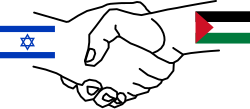
The Israeli-Palestinian Conflict is a long-running political and territorial dispute between Israelis and Palestinians over land, sovereignty, and national identity in the region of historic Palestine. Rooted in competing nationalist movements dating back to the late 19th and early 20th centuries, the conflict has involved wars, uprisings (intifadas), peace negotiations, and ongoing tensions over issues such as borders, Jerusalem, settlements, refugees, and statehood. More Less
1882 - 1903
% complete
The First Aliyah brought waves of Jewish immigrants from Eastern Europe and Yemen to Ottoman Palestine, establishing agricultural settlements and laying the demographic groundwork for future tensions between Jewish newcomers and the Arab population.
Image source: First Aliyah
Nov 2, 1917
% complete
The British government, in a letter from Foreign Secretary Arthur Balfour to Lord Rothschild, declared its support for the establishment of a 'national home for the Jewish people' in Palestine. The declaration galvanized Zionist aspirations while alarming Palestinian Arabs, who feared dispossession.
Image source: Balfour Declaration
Sep 29, 1923
% complete
The League of Nations formally granted Britain the Mandate for Palestine, charging it with administering the territory and implementing the Balfour Declaration. British rule oversaw growing Jewish immigration and land purchases, fueling Arab resentment.
Image source: Mandate for Palestine
Aug 23, 1929 - Aug 29, 1929
% complete
Widespread Arab riots erupted across Palestine following disputes over access to the Western Wall. In Hebron, dozens of Jewish residents were killed, devastating the ancient Jewish community and deepening mutual fear between the two peoples.
Image source: 1929 Palestine riots
1936 - 1939
% complete
Palestinian Arabs launched a large-scale revolt against British rule and Jewish immigration, marked by strikes, guerrilla warfare, and harsh British suppression. The revolt devastated Palestinian society and led Britain to restrict Jewish immigration via the 1939 White Paper.
Image source: 1936–1939 Arab revolt in Palestine
Nov 29, 1947
% complete
UN General Assembly Resolution 181 proposed dividing Mandatory Palestine into independent Jewish and Arab states with Jerusalem under international administration. Jewish leaders accepted the plan; Arab leaders rejected it, and civil war broke out almost immediately.
Image source: United Nations Partition Plan for Palestine
Apr 9, 1948
% complete
Paramilitary forces of the Irgun and Lehi killed over 100 Palestinian villagers near Jerusalem during the civil war phase of the conflict. The massacre spread terror among Palestinians and accelerated mass flight from areas of fighting.
Image source: Deir Yassin massacre
1948 - 1949
% complete
During the 1948 war, approximately 700,000 Palestinians fled or were expelled from their homes in what Palestinians call the Nakba ('catastrophe'). The refugee crisis remains a central grievance and a core issue in peace negotiations ever since.
Image source: 1948 Palestinian expulsion and flight
May 14, 1948 - Mar 10, 1949
% complete
David Ben-Gurion proclaimed Israel's independence as British rule ended. Armies of Egypt, Jordan, Syria, Iraq, and Lebanon invaded. By war's end, Israel controlled more territory than the partition plan allotted, while Jordan held the West Bank and Egypt held Gaza; roughly 700,000 Palestinians became refugees.
Image source: 1948 Arab–Israeli War
Oct 29, 1956 - Nov 6, 1956
% complete
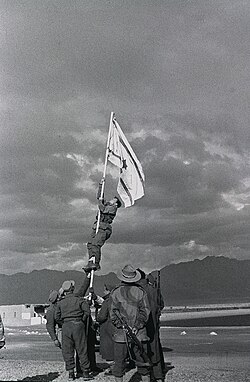
Israel invaded Egypt's Sinai Peninsula in collusion with Britain and France after Egypt nationalized the Suez Canal and blockaded Israeli shipping. International pressure forced a withdrawal, but the campaign temporarily opened the Straits of Tiran to Israeli traffic.
Image source: Suez Crisis
1967 - Aug 7, 1970
% complete
Egypt waged a prolonged campaign of artillery duels, commando raids, and aerial combat against Israeli positions along the Suez Canal, seeking to wear down Israeli defenses. The conflict ended with a ceasefire largely restoring pre-war lines.
Image source: War of Attrition
Jun 5, 1967 - Jun 10, 1967
% complete
Israel launched preemptive strikes against Egypt, Jordan, and Syria, capturing the Sinai Peninsula, Gaza Strip, West Bank, East Jerusalem, and Golan Heights in six days. The occupation of these territories fundamentally reshaped the conflict and created the framework of the modern Palestinian question.
Image source: Six-Day War
Oct 6, 1973 - Oct 25, 1973
% complete
Egypt and Syria launched surprise attacks on Israel on the holiest day of the Jewish calendar. After initial setbacks, Israel counterattacked successfully, but the war shattered complacency and set the stage for eventual Egyptian-Israeli diplomacy.
Image source: Yom Kippur War
Jun 6, 1982 - Jun 1985
% complete
Israel invaded southern Lebanon to expel the Palestine Liberation Organization (PLO), which had used Lebanon as a base for attacks. The PLO evacuated to Tunis, but the war spawned the Hezbollah insurgency and included the controversial Sabra and Shatila massacre by allied Christian militias.
Image source: 1982 Lebanon War
Dec 1987
% complete
Sheikh Ahmed Yassin and associates established Hamas as an offshoot of the Muslim Brotherhood, combining social services with armed resistance to Israel. Hamas would grow into a major political and military force opposing the peace process.
Image source: Hamas
Dec 9, 1987 - Sep 13, 1993
% complete
A mass Palestinian uprising against Israeli occupation began spontaneously in Gaza and spread throughout the territories, featuring boycotts, stone-throwing, strikes, and clashes with Israeli forces. Hundreds died, and the uprising shifted world opinion and empowered grassroots Palestinian leadership.
Image source: First Intifada
Sep 28, 2000 - Feb 8, 2005
% complete
Ariel Sharon's visit to the Temple Mount/Haram al-Sharif sparked massive protests that escalated into years of violence, including suicide bombings, Israeli military operations, and the construction of the West Bank separation barrier. Around 3,000 Palestinians and 1,000 Israelis were killed before the Sharm el-Sheikh summit restored calm.
Image source: Second Intifada
Nov 22, 1967
% complete
Resolution 242 called for Israeli withdrawal from territories occupied in the Six-Day War in exchange for recognition and peace, establishing the 'land for peace' formula that would anchor all subsequent diplomatic efforts.
Sep 17, 1978
% complete
Brokered by US President Jimmy Carter at Camp David, Egyptian President Anwar Sadat and Israeli Prime Minister Menachem Begin reached a framework for peace that led to Egypt recognizing Israel and Israel withdrawing from Sinai, though the Palestinian autonomy provisions were never implemented.
Image source: Camp David Accords
Mar 26, 1979
% complete
Egypt became the first Arab state to formally recognize Israel, signing a treaty at the White House. Israel withdrew from the Sinai Peninsula over three years, ending the state of war between the two countries.
Image source: Egypt–Israel peace treaty
Nov 15, 1988
% complete
At an Algiers meeting, the Palestine National Council proclaimed the State of Palestine, implicitly accepting UN Resolution 181's two-state logic. Dozens of states recognized the declaration, strengthening Palestinian diplomatic standing.
Image source: Palestinian Declaration of Independence
Oct 30, 1991 - Nov 1, 1991
% complete
Sponsored by the United States and Soviet Union after the Gulf War, the Madrid Conference brought Israelis and Arabs, including a joint Jordanian-Palestinian delegation, into direct multilateral talks for the first time, launching a new era of negotiation.
Image source: Madrid Conference of 1991
Sep 13, 1993
% complete
After secret negotiations in Norway, Yitzhak Rabin and Yasser Arafat signed the Declaration of Principles on the White House lawn, establishing mutual recognition between Israel and the PLO and creating the Palestinian Authority with interim self-rule in parts of the occupied territories.
Image source: Oslo I Accord
Sep 28, 1995
% complete
The Interim Agreement expanded Palestinian self-rule and partitioned the West Bank into Areas A (full Palestinian control), B (shared control), and C (full Israeli control). The division entrenched fragmented governance and became a lasting source of friction.
Image source: Oslo II Accord
Nov 4, 1995
% complete
Israeli extremist Yigal Amir shot and killed Prime Minister Yitzhak Rabin at a Tel Aviv rally, aiming to derail the Oslo process. Rabin's death removed the process's chief Israeli champion and emboldened its opponents on both sides.
Image source: Assassination of Yitzhak Rabin
Jul 11, 2000 - Jul 25, 2000
% complete
US President Bill Clinton hosted Ehud Barak and Yasser Arafat for final-status talks on borders, refugees, and Jerusalem. The summit collapsed without agreement, each side blaming the other, and the failure paved the way for renewed violence.
Image source: 2000 Camp David Summit
Mar 28, 2002
% complete
Saudi Crown Prince Abdullah introduced a plan, endorsed by the Arab League, offering full normalization between Israel and all Arab states in exchange for Israeli withdrawal from occupied territories, a Palestinian state with East Jerusalem as capital, and a just solution for refugees. Israel never formally accepted it.
Apr 30, 2003
% complete
The Quartet (US, EU, UN, Russia) presented a phased plan envisioning an independent Palestinian state alongside Israel by 2005. Implementation stalled amid continued violence, settlement growth, and Palestinian political turmoil.
Image source: Road map for peace
Aug 15, 2005 - Sep 12, 2005
% complete
Prime Minister Ariel Sharon unilaterally dismantled all 21 Israeli settlements in Gaza and four in the northern West Bank, evacuating about 8,000 settlers. Israel retained control of Gaza's borders, airspace, and coastline, and the move was followed by internal Israeli political upheaval.
Image source: Israeli disengagement from Gaza
Jan 25, 2006
% complete
Hamas won a majority of seats in the Palestinian Legislative Council, shocking Israel and Western donors who demanded Hamas renounce violence and recognize Israel. International aid was cut off, and tensions with Fatah escalated toward open conflict.
Image source: 2006 Palestinian legislative election
Jun 10, 2006 - Jun 15, 2007
% complete
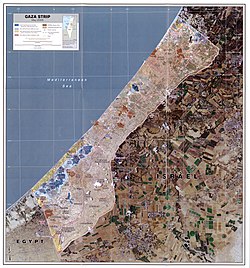
Fighting between Hamas and Fatah culminated in Hamas seizing full control of the Gaza Strip in June 2007, ousting Fatah forces. President Abbas dissolved the unity government, leaving Hamas ruling Gaza and the Palestinian Authority governing the West Bank—a split that persists today.
Image source: Battle of Gaza (2007)
Dec 27, 2008 - Jan 18, 2009
% complete
Israel launched a major offensive against Hamas in Gaza following rocket fire, conducting airstrikes and a ground invasion. Over 1,100 Palestinians and 13 Israelis were killed. The war drew widespread international criticism and UN inquiries into alleged war crimes.
May 31, 2010
% complete
Israeli commandos boarded the Turkish-led Mavi Marmara aid ship attempting to break the Gaza blockade; nine activists were killed. The raid caused a severe crisis in Israel-Turkey relations and prompted Israel to ease some restrictions on goods entering Gaza.
Image source: Gaza flotilla raid
Nov 29, 2012
% complete
By a vote of 138 to 9, the UN upgraded Palestine to non-member observer state status, implicitly recognizing Palestinian statehood within the 1967 lines. The vote enabled Palestine to join international bodies such as the ICC.
Image source: United Nations General Assembly resolution 67/19
Jul 8, 2014 - Aug 26, 2014
% complete
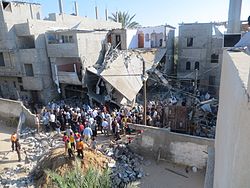
Triggered by rocket fire and the murder of Israeli and Palestinian teenagers, seven weeks of fighting between Israel and Hamas killed over 2,100 Palestinians and 73 Israelis, destroyed thousands of homes in Gaza, and ended with an Egyptian-brokered ceasefire.
Image source: 2014 Gaza War
Sep 15, 2020
% complete
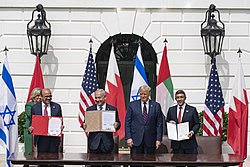
Brokered by the Trump administration, the UAE and Bahrain normalized relations with Israel, later joined by Morocco and Sudan. The accords reshaped Middle East diplomacy, sidelining the Palestinian issue in some Arab capitals and prompting fears among Palestinians of marginalization.
Image source: Abraham Accords
May 6, 2021 - May 21, 2021
% complete
Tensions over planned evictions in Sheikh Jarrah and clashes at Al-Aqsa Mosque escalated into an 11-day war between Israel and Hamas, with rockets on Israeli cities and heavy airstrikes on Gaza. More than 250 people were killed before an Egyptian-brokered ceasefire took hold.
Image source: 2021 Israel–Palestine crisis
Or browse the full history timeline directory, with more than 2,000 topics.
This Israeli-Palestinian Conflict timeline was generated with the help of AI, using information found on the internet.
We work hard to keep these timelines accurate, but mistakes do get through. If you spot one, email us at [email protected] and we'll fix it for future visitors.
Generate yours with AI or build it from scratch, for free.
Export your timeline, add your own events, edit or remove AI-generated events, and much more
No credit card required.
Cancel anytime.
Cancel anytime.
You can create an unlimited number of timelines with up to 10 events on each one, customize how they look, export them to PDF, PNG, PowerPoint, CSV, and Excel, and share them with a link. Paid plans raise the event limit and add features like spreadsheet imports and collaborators.
Yes. You can cancel your subscription from your account page at any time, and you will not be charged again. Your subscription stays active for the rest of the period you already paid for.
Yes. We will email you a reminder before the annual renewal, and we will also email you a receipt.
Yes. You can email us within 15 days of any payment, and we will issue you a full refund.
Check out our pricing docs or send us an email anytime: [email protected].