-
Use Cases
-
Resources
-
Pricing
The War on Terror is the international military and political campaign launched by the United States and its allies following the September 11, 2001 terrorist attacks. It encompasses the invasions of Afghanistan and Iraq, the fight against al-Qaeda and ISIS, drone warfare, counterterrorism legislation, and ongoing operations against extremist groups across the Middle East, Africa, and Asia. More Less
Dec 24, 1979 - Feb 15, 1989
% complete
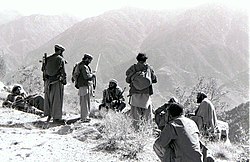
The Soviet Union invaded Afghanistan to support the communist government against mujahideen fighters. The decade-long war, backed by US-funded arms through Operation Cyclone, devastated Afghanistan and created conditions that later enabled the rise of extremist groups including al-Qaeda.
Image source: Soviet–Afghan War
Aug 11, 1988
% complete
Osama bin Laden established al-Qaeda, a militant Sunni Islamist organization, drawing on veterans of the Afghan war against the Soviets. The network would go on to orchestrate attacks on American targets worldwide, culminating in the September 11 attacks.
Image source: Al-Qaeda
Aug 7, 1998
% complete
Al-Qaeda carried out near-simultaneous truck bombings at the US embassies in Nairobi, Kenya, and Dar es Salaam, Tanzania, killing 224 people. The attacks prompted US cruise missile strikes on targets in Afghanistan and Sudan and put bin Laden at the top of America's most-wanted list.
Image source: 1998 United States embassy bombings
Oct 12, 2000
% complete
Al-Qaeda operatives attacked the US Navy destroyer USS Cole with a suicide boat bomb while it refueled in Aden, Yemen, killing 17 American sailors. The attack demonstrated al-Qaeda's growing capability and resolve to strike US military assets.
Image source: USS Cole bombing
Sep 11, 2001
% complete
Nineteen al-Qaeda hijackers seized four commercial airliners, crashing two into the World Trade Center towers in New York City, one into the Pentagon, and one into a Pennsylvania field after passengers fought back. Nearly 3,000 people were killed in the deadliest attack on US soil, prompting the global War on Terror.
Image source: September 11 attacks
Sep 14, 2001
% complete
Congress overwhelmingly passed the Authorization for Use of Military Force (AUMF), granting President Bush broad authority to use force against those responsible for the September 11 attacks. The 2001 AUMF has since underpinned US military operations in numerous countries.
Image source: Authorization for Use of Military Force of 2001
Sep 20, 2001
% complete
President George W. Bush addressed a joint session of Congress declaring a global 'War on Terror,' demanding that the Taliban hand over bin Laden and vowing to pursue terrorist organizations and the nations that harbor them anywhere in the world.
Image source: War on terror
Oct 26, 2001
% complete
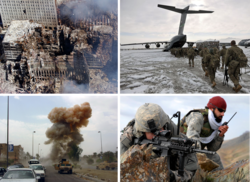
President Bush signed the USA PATRIOT Act, dramatically expanding government surveillance powers, enhancing law enforcement's ability to investigate terrorism, and increasing information sharing among intelligence agencies. The law sparked ongoing debates over civil liberties and privacy.
Image source: Patriot Act
Jan 11, 2002
% complete
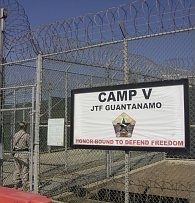
The first detainees from the War on Terror arrived at the US naval base at Guantanamo Bay, Cuba, which became the primary detention facility for suspected terrorists. The camp became internationally controversial over allegations of torture, indefinite detention without trial, and human rights abuses.
Image source: Guantanamo Bay detention camp
Jan 23, 2002 - Feb 1, 2002
% complete
Wall Street Journal reporter Daniel Pearl was abducted in Karachi by militants linked to al-Qaeda and beheaded, with his murder filmed and released online. The killing shocked journalists worldwide and highlighted the dangers faced by reporters covering terrorism.
Image source: Daniel Pearl
Oct 12, 2002
% complete
Jemaah Islamiyah, an al-Qaeda-linked group, detonated bombs at nightclubs in Kuta, Bali, killing 202 people, mostly foreign tourists. It was the deadliest terrorist attack in Indonesia's history and prompted a major regional counterterrorism crackdown.
Image source: 2002 Bali bombings
Mar 11, 2004
% complete
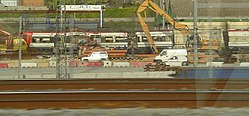
Coordinated bombs ripped through commuter trains in Madrid during rush hour, killing 193 people in Europe's deadliest jihadist attack. Three days later, Spanish voters ousted the government that had supported the Iraq War.
Image source: 2004 Madrid train bombings
Sep 1, 2004 - Sep 3, 2004
% complete
Chechen separatist militants seized School No. 1 in Beslan, Russia, taking more than 1,100 hostages including hundreds of children. At least 334 people died when security forces stormed the building, one of the deadliest terrorist attacks ever recorded.
Image source: Beslan school siege
Jul 7, 2005
% complete
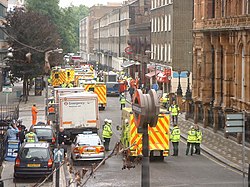
Four British suicide bombers attacked London's public transport system during morning rush hour, killing 52 commuters. The attacks by homegrown radicals shocked Britain and reshaped its domestic counterterrorism strategy.
Image source: 7 July 2005 London bombings
Dec 27, 2007
% complete
Former Pakistani Prime Minister Benazir Bhutto was killed in a suicide attack in Rawalpindi while campaigning for her return to power. Her assassination destabilized Pakistan and underscored the threat posed by militants along its border regions.
Image source: Assassination of Benazir Bhutto
Nov 26, 2008 - Nov 29, 2008
% complete
Lashkar-e-Taiba militants launched coordinated shootings and bombings across Mumbai, attacking the Taj Mahal Palace hotel and other landmarks and killing 166 people over four days. The siege exposed gaps in India's coastal security and counterterrorism readiness.
Image source: 2008 Mumbai attacks
Jan 20, 2009
% complete
Barack Obama inherited two wars and pledged to refocus resources on Afghanistan and Pakistan, calling it the central front against al-Qaeda. He ordered troop increases in Afghanistan while setting a timetable to end the combat mission in Iraq.
Image source: Presidency of Barack Obama
Dec 25, 2009
% complete
Umar Farouk Abdulmutallab attempted to detonate explosives hidden in his underwear aboard Northwest Airlines Flight 253 as it approached Detroit. The failed attack by an al-Qaeda affiliate in Yemen prompted sweeping changes in airport screening worldwide.
Image source: Northwest Airlines Flight 253
May 1, 2010
% complete
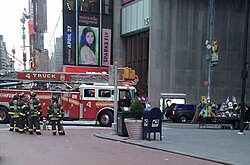
Faisal Shahzad parked a car bomb in Times Square, New York City, but the device failed to explode. He was arrested aboard a plane bound for Dubai days later, having been trained by the Pakistani Taliban, highlighting homegrown terrorism threats.
Image source: 2010 Times Square car bombing attempt
Dec 18, 2010
% complete
Popular uprisings toppled authoritarian regimes in Tunisia, Egypt, Libya, and beyond. The chaos of the Arab Spring, particularly Syria's civil war, created power vacuums exploited by extremist groups like ISIS and reshaped the counterterrorism landscape.
Image source: Arab Spring
May 2, 2011
% complete
US Navy SEALs conducted a nighttime helicopter raid on a compound in Abbottabad, Pakistan, killing al-Qaeda leader Osama bin Laden, who had evaded capture for nearly a decade. Crowds celebrated outside the White House as President Obama announced his death.
Image source: Killing of Osama bin Laden
Sep 30, 2011
% complete
A CIA drone strike in Yemen killed Anwar al-Awlaki, an American-born cleric and leading propagandist for al-Qaeda in the Arabian Peninsula. The targeted killing of a US citizen raised significant legal and ethical questions about drone warfare.
Image source: Anwar al-Awlaki
Sep 22, 2014
% complete
The United States formed an international coalition and began airstrikes against ISIS in Iraq and later Syria, marking America's return to military action in Iraq. Operation Inherent Resolve grew into a multiyear campaign involving dozens of nations.
Image source: Combined Joint Task Force – Operation Inherent Resolve
Jan 7, 2015 - Jan 9, 2015
% complete
Two brothers loyal to al-Qaeda stormed the offices of satirical magazine Charlie Hebdo in Paris, killing 12 people. A related hostage crisis followed, and the attacks galvanized European counterterrorism efforts under the banner of free expression.
Image source: Charlie Hebdo shooting
Nov 13, 2015
% complete
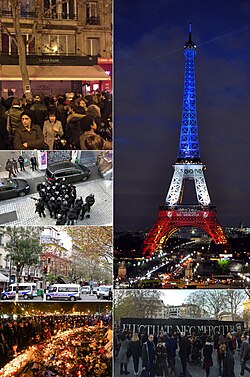
ISIS attackers struck the Bataclan concert hall, cafes, and a stadium in Paris, killing 130 people in the deadliest attack in France since World War II. France responded by intensifying airstrikes against ISIS and declaring a state of emergency.
Image source: November 2015 Paris attacks
Dec 2, 2015
% complete
A married couple inspired by ISIS opened fire at a holiday party in San Bernardino, California, killing 14 people. The attack intensified debates in the US over radicalization, gun control, and surveillance.
Image source: 2015 San Bernardino attack
Jun 12, 2016
% complete
Omar Mateen, who had pledged allegiance to ISIS, killed 49 people at the Pulse nightclub in Orlando, Florida, in the deadliest mass shooting in modern US history at the time. The attack targeted the LGBTQ community and shocked the nation.
Image source: Pulse nightclub shooting
Oct 1, 2017
% complete
Stephen Paddock fired on crowds attending a music festival from a Las Vegas hotel window, killing 58 people and injuring hundreds more. Though not attributed to international terrorism, the massacre fueled national debates about gun policy and mass violence.
Image source: 2017 Las Vegas shooting
Oct 17, 2017
% complete
US-backed Syrian Democratic Forces captured Raqqa after months of fighting, ending ISIS's self-declared capital. The loss of Raqqa, following Mosul's fall, effectively dismantled ISIS's territorial proto-state.
Image source: Battle of Raqqa (2017)
Oct 26, 2019
% complete
US special forces raided a compound in northwestern Syria, killing ISIS leader Abu Bakr al-Baghdadi, who detonated a suicide vest as commandos closed in. The operation removed the world's most wanted terrorist leader.
Image source: Death of Abu Bakr al-Baghdadi
Oct 7, 2001
% complete
The United States, joined by British forces, launched Operation Enduring Freedom with airstrikes and special operations forces supporting the Northern Alliance against the Taliban regime, which had sheltered al-Qaeda. The invasion toppled the Taliban government within weeks.
Image source: United States invasion of Afghanistan
Nov 13, 2001
% complete
Northern Alliance forces captured Kabul as the Taliban retreated southward, marking the collapse of Taliban rule in Afghanistan's capital. An interim government under Hamid Karzai was soon established with international backing.
Image source: Fall of Kabul (2001)
Dec 5, 2001
% complete
Afghan political factions meeting in Bonn, Germany, agreed to establish an interim authority led by Hamid Karzai, laying out a path toward a new constitution and democratic elections in post-Taliban Afghanistan.
Image source: Bonn Agreement (Afghanistan)
Dec 12, 2001 - Dec 17, 2001
% complete
US and allied Afghan forces assaulted the cave complex of Tora Bora in eastern Afghanistan where Osama bin Laden was believed to be hiding. Despite intense bombardment, bin Laden escaped across the border into Pakistan, evading capture for nearly another decade.
Image source: Battle of Tora Bora
Jan 1, 2003
% complete
Provincial Reconstruction Teams combining military personnel and civilian experts began deploying across Afghanistan to extend governance, rebuild infrastructure, and win support among rural populations, becoming a centerpiece of stabilization efforts.
Image source: Provincial Reconstruction Team
Dec 1, 2009
% complete
President Obama announced he would send 30,000 additional troops to Afghanistan to break the Taliban's momentum while setting July 2011 as the date to begin drawing forces down, balancing escalation with an eventual exit strategy.
Image source: War in Afghanistan (2001–2021)
Feb 29, 2020
% complete
The United States and the Taliban signed an agreement in Doha, Qatar, committing to the phased withdrawal of all US troops by May 2021 in exchange for Taliban guarantees against harboring terrorists and commitments to intra-Afghan talks.
Image source: United States–Taliban deal
Aug 30, 2021
% complete
The last American soldiers departed Kabul's Hamid Karzai International Airport, ending America's longest war after nearly twenty years. The chaotic withdrawal followed the Taliban's swift reconquest of the country, closing a defining chapter of the War on Terror.
Image source: War in Afghanistan (2001–2021)
Mar 20, 2003 - May 1, 2003
% complete
A US-led coalition invaded Iraq, alleging that Saddam Hussein possessed weapons of mass destruction and ties to terrorism. Baghdad fell within three weeks, and Bush declared major combat operations ended on May 1, though no stockpiles of WMD were ever found.
Image source: 2003 invasion of Iraq
Apr 9, 2003
% complete
US forces entered Baghdad, toppling Saddam Hussein's regime as iconic footage showed a statue of the dictator pulled down in Firdos Square. The rapid victory was followed by widespread looting and the beginning of a difficult occupation.
Image source: Battle of Baghdad (2003)
Dec 13, 2003
% complete
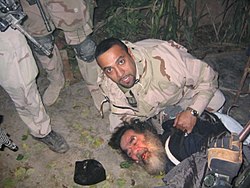
American forces found Saddam Hussein hiding in a spider hole near Tikrit during Operation Red Dawn. His capture removed the figurehead of the former regime, though an insurgency continued to intensify across Iraq.
Image source: Capture of Saddam Hussein
Apr 28, 2004
% complete
CBS News broadcast photographs showing US soldiers abusing Iraqi detainees at Abu Ghraib prison, sparking global outrage, damaging America's moral standing, and fueling insurgent recruitment. Several soldiers were court-martialed in the scandal's aftermath.
Image source: Abu Ghraib torture and prisoner abuse
Feb 22, 2006
% complete
The bombing of the golden-domed Al-Askari Shrine in Samarra ignited full-scale sectarian warfare between Iraq's Shia and Sunni communities, driving Iraq to the brink of civil war and sharply increasing American troop casualties.
Image source: 2006 al-Askari mosque bombing
Jan 10, 2007
% complete
President Bush announced the deployment of more than 20,000 additional troops to Iraq to secure Baghdad and quell sectarian violence. Combined with Sunni tribal cooperation against al-Qaeda in Iraq, the surge substantially reduced violence by 2008.
Image source: Iraq War troop surge of 2007
Jun 30, 2009
% complete
Under a status of forces agreement with Iraq, American forces withdrew from urban areas and handed security responsibilities to Iraqi forces, a milestone on the road to full US withdrawal planned for the end of 2011.
Image source: Withdrawal of United States troops from Iraq (2007–2011)
Dec 18, 2011
% complete
The final convoy of American soldiers crossed into Kuwait, ending nearly nine years of US military presence in Iraq. The withdrawal left behind a fragile Iraqi state that would soon be tested by resurgent Sunni extremism.
Jun 29, 2014
% complete
The Islamic State in Iraq and Syria proclaimed a caliphate under Abu Bakr al-Baghdadi after seizing Mosul and vast territory in western Iraq and eastern Syria. Its brutal rule and global recruitment campaign triggered renewed international intervention.
Image source: Islamic State
Oct 17, 2016 - Jul 10, 2017
% complete
Iraqi forces backed by the US-led coalition launched a massive offensive to retake Mosul, ISIS's largest stronghold. After nine months of brutal urban combat, Iraq declared victory, dealing a decisive blow to ISIS's territorial control.
Image source: Battle of Mosul (2016–2017)
Or browse the full history timeline directory, with more than 2,000 topics.
This War on Terror timeline was generated with the help of AI, using information found on the internet.
We work hard to keep these timelines accurate, but mistakes do get through. If you spot one, email us at [email protected] and we'll fix it for future visitors.
Generate yours with AI or build it from scratch, for free.
Export your timeline, add your own events, edit or remove AI-generated events, and much more
No credit card required.
Cancel anytime.
Cancel anytime.
You can create an unlimited number of timelines with up to 10 events on each one, customize how they look, export them to PDF, PNG, PowerPoint, CSV, and Excel, and share them with a link. Paid plans raise the event limit and add features like spreadsheet imports and collaborators.
Yes. You can cancel your subscription from your account page at any time, and you will not be charged again. Your subscription stays active for the rest of the period you already paid for.
Yes. We will email you a reminder before the annual renewal, and we will also email you a receipt.
Yes. You can email us within 15 days of any payment, and we will issue you a full refund.
Check out our pricing docs or send us an email anytime: [email protected].