-
Use Cases
-
Resources
-
Pricing
Aug 25, 1530
% complete
Ivan IV Vasilyevich, later known as Ivan the Terrible, was born in Kolomenskoye, near Moscow, to Grand Prince Vasily III of Moscow. His birth secured the continuation of the Rurik dynasty, though his father would die just three years later, setting the stage for a turbulent childhood.
Image source: Ivan the Terrible
Dec 3, 1533
% complete
Following the death of his father Vasily III, the three-year-old Ivan became Grand Prince of Moscow. His mother Elena Glinskaya initially ruled as regent on his behalf, governing the state during his minority.
Image source: Vasili III of Russia
Apr 4, 1538
% complete
Ivan's mother, Elena Glinskaya, died suddenly, widely suspected to have been poisoned by boyar rivals. Her death left the young prince at the mercy of feuding boyar factions, particularly the Shuisky family, whose neglect reportedly traumatized him and shaped his later distrust of nobility.
Image source: Elena Glinskaya
Jan 16, 1547
% complete
At age sixteen, Ivan IV was crowned with the Monomakh's Cap as the first Tsar of All Russia by Metropolitan Macarius in Moscow's Cathedral of the Dormition. The title elevated Russia from a grand duchy to a sovereign empire, asserting claims to imperial Byzantine heritage.
Image source: Tsardom of Russia
Mar 31, 1584
% complete
Ivan's surviving son Fyodor I succeeded him, though the pious but intellectually weak tsar left governance largely to his brother-in-law Boris Godunov. With no male heir, Fyodor's reign set the stage for dynastic crisis after his death in 1598.
Image source: Feodor I of Russia
Feb 3, 1547
% complete
Two weeks after his coronation, Ivan married Anastasia Romanovna Zakharina-Yurieva, chosen from a bride show. Anastasia became a calming influence on Ivan's temperament, and their marriage lasted thirteen years until her death, which profoundly affected the tsar's mental state.
Image source: Anastasia Romanovna
Aug 7, 1560
% complete
Ivan's beloved wife died suddenly, and rumors spread that she had been poisoned by boyars. Grief-stricken and increasingly paranoid, the tsar turned sharply against his former advisors, and his behavior grew noticeably more erratic and cruel in the following years.
1561
% complete
Roughly a year after Anastasia's death, Ivan married Maria Temryukovna, daughter of a Circassian prince of Kabardia. The union brought Circassian influence to court but did little to temper Ivan's growing paranoia and cruelty.
Image source: Maria Temryukovna
Nov 1571
% complete
Ivan selected Marfa Sobakina as his fifth wife through a bride show, but she fell gravely ill shortly after the wedding and died within weeks, possibly poisoned. The scandal prompted church scrutiny of Ivan's repeated marriages, which violated canon law.
Image source: Marfa Sobakina
Nov 19, 1581
% complete
In a fit of rage, Ivan struck his pregnant son and heir apparent with a staff, inflicting wounds that proved fatal within days. The death of Ivan Ivanovich left the succession to the frail Fyodor and is often cited as a symbolic end to the Rurikid line's strength.
Image source: Tsarevich Ivan Ivanovich of Russia
Mar 28, 1584
% complete
Ivan died suddenly in Moscow while preparing for a game of chess, aged fifty-three. Contemporaries noted his body appeared swollen and decomposing rapidly, fueling speculation about poisoning. He was buried alongside his son Ivan in the Archangel Cathedral of the Kremlin.
Jun 21, 1547 - Jun 29, 1547
% complete
A devastating fire swept through Moscow, killing thousands and leaving much of the city in ruins. Rumors blamed the Glinsky family for arson, sparking an armed uprising that forced Ivan to witness mob violence against his relatives, deepening his resolve to curb boyar power.
Image source: Fire of Moscow (1547)
Feb 27, 1549
% complete
Ivan convened the first zemsky sobor, an assembly of representatives from clergy, nobility, merchants, and commoners. The council addressed grievances against corrupt officials and endorsed reforms, marking an early experiment in consultative governance in Russia.
Image source: Zemsky Sobor
1550
% complete
The Sudebnik of 1550 standardized laws across the realm, codified judicial procedures, limited corruption through regulated fees, and strengthened central authority. It formed part of a broader program of reforms undertaken with Ivan's circle of advisors known as the Chosen Council.
Image source: Sudebnik of 1497
1550
% complete
Ivan created the streltsy, Russia's first standing army units armed with firearms, organized into permanent regiments based in towns. They played crucial roles in subsequent wars and sieges, though centuries later they would clash with Peter the Great.
Image source: Streltsy
Aug 24, 1553
% complete
English explorer Richard Chancellor reached Moscow seeking the Northeast Passage and met with Ivan, who welcomed trade ties. The encounter established the Muscovy Company and opened direct commercial relations between England and Russia, bypassing Polish-Lithuanian intermediaries.
Image source: Richard Chancellor
1560
% complete
After Anastasia's death, Ivan disbanded the Chosen Council, exiling or disgracing key advisors like Adashev and Silvester. The collapse ended the era of collaborative reform and signaled Ivan's determination to rule autocratically without noble counsel.
1562 - 1583
% complete
Ivan conducted a lengthy diplomatic correspondence with Queen Elizabeth I, proposing marriage at one point and seeking military alliance and asylum guarantees. Though the match never materialized, English merchants received privileged trading rights within Russia.
Image source: Muscovy Company
Dec 1564 - 1572
% complete
After abruptly departing Moscow and threatening abdication, Ivan returned with the boyars' submission and split the country into the oprichnina under his personal control and the zemshchina. Backed by the feared oprichniki, he waged terror against suspected traitors among the nobility.
Image source: Oprichnina
Jan 2, 1570 - Feb 13, 1570
% complete
Suspecting Novgorod of treasonous dealings with Poland-Lithuania, Ivan led the oprichniki in a six-week orgy of violence against the great trading city. Thousands were tortured and killed, churches were looted, and Novgorod never recovered its former prominence.
Image source: Massacre of Novgorod
1572
% complete
Following the failure of oprichnina forces against Báthory's armies and the general devastation it caused, Ivan formally abolished the oprichnina and even forbade mention of the word. Its legacy of terror and economic ruin nonetheless scarred the nation.
1584
% complete
In one of his last acts as tsar, Ivan ordered the founding of New Kholmogory at the mouth of the Northern Dvina, later renamed Arkhangelsk. It became Russia's principal Arctic seaport for trade with Western Europe until St. Petersburg rose a generation later.
Image source: Arkhangelsk
Oct 2, 1552
% complete
Russian forces under Ivan stormed and captured the Tatar stronghold of Kazan after a prolonged siege, toppling the Khanate of Kazan. This victory marked the beginning of Russian expansion into the Volga region and incorporated large Muslim populations into the tsardom.
Image source: Siege of Kazan
1556
% complete
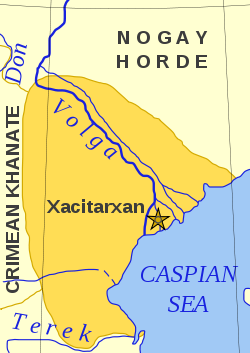
Building on the conquest of Kazan, Russian troops seized Astrakhan without major resistance, bringing the entire Volga river basin under Muscovite control. The annexation opened trade routes to Persia and Central Asia and made Russia a multiethnic empire.
Image source: Astrakhan Khanate
Jan 22, 1558
% complete
Seeking access to Baltic Sea ports, Ivan ordered the invasion of the Livonian Confederation, initiating the long and costly Livonian War. Initial victories gave Russia control of key towns such as Narva and Dorpat before the conflict widened into a pan-European struggle.
Image source: Livonian War
Jul 1572 - Aug 1572
% complete
Near Moscow, Russian forces decisively crushed a massive invading force of Crimean Tatars and Nogais under Devlet Giray. The victory at Molodi saved Moscow from destruction and secured Russia's southern frontier for decades.
Image source: Battle of Molodi
1581 - 1585
% complete
The Cossack leader Yermak Timofeyevich, backed by the Stroganov merchant family, led an expedition east across the Urals that defeated Kuchum, Khan of Sibir. This campaign launched the Russian conquest of Siberia, one of Ivan's most consequential expansions.
Image source: Yermak Timofeyevich
Jan 15, 1582
% complete
Exhausted by decades of fighting against Poland-Lithuania, Sweden, and Denmark, Russia signed the Truce of Jam Zapolski with Stephen Báthory of Poland, ceding Livonia. The war ended in strategic failure, denying Ivan his coveted Baltic coastline.
Image source: Livonian War
Or browse the full history timeline directory, with more than 2,000 topics.
This Ivan the Terrible timeline was generated with the help of AI, using information found on the internet.
We work hard to keep these timelines accurate, but mistakes do get through. If you spot one, email us at [email protected] and we'll fix it for future visitors.
Generate yours with AI or build it from scratch, for free.
Export your timeline, add your own events, edit or remove AI-generated events, and much more
No credit card required.
Cancel anytime.
Cancel anytime.
You can create an unlimited number of timelines with up to 10 events on each one, customize how they look, export them to PDF, PNG, PowerPoint, CSV, and Excel, and share them with a link. Paid plans raise the event limit and add features like spreadsheet imports and collaborators.
Yes. You can cancel your subscription from your account page at any time, and you will not be charged again. Your subscription stays active for the rest of the period you already paid for.
Yes. We will email you a reminder before the annual renewal, and we will also email you a receipt.
Yes. You can email us within 15 days of any payment, and we will issue you a full refund.
Check out our pricing docs or send us an email anytime: [email protected].