-
Use Cases
-
Resources
-
Pricing
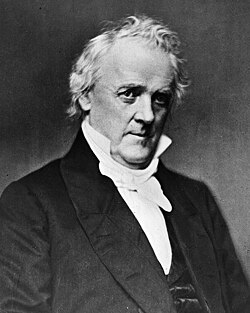
James Buchanan was the 15th President of the United States (1857–1861), the only president from Pennsylvania and the only one to remain a lifelong bachelor. His presidency was dominated by the sectional crisis over slavery, including the Dred Scott decision, Bleeding Kansas, and the secession of Southern states that preceded the Civil War. More Less
Apr 23, 1791
% complete
James Buchanan was born on April 23, 1791, in a log cabin at Cove Gap (now Buchanan's Birthplace State Park), near Mercersburg, Pennsylvania. He was the son of Irish immigrant James Buchanan Sr. and Elizabeth Speer, the second of eleven children.
Image source: James Buchanan
1807 - 1809
% complete
Buchanan enrolled at Dickinson College in Carlisle, Pennsylvania, where he studied law and classical subjects. Though briefly expelled for disciplinary issues, he was reinstated and graduated with honors in 1809.
Image source: Dickinson College
1812
% complete
After studying law in Lancaster under attorney John Kittera, Buchanan passed the bar exam in 1812 and began practicing law in Lancaster, quickly building a successful practice.
1814
% complete
During the British threat to Baltimore in 1814, Buchanan volunteered in a Pennsylvania militia unit that helped defend Baltimore, though he saw no combat action.
Image source: War of 1812
1819
% complete
Buchanan became engaged to Ann Caroline Coleman, but the engagement broke off amid rumors and misunderstandings. Ann died shortly afterward, possibly by suicide, and Buchanan never married, remaining a lifelong bachelor.
1816
% complete
Buchanan began his political career by winning election to the Pennsylvania House of Representatives as a Federalist, serving multiple terms and establishing himself as a rising figure in state politics.
Image source: Pennsylvania House of Representatives
1821 - 1831
% complete
Buchanan won election to the U.S. House of Representatives from Pennsylvania, serving five terms. He aligned first with the Federalists and later joined Andrew Jackson's Democratic Party.
Image source: United States House of Representatives
Apr 11, 1832 - Aug 5, 1833
% complete
President Andrew Jackson appointed Buchanan as the United States minister to Russia. During his tenure, he negotiated a commercial treaty with Russia, the first of its kind between the two nations.
Image source: List of ambassadors of the United States to Russia
Dec 6, 1834 - Mar 4, 1845
% complete
Buchanan was elected to the U.S. Senate from Pennsylvania as a Democrat, serving over a decade. He became a prominent voice on foreign policy and supported territorial expansion while defending Southern interests on slavery.
Image source: United States Senate
Mar 10, 1845 - Mar 7, 1849
% complete
President James K. Polk appointed Buchanan as Secretary of State. He helped negotiate the Oregon Treaty with Britain and managed diplomacy during the Mexican-American War, including negotiations over California and New Mexico.
Jun 15, 1846
% complete
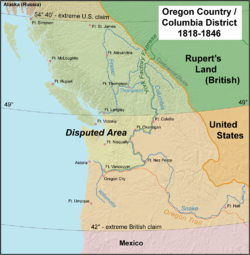
As Secretary of State, Buchanan helped negotiate the Oregon Treaty, which set the boundary between American and British territory at the 49th parallel, peacefully resolving a long-standing dispute over the Pacific Northwest.
Image source: Oregon Treaty
Feb 2, 1848
% complete
Buchanan participated in the diplomatic efforts surrounding the war's conclusion. The treaty ceded vast territories including California and New Mexico to the United States, expanding the nation significantly.
Image source: Treaty of Guadalupe Hidalgo
1853 - 1856
% complete
President Franklin Pierce appointed Buchanan as minister to the Court of St James's. While abroad, he contributed to the controversial Ostend Manifesto, which proposed the acquisition of Cuba from Spain.
May 30, 1854
% complete
The Kansas-Nebraska Act, allowing settlers to decide slavery's fate through popular sovereignty, shattered the Missouri Compromise and intensified sectional tensions, setting the stage for Buchanan's presidency.
Image source: Kansas–Nebraska Act
Oct 9, 1854
% complete
Buchanan, along with ministers John Mason and Pierre Soulé, drafted the Ostend Manifesto in Belgium, urging the purchase or seizure of Cuba to protect Southern slaveholding interests. The document was leaked and caused a national scandal.
Image source: Ostend Manifesto
Jun 5, 1856
% complete
The Democratic Party nominated James Buchanan for president at its convention in Cincinnati, Ohio, choosing him partly because his diplomatic service abroad had kept him away from the bitter domestic battles over Kansas.
Image source: 1856 Democratic National Convention
Nov 4, 1856
% complete
Buchanan defeated Republican John C. Frémont and Know Nothing candidate Millard Fillmore, winning 174 electoral votes. He carried every slave state except Maryland and five free states, becoming the 15th president-elect.
Image source: 1856 United States presidential election
1857 - 1858
% complete
Violence between pro-slavery and antislavery settlers raged in Kansas Territory. Buchanan endorsed the pro-slavery Lecompton Constitution, deepening the split within the Democratic Party and alienating Northern Democrats like Stephen Douglas.
Image source: Bleeding Kansas
Mar 4, 1857
% complete
James Buchanan took the oath of office on the Capitol's east portico, becoming the 15th president and the only president from Pennsylvania. In his inaugural address, he expressed hope that the Supreme Court would settle the slavery question.
Image source: Inauguration of James Buchanan
Mar 6, 1857
% complete
Two days after Buchanan's inauguration, the Supreme Court ruled that African Americans were not citizens and Congress could not bar slavery from territories. Buchanan had hinted at the decision in his inaugural address, having learned of it beforehand, which inflamed Northern outrage.
Image source: Dred Scott v. Sandford
May 1857 - Jul 1858
% complete
Buchanan sent federal troops to Utah Territory to assert authority over Brigham Young's Mormon community, fearing rebellion. The largely bloodless conflict ended with a negotiated settlement after a winter standoff.
Image source: Utah War
Aug 24, 1857 - 1858
% complete
A financial crisis triggered by the failure of Ohio Life Insurance and Trust Company plunged the nation into a severe depression. Buchanan took a limited-government approach, refusing to intervene substantially, which drew criticism as unemployment soared.
Image source: Panic of 1857
Aug 21, 1858 - Oct 16, 1858
% complete
While Buchanan presided, Abraham Lincoln and Stephen Douglas debated slavery's expansion across Illinois. Douglas's victory weakened Buchanan's hold on the Democratic Party, while Lincoln's national profile rose dramatically.
Image source: Lincoln–Douglas debates
Oct 16, 1859 - Oct 18, 1859
% complete
Abolitionist John Brown seized the federal arsenal at Harpers Ferry, Virginia, hoping to spark a slave uprising. Federal troops under Robert E. Lee captured him, and his execution further polarized North and South during Buchanan's presidency.
Image source: John Brown's raid on Harpers Ferry
Apr 1860 - Jun 1860
% complete
The Democratic Party fractured at its Charleston convention over slavery, with Southern delegates walking out. The party split into Northern and Southern factions, effectively guaranteeing Republican victory and dooming Buchanan's legacy.
Image source: 1860 Democratic National Conventions
Nov 6, 1860
% complete
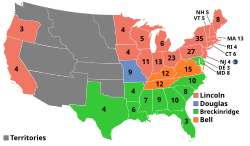
Lincoln's victory without any Southern support convinced Southern leaders that their interests were no longer safe in the Union. Buchanan, a lame duck, faced an escalating secession crisis in his final months.
Image source: 1860 United States presidential election
Dec 20, 1860
% complete
Following Lincoln's election, South Carolina declared secession, followed by six more Southern states before Buchanan left office. Buchanan declared secession illegal but also believed the federal government lacked power to coerce states, taking little decisive action.
Image source: South Carolina Declaration of Secession
Jan 9, 1861
% complete
Buchanan ordered the unarmed merchant ship Star of the West to reinforce Fort Sumter in Charleston Harbor. South Carolina batteries fired on the ship, forcing it to turn back — widely considered the first shots of the Civil War.
Image source: Star of the West
Feb 8, 1861
% complete
Seven seceding states formed the Confederate States of America, electing Jefferson Davis as president. Buchanan handed Lincoln a nation on the brink of civil war, having failed to resolve the crisis.
Image source: Confederate States of America
Mar 4, 1861
% complete
Leaving office deeply unpopular, Buchanan retired to his estate, Wheatland, in Lancaster, Pennsylvania. He watched the Civil War unfold and supported the Union cause, though many blamed him for failing to prevent the conflict.
Image source: Wheatland (James Buchanan House)
Apr 12, 1861
% complete
Just weeks after Buchanan left office, Confederate forces bombarded Fort Sumter, igniting the Civil War. Critics blamed Buchanan's indecisiveness for emboldening secessionists during the interregnum.
Image source: Battle of Fort Sumter
1866
% complete
Buchanan published 'Mr. Buchanan's Administration on the Eve of the Rebellion,' a book defending his handling of the secession crisis. It received harsh reviews and did little to rehabilitate his reputation.
Image source: Mr. Buchanan's Administration on the Eve of the Rebellion
Jun 1, 1868
% complete
Buchanan died of respiratory failure at age 77 at his home in Lancaster, Pennsylvania. He was buried in Woodward Hill Cemetery. Historians have consistently ranked him among the worst presidents due to his failure to address the secession crisis.
Or browse the full history timeline directory, with more than 2,000 topics.
This James Buchanan timeline was generated with the help of AI, using information found on the internet.
We work hard to keep these timelines accurate, but mistakes do get through. If you spot one, email us at [email protected] and we'll fix it for future visitors.
Generate yours with AI or build it from scratch, for free.
Export your timeline, add your own events, edit or remove AI-generated events, and much more
No credit card required.
Cancel anytime.
Cancel anytime.
You can create an unlimited number of timelines with up to 10 events on each one, customize how they look, export them to PDF, PNG, PowerPoint, CSV, and Excel, and share them with a link. Paid plans raise the event limit and add features like spreadsheet imports and collaborators.
Yes. You can cancel your subscription from your account page at any time, and you will not be charged again. Your subscription stays active for the rest of the period you already paid for.
Yes. We will email you a reminder before the annual renewal, and we will also email you a receipt.
Yes. You can email us within 15 days of any payment, and we will issue you a full refund.
Check out our pricing docs or send us an email anytime: [email protected].