-
Use Cases
-
Resources
-
Pricing
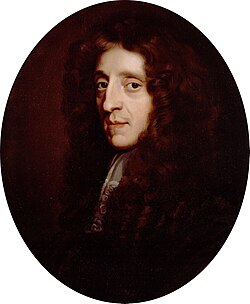
John Locke (1632–1704) was an English philosopher and physician widely regarded as one of the most influential Enlightenment thinkers, often called the father of liberalism. His works on political philosophy, including the Two Treatises of Government, and his theory of empiricism profoundly shaped modern ideas about natural rights, government by consent, and individual liberty. More Less
Aug 29, 1632
% complete
John Locke was born on 29 August 1632 to Puritan parents in the village of Wrington, Somerset. His father, born in 1606, was 23 when he married Agnes Keene, age 33. There was no hint at his birth that he would become a notable figure in history.
Image source: John Locke
1633
% complete
Soon after Locke's birth, the family moved to the market town of Pensford, about seven miles south of Bristol, into a house his father Nicholas, a lawyer involved in the cloth trade, had received.
1642
% complete
Young Locke was 10 at the outbreak of the English Civil War in 1642, which pitted royalists supporting Charles I against Parliamentarian forces. He lived through the turbulent era of war and the Commonwealth that followed the execution of Charles I.
Image source: English Civil War
1647
% complete
In 1647, young Locke's provincial life changed when he became a student at the prestigious Westminster School in London, under the sponsorship of Popham.
Image source: Westminster School
1648
% complete
Locke's father continued in the cloth trade as a businessman involved in the putting-out system, providing raw wool to weavers working in their homes, then collecting the finished cloth and sending it on.
Feb 1656
% complete
Locke was awarded a bachelor's degree from Christ Church, Oxford, in February 1656, during the Interregnum period.
Jun 1658
% complete
Locke earned a master's degree in June 1658 from Christ Church, Oxford, completing his formal education during the Interregnum.
1660
% complete
Through his friend Richard Lower, whom he knew from Westminster School, Locke was introduced to medicine and the experimental philosophy being pursued at other universities and by members of the Royal Society, founded in 1660.
Image source: Richard Lower (physician)
1665
% complete
In 1665, Locke travelled outside England for the first time, serving as secretary to Sir Walter Vane on a royal diplomatic mission to the Elector of Brandenburg.
1666
% complete
In 1666, when Locke was 34, he met Anthony Ashley Cooper, later Lord Shaftesbury, becoming his associate. Shaftesbury was a key figure in English political life after the Restoration, and Locke was appointed to governmental posts at his recommendation.
Image source: Anthony Ashley Cooper, 1st Earl of Shaftesbury
1667
% complete
In 1667 Locke moved into Shaftesbury's London home at Exeter House on the Strand, to serve as his personal physician.
1668
% complete
In 1668, Locke was elected a Fellow of the Royal Society, recognizing his contributions to experimental philosophy and medicine.
Image source: Royal Society
1669
% complete
In 1669 Ashley, one of the Lord Proprietors of Carolina, directed Locke in drafting the Fundamental Constitutions of Carolina.
Image source: Fundamental Constitutions of Carolina
1672 - 1675
% complete
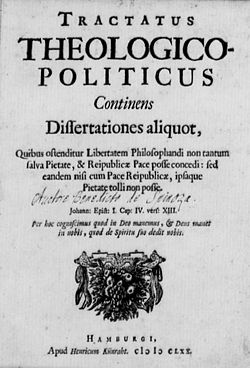
Locke was one of the early scholars in Britain to read and own Baruch Spinoza's radical text Tractatus Theologico-Politicus in 1672. He sold it to Shaftesbury in 1675 but purchased another copy to replace it.
Image source: Tractatus Theologico-Politicus
1672 - 1673
% complete
Locke's patron became Lord Chancellor in 1672 and then was raised to the title 1st Earl of Shaftesbury in 1673, elevating Locke's own standing in English political circles.
1675 - 1677
% complete
After Shaftesbury fell from favour in 1675, Locke left England for France on a trip already planned, traveling on an extended tour from 1675 to 1677.
Feb 1675
% complete
Locke was awarded a bachelor of medicine in February 1675, having studied the subject extensively at Oxford and already served as a physician before formal certification.
1678 - 1679
% complete
Locke traveled in France a second time on an extended tour from 1678 to 1679, deepening his intellectual experiences abroad.
1679
% complete
Locke returned to England in 1679 when Shaftesbury's political fortunes took a positive turn, resuming his involvement in English political life.
1683
% complete
Philosopher Algernon Sidney, who was exploring ideas similar to those in Locke's writings, was executed for treason against Charles II in 1683, highlighting the dangers facing critics of the crown.
Image source: Algernon Sidney
1683 - 1688
% complete
In 1683, Locke slipped away to the Dutch Republic in political exile, spending five years there in various cities beyond the reach of the crown wishing to arrest him.
1684
% complete
While in exile and deprived of his connection to Oxford, Locke's senior studentship was revoked in 1684 when Charles II told the head of Christ Church, Oxford that it was to be taken away.
1686
% complete
Locke published his method in French in 1686; it was later republished posthumously in English in 1706.
1688 - 1689
% complete
The Glorious Revolution of 1688 ousted Catholic James II and brought Protestants William III and Mary II to the English throne. In the preface to the Two Treatises, Locke says they were written to defend this revolution, though recent scholarship suggests the work was composed well before that.
Image source: Glorious Revolution
Feb 1688
% complete
Locke arrived back in England in February 1688, aged 57, accompanying Queen Mary II, aided by connections to Pembroke and Mordaunt who were now in positions to help him following the Revolution.
Image source: Mary II of England
1689
% complete
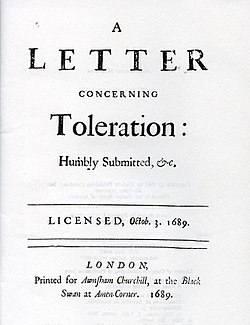
In 1689, Locke published A Letter Concerning Toleration anonymously, arguing for religious tolerance. His position was influenced by Baptist theologians like John Smyth and Thomas Helwys, who had demanded freedom of conscience in the early 17th century.
Image source: A Letter Concerning Toleration
1689 - 1690
% complete
Locke's Two Treatises of Government were published anonymously in 1689/90. They are believed to have influenced the language Thomas Jefferson chose in drafting the July 1776 Declaration of Independence, though in the late 17th and early 18th centuries they were rarely cited.
Image source: Two Treatises of Government
1689 - 1690
% complete
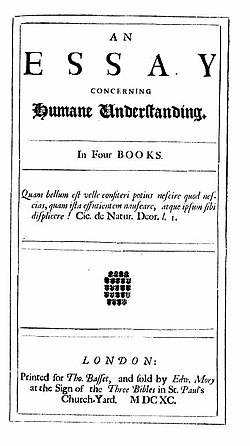
Locke's An Essay Concerning Human Understanding was published in 1689/90. Intellectual historians such as Charles Taylor and Jerrold Seigel argue it marks the beginning of the modern Western conception of the self, and it strongly influenced educational theory and psychology.
Image source: An Essay Concerning Human Understanding
1691
% complete
In 1691 Locke set out his general theory of value and price, a supply-and-demand theory, in a letter to a member of parliament titled Some Considerations on the Consequences of the Lowering of Interest and the Raising of the Value of Money.
1691 - 1704
% complete
Locke had been resident at Oates Manor since 1691, after returning from exile in Holland, living there until his death.
1695
% complete
Locke published The Reasonableness of Christianity in 1695, expressing his conviction that the entire content of the Bible was in agreement with human reason. By this time he was also advocating Socinian views on tolerance and Christology.
Image source: John Locke
1695
% complete
Historian Julian Hoppit noted that Locke's Two Treatises made little impression except among some Whigs until 1703, though in Oxford in 1695 it was reported to have made 'a great noise'.
1707
% complete
Wainwright notes that in the posthumously published Paraphrase (1707), Locke's interpretation of Ephesians 1:10 differs markedly from Socinians such as Biddle, possibly indicating a shift toward accepting Christ's pre-existence near the end of his life.
Or browse the full history timeline directory, with more than 2,000 topics.
This John Locke timeline was generated with the help of AI, using information found on the internet.
We work hard to keep these timelines accurate, but mistakes do get through. If you spot one, email us at [email protected] and we'll fix it for future visitors.
Generate yours with AI or build it from scratch, for free.
Export your timeline, add your own events, edit or remove AI-generated events, and much more
No credit card required.
Cancel anytime.
Cancel anytime.
You can create an unlimited number of timelines with up to 10 events on each one, customize how they look, export them to PDF, PNG, PowerPoint, CSV, and Excel, and share them with a link. Paid plans raise the event limit and add features like spreadsheet imports and collaborators.
Yes. You can cancel your subscription from your account page at any time, and you will not be charged again. Your subscription stays active for the rest of the period you already paid for.
Yes. We will email you a reminder before the annual renewal, and we will also email you a receipt.
Yes. You can email us within 15 days of any payment, and we will issue you a full refund.
Check out our pricing docs or send us an email anytime: [email protected].