
-
Use Cases
-
Resources
-
Pricing
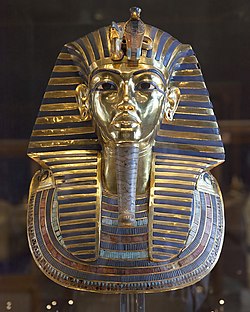
King Tutankhamun, often called 'King Tut,' was an Egyptian pharaoh of the 18th Dynasty who ruled during the New Kingdom period. Ascending the throne as a child around 1332 BCE, he restored traditional Egyptian polytheistic religion after his predecessor Akhenaten's monotheistic reforms. Though his reign was relatively unremarkable, he became world-famous after British archaeologist Howard Carter discovered his nearly intact tomb in the Valley of the Kings in 1922, revealing dazzling treasures including his iconic golden funerary mask. More Less
1903
% complete
After an automobile accident in 1901 left George Herbert, 5th Earl of Carnarvon, very unhealthy and frail, his doctor recommended a warmer climate. In 1903, the Carnarvons traveled to Egypt, where the Earl became interested in Egyptology.
Image source: George Herbert, 5th Earl of Carnarvon
1905 - 1914
% complete
The concession rights for excavating the Valley of the Kings were held by Theodore Davis from 1905 until 1914, during which time he searched extensively for royal tombs.
Image source: Theodore M. Davis
1907
% complete
In 1907, Howard Carter was invited by William Garstin and Gaston Maspero to excavate for George Herbert, 5th Earl of Carnarvon in the Valley of the Kings, beginning their famous partnership.
Image source: Howard Carter
1915
% complete
After a systematic search beginning in 1915, Howard Carter sought the actual tomb of Tutankhamun (KV62) in the Valley of the Kings, an area that had remained unexcavated due to its proximity to KV9 and concerns about impeding tourist access.
Image source: Tutankhamun
Nov 1922
% complete
In November 1922, after years of searching, Howard Carter discovered the intact tomb of Tutankhamun in the Valley of the Kings, one of the greatest archaeological discoveries in history.
Nov 4, 1922
% complete
On 4 November 1922, excavators led by Howard Carter and his patron, George Herbert, 5th Earl of Carnarvon, uncovered the first step of the entrance staircase leading down to Tutankhamun's tomb (KV62).
Feb 1923
% complete
By February 1923, the antechamber of Tutankhamun's tomb had been cleared of everything except two sentinel statues, revealing the extraordinary wealth buried with the young king.
Feb 17, 1923
% complete
On 17 February 1923 at just after two o'clock, the seal to Tutankhamun's burial chamber was broken, marking a historic moment in archaeology.
1926
% complete
Photographs taken at the conclusion of Carter's excavation in 1926 show that the chest wall of the king was intact, still wearing a beaded collar with falcon-headed terminals and a beaded skullcap, evidence later used to assess post-excavation damage.
Nov 4, 2007
% complete
On 4 November 2007, 85 years to the day after Carter's discovery, Tutankhamun's mummy was placed on display in his underground tomb at Luxor, when the linen-wrapped mummy was removed from its golden sarcophagus to a climate-controlled glass box.
2009 - Feb 2019
% complete
In 2009, the tomb was closed for restoration by the Ministry of Antiquities and the Getty Conservation Institute. While the closure was originally planned for five years to restore walls affected by humidity, the Egyptian revolution of 2011 set the project back. The tomb reopened in February 2019.
2021
% complete
Notably, the search for the temple of Tutankhamun near the temple of Ay and Horemheb led to the discovery of the lost city of Aten in 2021, a major archaeological find.
Image source: Aten (city)
2022
% complete
Letters published in 2022 of correspondence between Rex Engelbach and Alan Gardiner revealed that Howard Carter had stolen objects from the tomb before it was officially opened.
1923
% complete
Ancient Egyptian references became common in popular culture following the discovery, including Tin Pan Alley songs. The most popular was 'Old King Tut' by Harry Von Tilzer from 1923, recorded by prominent artists such as Jones & Hare and Sophie Tucker.
Image source: Tutankhamun
Apr 5, 1923
% complete
George Herbert, 5th Earl of Carnarvon, died on 5 April 1923, five months after the discovery of the first step leading down to the tomb on 4 November 1922. His death fueled popular legends of a 'curse of the pharaohs.'
Image source: Curse of the pharaohs
1978
% complete
While The Treasures of Tutankhamun exhibit was touring the United States in 1978, comedian Steve Martin wrote a novelty song 'King Tut,' which became a hit and reflected the ongoing fascination with the pharaoh.
Image source: King Tut (song)
2023
% complete
In 2023, an exhibit titled 'Kemet: Egypt in Hip-Hop, Jazz, Soul and Funk' at the Dutch National Museum of Antiquities in Leiden depicted a statue of rapper Nas's (1999) I Am... album cover, prompting discussion. Egyptian journalist Shahira Amin responded in a 2023 article titled 'Egyptians aren't racist.'
2023
% complete
In 2023, an extinct whale discovered in the Eocene deposits of Egypt was named Tutcetus, after Tutankhamun, due to the small size and immature age of the type specimen.
Image source: Tutcetus
1961
% complete
The Egyptian government allowed tours of Tutankhamun's tomb beginning in 1961, opening the burial site to visitors from around the world.
1962
% complete
The exhibitions of Tutankhamun's treasures began in 1962 when Algeria won its independence from France, starting decades of international tours that drew unprecedented public response worldwide.
Aug 21, 1965 - Oct 10, 1965
% complete
In 1965, the Tutankhamun exhibit traveled to Tokyo National Museum in Tokyo, Japan (21 August–10 October), where it garnered more visitors than the future New York exhibit in 1979.
1972 - 1979
% complete
The Treasures of Tutankhamun tour ran from 1972 to 1979, first shown in London at the British Museum from 30 March until 30 September 1972, then continuing with a hugely popular US exhibition which ran from 17 November 1976 through 15 April 1979.
Image source: Exhibitions of artifacts from the tomb of Tutankhamun
2025
% complete
Before being relocated to the Grand Egyptian Museum in 2025, some of Tutankhamun's treasures had traveled worldwide with unprecedented response. The treasures will be permanently housed in the new Grand Egyptian Museum in Cairo.
Image source: Grand Egyptian Museum
1968
% complete
Murder by a blow to the head was hypothesized as a result of the 1968 x-ray, which showed two bone fragments inside Tutankhamun's skull. The x-ray also noted the absence of both the beaded collar and chest wall seen in 1926 photographs.
1983
% complete
In 1983, forensic artist Betty Pat Gatliff, alongside forensic anthropologist Clyde Snow, developed a reconstruction image of Tutankhamun's face from a plaster cast of his skull.
2005
% complete
In 2005, an extensively media-covered study by the Egyptian Supreme Council of Antiquities and National Geographic employed three different research teams (Egyptian, French, and American) to develop a facial image of Tutankhamun using CT scans of his skull.
2005
% complete
The majority of diagnoses of Tutankhamun's ailments stem from research conducted via CT scans and genetic testing, such as the 2005 CT scans of his mummy. The scan showed he had experienced a compound left leg fracture, and it was hypothesized he had a flat right foot with hypophalangism. Researchers also argued the results suggest he had a partial cleft palate on his hard palate.
2008
% complete
In 2008, Egyptologist Stuart Tyson Smith criticized the skin-tone choice of the 2005 study, stating that the light skin tone was indicative of a bias, elaborating that ancient Egyptians were generally of darker skin tone, especially in more southern regions.
2010 - 2012
% complete
Studies from 2010 and 2012 examined the genetics of the Amarna royal mummies, including Tutankhamun, contributing to later analyses of ancient Egyptian population affinities.
2011
% complete
Computed tomography studies published in 2011 revealed that one daughter of Tutankhamun was born prematurely at 5–6 months of pregnancy and the other at full-term, 9 months.
2012
% complete
In 2012, it was suggested that Tutankhamun died from a combination of malaria and a leg fracture, building on earlier CT scan findings of a compound left leg fracture.
2014
% complete
In a 2014 BBC documentary presented by Dallas Campbell, titled Tutankhamun: The Truth Uncovered, results were revealed of a computerized forensic reconstruction of Tutankhamun's body that harnessed 2,000 CT scans of his mummy to generate an image of his body.
2020
% complete
A genetic study published in 2020 revealed Tutankhamun had the haplogroups YDNA R1b, which originally left Africa, became R1b in Western Asia, then split again and migrated back into Africa from North Africa between 8000 and 7000 years ago during the 'Green Sahara' period.
2020
% complete
Around 2020, the Tutankhamun's Sticks and Staves Project was launched by an international team of scientists aiming to analyze the various stick objects found in Tutankhamun's tomb.
2022
% complete
In 2022, bioarcheologist Andrew Nelson used CT scans and the 3D bioimaging software Dragonfly to create a virtual model of Tutankhamun's face.
2022
% complete
Only in 2022 was a complex technological and material study of Tutankhamun's mask published, shedding new light on the construction and materials of the iconic golden funerary mask.
Image source: Mask of Tutankhamun
2023
% complete
A 2023 meta-analysis study found that 22% of ancient Egyptian mummies tested positive for malaria, lending support to theories connecting malaria to Tutankhamun's death.
2023
% complete
In 2023, researchers developed a new version of Tutankhamun's face using further CT scans. Results greatly resembled the 2005 CT scan reconstruction, and the skin tone was also akin to the skin tone chosen in the 2005 study.
2025
% complete
In 2025, biochemist Jean-Philippe Gourdine reviewed genetic data on Ancient Egyptian populations in General History of Africa Volume IX. Expanding on a previous STR analysis co-performed with Keita on the Amarna royal mummies including Tutankhamun, Gourdine stated the analysis found strong affinities with current sub-Saharan populations: 41 per cent to 93.9 per cent for sub-Saharan Africa, compared to 4.6 per cent to 41 per cent for Eurasia and 0.3 per cent to 16 per cent for Asia.
2025
% complete
In 2025, Christopher Ehret, David Schoenbrun, Steven A Brandt and Shomarka Keita issued a multidisciplinary review, noting the R1b M89 haplogroup subtype identified among the three Amarna pharaohs (Tutankhamun, Amenhotep III and Akhenaten) was not further specified. They also disclosed through personal communication with the Gad team that other eighteenth dynasty lineages in the Amarna period were found to be E1b1a (Gad et al 2020).
Or browse the full history timeline directory, with more than 2,000 topics.
This King Tutankhamun timeline was generated with the help of AI, using information found on the internet.
We work hard to keep these timelines accurate, but mistakes do get through. If you spot one, email us at [email protected] and we'll fix it for future visitors.
Generate yours with AI or build it from scratch, for free.
Export your timeline, add your own events, edit or remove AI-generated events, and much more
No credit card required.
Cancel anytime.
Cancel anytime.
You can create an unlimited number of timelines with up to 10 events on each one, customize how they look, export them to PDF, PNG, PowerPoint, CSV, and Excel, and share them with a link. Paid plans raise the event limit and add features like spreadsheet imports and collaborators.
Yes. You can cancel your subscription from your account page at any time, and you will not be charged again. Your subscription stays active for the rest of the period you already paid for.
Yes. We will email you a reminder before the annual renewal, and we will also email you a receipt.
Yes. You can email us within 15 days of any payment, and we will issue you a full refund.
Check out our pricing docs or send us an email anytime: [email protected].