-
Use Cases
-
Resources
-
Pricing
1550 - 1650
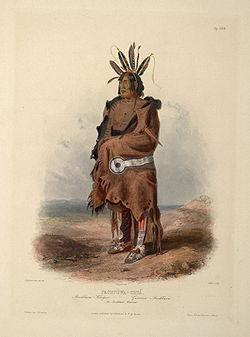
In the late sixteenth and early seventeenth centuries, Dakota-Lakota speakers lived in the upper Mississippi region, in territory now associated with Minnesota and Wisconsin.
Image source: Dakota people
1600 - 1700
Originally based around the western Great Lakes, the Lakota were pushed onto the northern Great Plains during the seventeenth century through conflicts with Anishinaabe and Cree peoples.
Image source: Lakota people
1650 - 1700
Cree war parties armed with iron weapons and seeking beaver pressed the Sioux from the north, contributing to their westward movement onto the Great Plains during the mid- to late seventeenth century.
Image source: Beaver Wars
1660
French explorers estimated the combined population of the Sioux—Lakota, Santee, Yankton, and Yanktonai—at approximately 28,000 people.
1700 - 1730
In the early eighteenth century, Lakota obtained horses through trade with the Cheyenne along the Missouri River. They called the animals šuŋkawakaŋ, meaning roughly “dog of power, mystery, or wonder,” and began transforming into a mounted buffalo-hunting society.
1720
After 1720, the Lakota branch of the Seven Council Fires split into two major groupings: the Saône, who moved toward the Lake Traverse area, and the Oglála-Sičháŋǧu, who occupied the James River valley.
1730
Around 1730, adoption of horse culture enabled the Lakota to expand across the Plains, intensify buffalo hunting, and increase their mobility and military power.
1750
By about 1750, the Saône had moved to the east bank of the Missouri River. The Oglála and Brulé followed approximately ten years later.
1766 - 1790
The Cheyenne acquired horses by 1766 and moved near the Black Hills around 1790. Further horse acquisition allowed them to abandon agriculture for full-time bison hunting, a development that shaped their relations with the Lakota.
1770
After crossing the Missouri River, the Lakota established themselves in the Black Hills by the 1770s. The region became the spiritual center of Lakota territory and later the focus of a major land dispute.
Image source: Black Hills
1781
A smallpox epidemic that began in 1781, originating in Mexico City in 1779 and traveling north through trade networks, devastated Missouri Valley villagers and reshaped the regional balance of power.
Sep 1804
In September 1804, the Lewis and Clark Expedition entered Sicangu territory near the mouth of the Bad River. This was the first contact between Lakota peoples and individuals officially representing the United States government under a presidential commission.
Image source: Lewis and Clark Expedition
1823
Some Lakota bands became the first Indigenous allies of the U.S. Army under Colonel Henry Leavenworth during the Arikara War. The Lakota were unimpressed by the American soldiers’ battlefield performance.
Image source: Arikara War
1825
An American Horse ledger records an Oglála council in which elder headmen presided, wakíčhuŋza served as decision-makers and heralds, and akíčhita societies enforced order. The account documents established Lakota political institutions.
1825
The Atkinson-O'Fallon expedition secured the first formal treaty between the United States and the Plains Lakota. Lakota winter counts largely treated the treaty as insignificant, recording the Missouri River flood instead.
1840 - 1841
A treaty made between the Lakota and Cheyenne in 1840 or 1841 was one of the few exceptions to the intertribal warfare affecting the Lakota during this period.
1843
In 1843, southern Lakota attacked the Pawnee village of Chief Blue Coat near the Loup River, killing many people and burning approximately half of the earth lodges.
Jan 1846
In January 1846, the Oglála and Sičháŋǧu wrote to the President of the United States invoking iglúwašte, or reciprocity. They presented themselves as equal negotiating partners and demanded compensation under the terms of the 1825 treaty.
1851
After the U.S. Army built Fort Laramie without permission on Lakota and Arapaho land, the United States convened a large council at Horse Creek. The resulting treaty recognized Lakota sovereignty over much of the central Plains in exchange for allowing passage along the Oregon Trail.
Image source: Treaty of Fort Laramie (1851)
1851
Several Lakota winter counts for 1851 ignored the American treaty and instead recorded a peace made with the Crow. The agreement was negotiated privately and reflected the intertribal geopolitics most important to the Lakota.
Sep 2, 1855
General William S. Harney led roughly six hundred soldiers against a village of Sicangu, Oglala, Miniconjou, and Cheyenne near Blue Water Creek at Ash Hollow, Nebraska. At least 86 people were killed and 70 women and children were captured, making it the Lakota’s worst defeat in more than a century.
1866 - 1868
The U.S. Army fought the Lakota and their allies along the Bozeman Trail while constructing forts to protect the route. Oglala leader Red Cloud led the Lakota to victory, forcing the United States to abandon the trail.
Image source: Red Cloud's War
1868
The 1868 Fort Laramie Treaty closed the Bozeman Trail and established the Great Sioux Reservation across the western half of present-day South Dakota. It also closed the Black Hills to white settlement for as long as the river flowed and the eagle flew.
Image source: Treaty of Fort Laramie (1868)
1872
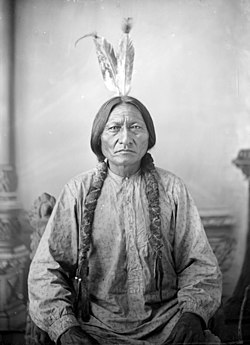
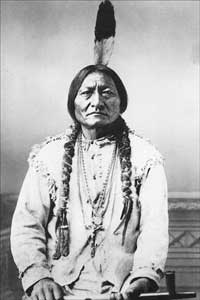
Although Sitting Bull opened talks at Fort Peck and accepted government rations, his followers continued to oppose a proposed railroad route through territory they regarded as protected by the 1868 treaty. Lakota warriors confronted survey parties along the Yellowstone and Powder rivers.
Image source: Sitting Bull
Aug 1873
Surveys for the Northern Pacific railroad resumed in 1873 with Custer’s Seventh Cavalry. Lakota forces engaged the expedition twice along the Yellowstone in August, producing the first encounters between Custer and bands he would meet at Little Bighorn.
Sep 1873
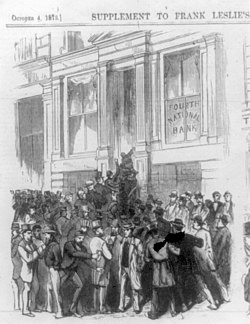
The Northern Pacific railroad project was halted primarily by financial failure rather than military defeat. Jay Cooke and Company defaulted, triggering the Panic of 1873 and leaving the railroad insolvent.
Image source: Panic of 1873
1874
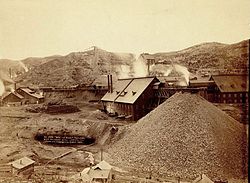
Lieutenant Colonel George Armstrong Custer led an expedition into the Black Hills in 1874 and confirmed the presence of gold. Prospectors flooded the region in violation of the 1868 treaty, while the government did not remove them.
Image source: Black Hills Gold Rush
Jun 17, 1876
A united force of Lakota, Arapaho, and Northern Cheyenne defeated General George Crook at the Battle of the Rosebud. The victory prevented Crook from locating the allied camp but also convinced many Lakota that the army would seek retaliation.
Image source: Battle of the Rosebud
Jun 25, 1876
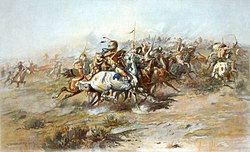
Lakota, Northern Cheyenne, and Arapaho forces destroyed Custer’s column at the Little Bighorn. Twelve officers, 247 soldiers, and three Arikara scouts were reported lost, making the battle a defining victory for the Indigenous forces and a shock to the United States.
Image source: Battle of the Little Bighorn
1877
Some Lakota bands signed a treaty ceding the Black Hills to the United States in 1877. The legitimacy of the cession has remained disputed, and Lakota nations have continued to reject the land as a settlement of their claims.
May 6, 1877 - Sep 1877
Crazy Horse surrendered at Fort Robinson, Nebraska, on May 6, 1877, after the United States intensified its campaign against remaining Lakota resistance. He was killed by a soldier later that year while resisting arrest.
Image source: Crazy Horse
Dec 15, 1890
Indian police sent to arrest Sitting Bull shot and killed him at Standing Rock on December 15, 1890. His death intensified the crisis surrounding the Ghost Dance movement and federal military intervention.
Dec 29, 1890
Two weeks after Sitting Bull’s death, the 7th Cavalry killed more than 250 Lakota men, women, and children at Wounded Knee. The massacre became a defining symbol of United States policy toward Native nations.
Image source: Wounded Knee Massacre
1805
The Lakota population was estimated at approximately 8,500 in 1805, providing a baseline for later comparisons as the population increased during the nineteenth century.
1881
The Lakota population was estimated at 16,110 in 1881. This represented substantial growth from the estimated 8,500 Lakota recorded in 1805.
1924
The Indian Citizenship Act of 1924 made most Lakota tribal members citizens of the United States, allowing them to vote in local, state, and federal elections, subject to applicable state restrictions at the time.
Image source: Indian Citizenship Act
1934
The Indian Reorganization Act of 1934 authorized frameworks under which many Lakota tribes developed constitutions, bylaws, and electoral procedures. Each tribe retains authority to determine its own citizenship criteria and government structure.
1978
The Indian Child Welfare Act of 1978 established legal protections for Native children and preferences for placing them with extended family, tribal members, or other Native families. It became central to later disputes over Lakota children in state foster care.
1980
In United States v. Sioux Nation of Indians, the U.S. Supreme Court awarded the Sioux nations $122 million for the taking of the Black Hills. The decision affirmed the legal basis of the claim, but the funds remained unaccepted in a Bureau of Indian Affairs account.
Image source: United States v. Sioux Nation of Indians
1988
The Indian Gaming Regulatory Act of 1988 authorized tribes to operate gaming on their lands as a means of promoting economic development, self-sufficiency, and strong tribal governments.
Sep 2007
In September 2007, the United Nations adopted the Declaration on the Rights of Indigenous Peoples. The declaration provided an international framework relevant to Lakota sovereignty, treaty rights, and self-determination movements.
Image source: Declaration on the Rights of Indigenous Peoples
Dec 2007
In December 2007, a group led by American Indian Movement activist Russell Means traveled to Washington, D.C., as the Lakota Freedom Delegation. It announced a unilateral withdrawal of the Lakota Sioux from treaties with the United States, but elected tribal governments repudiated the declaration.
2010
By 2010, the Lakota population exceeded 170,000 people, although only about 2,000 still spoke Lakȟótiyapi according to the cited account.
2011
The Sioux nations continued to decline the Black Hills settlement. Because the award remained in a Bureau of Indian Affairs account and accrued interest, its value exceeded one billion dollars by 2011.
2014
The Sioux Valley Dakota Nation’s self-government agreement took effect in 2014, providing a modern framework for governance among Dakota people in Canada.
Jun 15, 2023
In Haaland v. Brackeen, the U.S. Supreme Court ruled 7–2 that the Indian Child Welfare Act does not exceed Congress’s authority under the Indian Commerce Clause and does not violate the Tenth Amendment’s anti-commandeering doctrine.
Jul 15, 2024
On July 15, 2024, Canada apologized to nine Dakota and Lakota First Nations, affirmed their constitutional status as Aboriginal peoples, and committed to negotiating modern treaties and self-government arrangements. The nine bands reside in Manitoba and Saskatchewan.
2025
Native American children made up approximately 70 percent of South Dakota’s foster-care population at the close of fiscal year 2025, despite representing a much smaller share of the state’s child population. The disparity continues a concern documented by investigations since 2011.
May 1877 - Jul 1881
After Little Bighorn, Sitting Bull and approximately 400 Hunkpapa followers took refuge in Saskatchewan between Wood Mountain and Fort Qu'Appelle, an area remembered as Grandmother’s Land. Sitting Bull later returned to the United States and surrendered at Fort Buford.
Jul 19, 1881
Sitting Bull surrendered at Fort Buford on July 19, 1881, after several years in Canada. Following detention, he eventually rejoined the Hunkpapa at Standing Rock.
1890
Drought, crop failure, starvation, and inadequate federal rations deepened despair on Lakota reservations in 1890. The Ghost Dance, which promised the restoration of the old world and disappearance of white settlers, spread rapidly; federal officials misinterpreted it as preparation for war.
Image source: Ghost Dance
1903
Wind Cave, associated with the Lakota emergence story, became a national park in 1903. It was the first national park created specifically to protect a cave, although it lies within the territory underlying Sioux land claims.
Image source: Wind Cave National Park
Or browse the full history timeline directory, with more than 2,500 topics.
This Lakota History timeline was generated with the help of AI, using information found on the internet.
We work hard to keep these timelines accurate, but mistakes do get through. If you spot one, email us at [email protected] and we'll fix it for future visitors.
Generate yours with AI or build it from scratch, for free.
Export your timeline, add your own events, edit or remove AI-generated events, and much more
No credit card required.
Cancel anytime.
Cancel anytime.
You can create an unlimited number of timelines with up to 10 events on each one, customize how they look, export them to PDF, PNG, PowerPoint, CSV, and Excel, and share them with a link. Paid plans raise the event limit and add features like spreadsheet imports and collaborators.
Yes. You can cancel your subscription from your account page at any time, and you will not be charged again. Your subscription stays active for the rest of the period you already paid for.
Yes. We will email you a reminder before the annual renewal, and we will also email you a receipt.
Yes. You can email us within 15 days of any payment, and we will issue you a full refund.
Check out our pricing docs or send us an email anytime: [email protected].