-
Use Cases
-
Resources
-
Pricing
The Louvre Museum is the world's largest and most visited art museum, located in Paris, France. Originally built as a medieval fortress in the late 12th century, it served as a royal palace before opening as a public museum in 1793 during the French Revolution. Today it houses over 35,000 works of art, including masterpieces such as the Mona Lisa and the Venus de Milo. More Less
1190 - 1202
% complete
King Philip II of France ordered the construction of a fortress on the right bank of the Seine to protect Paris from Viking raids. The medieval Louvre castle featured a massive cylindrical keep and served as an arsenal and royal treasury, its foundations still visible today in the museum's Sully wing.
Image source: Medieval Louvre Castle
1364
% complete
King Charles V converted the military fortress into a royal residence, commissioning architect Raymond du Temple to add ornate windows, spiral staircases, and gardens. The Louvre became home to Charles V's famous library of nearly one thousand manuscripts.
1546
% complete
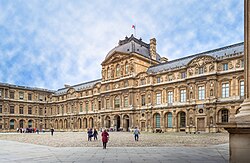
Francis I razed the medieval fortress and commissioned architect Pierre Lescot to build a Renaissance palace around a grand courtyard. This project began the transformation of the Louvre into the magnificent royal palace that would evolve over four centuries.
Image source: Louvre Palace
1564
% complete
Queen Catherine de' Medici commissioned the Tuileries Palace just west of the Louvre. Architects Philibert de l'Orme and Jean Bullant worked on linking the two palaces, eventually creating one of Europe's largest palace complexes.
Image source: Tuileries Palace
1595
% complete
Under Henry IV, construction began on a quarter-mile-long Grand Gallery along the Seine, physically connecting the Louvre and Tuileries palaces. Completed around 1610, it became one of Paris's great architectural achievements.
Image source: Grand Louvre
1667 - 1670
% complete
The East Facade of the Louvre, designed with contributions by Claude Perrault and Louis Le Vau, was built as a masterpiece of French Classicism. Its majestic colonnade became an iconic symbol of royal power, even as Louis XIV shifted his court to Versailles.
Image source: Louvre Colonnade
1678
% complete
After Louis XIV moved his court to Versailles, the Louvre's role declined as a residence. It was instead occupied by artists, academies including the Académie Royale de Peinture et de Sculpture, and the royal art collection's custodians, laying groundwork for its future museum function.
1747
% complete
In the mid-18th century, critics proposed displaying the king's paintings in the Grande Galerie, which had fallen into disrepair. Under Louis XV, plans for a royal museum advanced, with the Marquis de Marigny overseeing early preparations for public display of the royal collections.
Image source: Louvre
Aug 10, 1792
% complete
During the French Revolution, the storming of the Tuileries ended the monarchy, and revolutionary decrees nationalized the royal art collections, church property, and émigré holdings, creating the inventory that would form the new national museum.
Aug 10, 1793
% complete
Exactly one year after the fall of the monarchy, the Musée central des Arts opened in the Grande Galerie and Salon Carré, making the Louvre one of the world's first public museums, accessible free of charge to all citizens.
1797
% complete
Leonardo da Vinci's Mona Lisa entered the Louvre's collection after the Revolution, having hung in royal apartments at Fontainebleau. Over time it rose to become arguably the most famous painting in the world, drawing millions of visitors annually.
Image source: Mona Lisa
1803
% complete
Under Napoleon Bonaparte, the museum was renamed the Musée Napoléon and expanded dramatically with artworks seized during his European campaigns, including masterpieces from Italy, Spain, Austria, and Prussia, turning it into the greatest art collection in the world.
Image source: Louvre
1815
% complete
Following Napoleon's abdication, the Allied powers compelled France to return thousands of looted artworks to their countries of origin, significantly reducing the museum's holdings and prompting renewed acquisition efforts thereafter.
1820
% complete
The ancient Greek statue known as the Venus de Milo was unearthed on the island of Milos. France acquired the sculpture, which entered the Louvre in 1821 and quickly became celebrated as a pinnacle of Hellenistic art and one of the museum's most iconic works.
Image source: Venus de Milo
1843
% complete
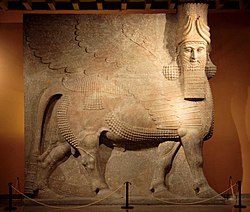
Paul-Émile Botta's excavations at Khorsabad uncovered monumental Assyrian reliefs and colossal winged bulls. These finds established the Louvre's renowned Department of Near Eastern Antiquities, pioneering Assyriology in France.
Image source: Dur-Sharrukin
1847
% complete
The colossal lamassu statues and palace reliefs from Dur-Sharrukin were displayed in purpose-built galleries, among the world's first museum exhibitions devoted to Assyrian civilization and a landmark in archaeological museology.
1861
% complete
Napoleon III acquired the vast Campana Collection of Greek, Roman, and Etruscan antiquities from the disgraced Italian collector Giampietro Campana, dramatically expanding the Louvre's classical departments.
Image source: Giampietro Campana
2003
% complete
President Jacques Chirac created a dedicated Department of Islamic Art, reflecting France's cultural engagement with the Muslim world. Support came from international patrons, leading to a major expansion of Islamic holdings and scholarship.
Oct 24, 2019 - Feb 24, 2020
% complete
Marking the 500th anniversary of Leonardo's death, the Louvre staged a landmark monographic exhibition uniting over 160 works. It attracted more than one million visitors, becoming one of the most successful art exhibitions ever held.
Image source: Leonardo da Vinci
1852 - 1857
% complete
Architects Hector Lefuel and Louis Visconti completed the long-planned north wing under Napoleon III, finishing the Louvre's architectural unity after centuries of piecemeal construction and creating the vast Cour Napoléon.
May 23, 1871 - May 24, 1871
% complete
During the final days of the Paris Commune, Communards set fire to the Tuileries Palace adjacent to the Louvre. The Tuileries was destroyed, though the main Louvre buildings survived, and the ruins stood until their demolition in 1883.
Image source: Paris Commune
Aug 21, 1911
% complete
Italian handyman Vincenzo Peruggia walked out of the Louvre with the Mona Lisa hidden under his coat. The theft made international headlines and, paradoxically, transformed the modest Renaissance portrait into a global celebrity before its recovery in 1913.
Aug 1939 - Sep 1939
% complete
Anticipating war, curators secretly evacuated hundreds of thousands of artworks from the Louvre, dispersing them to châteaux across France. The Mona Lisa traveled in a custom case marked with priority symbols, sheltering safely through the occupation.
Image source: Evacuation of the Louvre collection during World War II
Jun 1940 - Aug 1944
% complete
Nazi authorities occupied the evacuated Louvre, using its galleries for storage and propaganda displays while the museum's staff quietly protected hidden collections. Curators like Rose Valland tracked Nazi art plundering throughout the occupation.
Aug 25, 1944
% complete
With the liberation of Paris, the Louvre returned to Free French administration. The museum gradually reinstalled its dispersed collections, reopening fully to the public in the years following the war.
Image source: Liberation of Paris
1981 - 1989
% complete
President François Mitterrand's Grand Louvre project required the French Ministry of Finance, housed in the Richelieu wing since 1871, to relocate. Renovation opened the entire north wing to the museum, expanding exhibition space enormously.
1983 - 1989
% complete
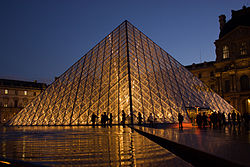
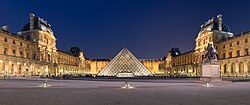
Chinese-American architect I. M. Pei designed a controversial glass and steel pyramid as the new main entrance to the Grand Louvre. Despite initial public outcry, the completed pyramid became a beloved modern icon harmonizing with the historic palace.
Image source: Louvre Pyramid
Mar 29, 1989
% complete
The glass pyramid officially opened, transforming visitor circulation by routing guests through a spacious underground lobby. It has since become one of Paris's most photographed landmarks and the symbolic face of the museum.
Nov 1993
% complete
The renovated Richelieu wing opened to the public, housing French sculpture, decorative arts, Northern European paintings, and Napoleonic apartments. Its opening fulfilled the Grand Louvre vision of a unified museum occupying the whole palace.
Sep 22, 2012
% complete
A striking undulating glass roof designed by Rudy Ricciotti covered new Islamic art galleries in the Cour Visconti, showcasing over 3,000 works spanning thirteen centuries and three continents in one of Europe's largest such collections.
Nov 11, 2017
% complete
Designed by Jean Nouvel, the Louvre Abu Dhabi opened on Saadiyat Island under a thirty-year agreement lending the Louvre's name and artworks. The universal museum extended the institution's global influence into the Persian Gulf region.
Image source: Louvre Abu Dhabi
Oct 30, 2020
% complete
Amid France's second COVID-19 lockdown, the Louvre closed to visitors for several months, suffering severe financial losses from lost ticket revenue while developing virtual tours and digital engagement to reach audiences worldwide.
Image source: COVID-19 pandemic in France
Or browse the full history timeline directory, with more than 2,000 topics.
This Louvre Museum timeline was generated with the help of AI, using information found on the internet.
We work hard to keep these timelines accurate, but mistakes do get through. If you spot one, email us at [email protected] and we'll fix it for future visitors.
Generate yours with AI or build it from scratch, for free.
Export your timeline, add your own events, edit or remove AI-generated events, and much more
No credit card required.
Cancel anytime.
Cancel anytime.
You can create an unlimited number of timelines with up to 10 events on each one, customize how they look, export them to PDF, PNG, PowerPoint, CSV, and Excel, and share them with a link. Paid plans raise the event limit and add features like spreadsheet imports and collaborators.
Yes. You can cancel your subscription from your account page at any time, and you will not be charged again. Your subscription stays active for the rest of the period you already paid for.
Yes. We will email you a reminder before the annual renewal, and we will also email you a receipt.
Yes. You can email us within 15 days of any payment, and we will issue you a full refund.
Check out our pricing docs or send us an email anytime: [email protected].