-
Use Cases
-
Resources
-
Pricing
Martin Luther King Jr. was an American Baptist minister and civil rights leader who became the most prominent spokesperson of the civil rights movement from the mid-1950s until his assassination in 1968. Known for advancing civil rights through nonviolent resistance inspired by his Christian beliefs and the teachings of Mahatma Gandhi, he delivered the famous 'I Have a Dream' speech during the 1963 March on Washington and was awarded the Nobel Peace Prize in 1964. More Less
Jan 15, 1929
% complete
Martin Luther King Jr. was born on January 15, 1929, in Atlanta, Georgia, to Michael King Sr. and Alberta Williams King. He was the second of three children in a family deeply rooted in the Baptist church, and his upbringing in Atlanta's Sweet Auburn neighborhood exposed him early to both the comforts of a middle-class Black community and the harsh realities of racial segregation in the American South.
Image source: Martin Luther King Jr.
Sep 1944
% complete
Skipping grades in high school, King enrolled at Morehouse College in Atlanta at just fifteen years old. Influenced by college president Benjamin Mays and his study of theology and philosophy, he decided to pursue the ministry, graduating in 1948 with a Bachelor of Arts degree in sociology.
Image source: Morehouse College
Feb 25, 1948
% complete
While still a student at Morehouse, King was ordained as a Baptist minister at Ebenezer Baptist Church, where his father served as pastor. This formal entry into religious life cemented his path toward combining spiritual leadership with social activism.
Image source: Ebenezer Baptist Church
May 1951
% complete
King attended Crozer Theological Seminary in Chester, Pennsylvania, where he was exposed to diverse theological ideas and the writings of thinkers like Reinhold Niebuhr and Mahatma Gandhi. He graduated in May 1951 with a Bachelor of Divinity degree, having been elected student body president and delivering the valedictory address.
Image source: Crozer Theological Seminary
Jun 18, 1953
% complete
Martin Luther King Jr. married Coretta Scott, a talented singer and aspiring concert artist from Alabama, at her family's home near Marion, Alabama. Their partnership became central to the civil rights movement, with Coretta playing an active role in activism throughout their marriage. They eventually had four children.
Image source: Coretta Scott King
Jun 5, 1955
% complete
King completed his doctoral studies in systematic theology at Boston University, earning a PhD at the age of twenty-five. His dissertation examined conceptions of God in the thought of Paul Tillich and Henry Nelson Wieman, and it was during this period that he refined the intellectual foundations of his philosophy of nonviolent resistance.
Image source: Boston University
Dec 5, 1955 - Dec 20, 1956
% complete
After Rosa Parks was arrested for refusing to give up her seat to a white passenger, the Black community of Montgomery, Alabama launched a boycott of the city's segregated bus system. King, then a young pastor at Dexter Avenue Baptist Church, was elected to lead the Montgomery Improvement Association, catapulting him into national prominence as a civil rights leader.
Image source: Montgomery bus boycott
Jan 30, 1956
% complete
During the Montgomery bus boycott, segregationists bombed King's home while his wife and infant daughter were inside. No one was injured, but the attack tested King's resolve. His calm response, urging followers to love their enemies, deepened public admiration for his commitment to nonviolence.
Nov 13, 1956
% complete
The Supreme Court ruled in Browder v. Gayle that segregated buses were unconstitutional, effectively ending the Montgomery bus boycott in victory. The ruling validated the year-long campaign led by King and demonstrated the power of sustained nonviolent protest combined with legal action.
Image source: Browder v. Gayle
Feb 1, 1960
% complete
Following the Greensboro sit-ins by four North Carolina A&T students, sit-in protests against segregated lunch counters spread rapidly across the South. King supported the student-led movement, which energized the civil rights struggle and led to the formation of the Student Nonviolent Coordinating Committee (SNCC).
Image source: Greensboro sit-ins
Oct 19, 1960
% complete
King joined students in a sit-in at Rich's department store in Atlanta and was arrested along with dozens of others. Sentenced to months of hard labor, he was released after presidential candidate John F. Kennedy intervened by calling Coretta Scott King, an act widely credited with helping Kennedy win Black voters in the 1960 election.
Nov 1961 - Aug 1962
% complete
King and the SCLC joined the Albany Movement, a broad desegregation campaign in Albany, Georgia. The campaign faced setbacks as local police chief Laurie Pritchett used non-confrontational tactics to avoid negative publicity, but the experience taught King valuable lessons about strategy that informed later, more successful campaigns.
Apr 3, 1963 - May 10, 1963
% complete
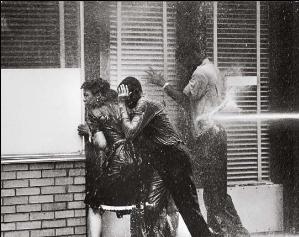
King led the SCLC's Birmingham campaign, one of the most consequential civil rights efforts in American history. Peaceful protesters, including children, faced fire hoses and police dogs under Public Safety Commissioner Eugene 'Bull' Connor. The shocking images broadcast nationwide galvanized public opinion and helped bring about federal civil rights legislation.
Image source: Birmingham campaign
Aug 28, 1963
% complete
Before a crowd of approximately 250,000 people gathered at the Lincoln Memorial for the March on Washington for Jobs and Freedom, King delivered his iconic 'I Have a Dream' speech. The address, envisioning a nation where his children would be judged by character rather than skin color, became one of the most celebrated speeches in American history.
Image source: March on Washington for Jobs and Freedom
Mar 7, 1965 - Mar 25, 1965
% complete
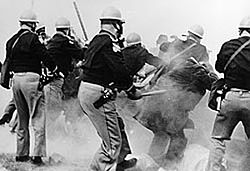
In support of voting rights for Black Americans, civil rights activists marched from Selma to Montgomery, Alabama. On 'Bloody Sunday,' marchers were brutally attacked by state troopers on the Edmund Pettus Bridge. King led subsequent marches, and the final successful march concluded at the Alabama State Capitol, building momentum for voting rights legislation.
Image source: Selma to Montgomery marches
Jan 1966 - Aug 1966
% complete
King expanded the movement northward, leading the Chicago Freedom Movement against housing discrimination and economic inequality. Marches through white neighborhoods were met with violent hostility, exposing racism beyond the South. The campaign resulted in agreements with city officials and influenced the later Fair Housing Act.
Image source: Chicago Freedom Movement
Dec 4, 1967
% complete
King announced the Poor People's Campaign, an ambitious effort to unite people of all races in demanding economic justice, including jobs, fair wages, and housing for the nation's poor. The campaign planned a massive march on Washington, though King would not live to see its realization.
Image source: Poor People's Campaign
Mar 18, 1968 - Apr 4, 1968
% complete
King traveled to Memphis, Tennessee, to support striking sanitation workers demanding better wages and safer conditions. He led marches and delivered his prophetic 'I've Been to the Mountaintop' speech on April 3, 1968, in which he spoke of having seen the promised land, though he might not get there himself.
Image source: Memphis sanitation strike
Feb 14, 1957
% complete
King helped establish the Southern Christian Leadership Conference (SCLC), an organization of Black churches and ministers dedicated to achieving civil rights through nonviolent means. As its first president, King used the SCLC as a platform to coordinate civil rights campaigns across the South for over a decade.
Image source: Southern Christian Leadership Conference
Jun 23, 1958
% complete
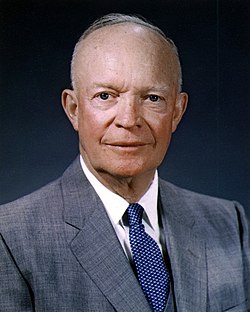
King joined other civil rights leaders in a meeting with President Dwight D. Eisenhower to discuss voting rights and civil rights legislation. Though the meeting produced limited immediate results, it marked growing recognition of King as a national figure whose counsel reached the highest levels of government.
Image source: Dwight D. Eisenhower
Sep 17, 1958
% complete
King published his first book, 'Stride Toward Freedom: The Montgomery Story,' chronicling the bus boycott and articulating his philosophy of nonviolent resistance. While signing copies in Harlem days later, he was stabbed by a mentally ill woman named Izola Curry; the blade narrowly missed his spine and he survived after surgery.
Image source: Stride Toward Freedom
Feb 2, 1959 - Mar 10, 1959
% complete
King traveled to India with his wife Coretta on a month-long pilgrimage to the land of Mahatma Gandhi. Meeting with Indian leaders and studying Gandhi's legacy firsthand strengthened his commitment to nonviolent resistance, which he described as the guiding light of the American civil rights movement.
Image source: Mahatma Gandhi
Apr 16, 1963
% complete
Arrested during the Birmingham campaign, King penned his famous 'Letter from Birmingham Jail' in response to eight white clergymen who criticized the protests. The eloquent letter defended nonviolent direct action, famously declaring that 'injustice anywhere is a threat to justice everywhere,' and became a foundational text of the civil rights movement.
Image source: Letter from Birmingham Jail
Jan 1964
% complete
TIME magazine named Martin Luther King Jr. its Man of the Year for 1963, recognizing his leadership in the Birmingham campaign and the March on Washington. The honor reflected his emergence as the preeminent voice of the American civil rights movement on the world stage.
Image source: Time Person of the Year
Jul 2, 1964
% complete
President Lyndon B. Johnson signed the Civil Rights Act of 1964, outlawing discrimination based on race, color, religion, sex, or national origin and ending segregation in public accommodations. King attended the signing ceremony, marking the legislative culmination of years of activism he had led and inspired.
Image source: Civil Rights Act of 1964
Oct 14, 1964
% complete
At thirty-five years old, King became the youngest recipient of the Nobel Peace Prize up to that time, honored for his nonviolent struggle against racial injustice. In his acceptance speech in Oslo, Norway, he declared that he accepted the award on behalf of a movement, donating the prize money to the civil rights cause.
Image source: Nobel Peace Prize
Aug 6, 1965
% complete
President Johnson signed the Voting Rights Act of 1965, prohibiting racial discrimination in voting and empowering federal oversight of voter registration in the South. The law represented a major triumph for King and the movement, dramatically increasing Black voter registration across the former Confederate states.
Apr 4, 1967
% complete
In his 'Beyond Vietnam' speech at Riverside Church in New York City, King broke with many political allies by condemning the Vietnam War. He argued that the war diverted resources from anti-poverty programs and disproportionately harmed poor and minority communities, a stance that drew sharp criticism but reflected his expanding vision of justice.
1968
% complete
Coretta Scott King established the Martin Luther King Jr. Center for Nonviolent Social Change in Atlanta to preserve her husband's legacy and promote nonviolence education. The center became a hub for civil rights education, archives, and advocacy, continuing the work King began.
Image source: King Center for Nonviolent Social Change
Apr 4, 1968
% complete
Martin Luther King Jr. was shot and killed by James Earl Ray while standing on the balcony of the Lorraine Motel in Memphis. His assassination sparked grief, riots in more than 100 cities, and nationwide mourning. President Johnson declared a national day of mourning, and King was laid to rest in Atlanta after a funeral attended by leaders from around the world.
Image source: Assassination of Martin Luther King Jr.
Apr 11, 1968
% complete
One week after King's assassination, Congress passed the Fair Housing Act, prohibiting discrimination in the sale, rental, and financing of housing. The legislation, a goal of King's Chicago campaign, was pushed through as a tribute to his memory and stands as part of his legislative legacy.
Jul 19, 1969
% complete
James Earl Ray pleaded guilty to assassinating Martin Luther King Jr. and was sentenced to ninety-nine years in prison. He later recanted his confession, and questions about possible conspiracies persisted for decades, fueling ongoing investigations and debate about the circumstances of the assassination.
Image source: James Earl Ray
Nov 2, 1983
% complete
After a long campaign led by Coretta Scott King and supporters, President Ronald Reagan signed legislation establishing Martin Luther King Jr. Day as a federal holiday, observed on the third Monday of January. First officially celebrated in 1986, it honors King's enduring contributions to equality and justice in America.
Image source: Martin Luther King Jr. Day
Or browse the full history timeline directory, with more than 2,000 topics.
This Martin Luther King Jr. timeline was generated with the help of AI, using information found on the internet.
We work hard to keep these timelines accurate, but mistakes do get through. If you spot one, email us at [email protected] and we'll fix it for future visitors.
Generate yours with AI or build it from scratch, for free.
Export your timeline, add your own events, edit or remove AI-generated events, and much more
No credit card required.
Cancel anytime.
Cancel anytime.
You can create an unlimited number of timelines with up to 10 events on each one, customize how they look, export them to PDF, PNG, PowerPoint, CSV, and Excel, and share them with a link. Paid plans raise the event limit and add features like spreadsheet imports and collaborators.
Yes. You can cancel your subscription from your account page at any time, and you will not be charged again. Your subscription stays active for the rest of the period you already paid for.
Yes. We will email you a reminder before the annual renewal, and we will also email you a receipt.
Yes. You can email us within 15 days of any payment, and we will issue you a full refund.
Check out our pricing docs or send us an email anytime: [email protected].