-
Use Cases
-
Resources
-
Pricing
Marxism is a social, political, and economic theory developed by Karl Marx and Friedrich Engels in the 19th century. It analyzes history through class struggle, critiques capitalism as an exploitative system, and advocates for a classless society achieved through proletarian revolution. Marxism profoundly influenced revolutions, political movements, and governments across the globe. More Less
Sep 1844
% complete
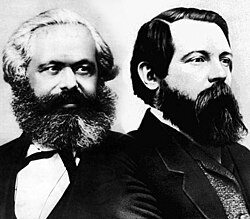
Karl Marx and Friedrich Engels first met in September 1844, beginning one of the most influential intellectual partnerships in history, which would shape socialist theory for generations.
Image source: Karl Marx
Jan 1845
% complete
After Marx was deported from France in January 1845, he and Engels moved to Belgium, which permitted greater freedom of expression than other European countries at the time.
Jan 1846
% complete
In January 1846, Marx and Engels returned to Brussels to establish the Communist Correspondence Committee, an organization to link socialists across Europe.
1847
% complete
In 1847, Marx and Engels began writing The Communist Manifesto, based on Engels' The Principles of Communism, commissioned by the Communist League.
Image source: The Communist Manifesto
Feb 1848
% complete
Six weeks after they began writing it, Marx and Engels published the 12,000-word pamphlet The Communist Manifesto in February 1848, declaring that class struggle is the central driving force of historical change.
1883
% complete
After Marx died in 1883, Engels became the editor and translator of Marx's writings, ensuring the continuation and dissemination of Marxist theory.
1845
% complete
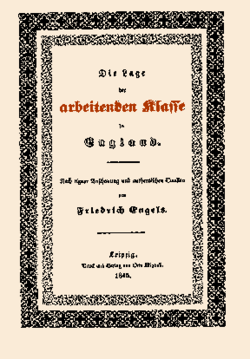
Friedrich Engels' short treatise The Condition of the Working Class in England in 1844 was salient in creating the socialist impetus in British politics, documenting the harsh realities faced by industrial workers.
Image source: The Condition of the Working Class in England
1845
% complete
In Theses on Feuerbach (1845), Marx notes that one 'must prove the truth — i.e. the reality and power, the this-sidedness of his thinking in practice,' emphasizing practice as the criterion of truth.
Image source: Theses on Feuerbach
1845
% complete
Marx's account of historical materialism is set out in The German Ideology (1845), co-written with Engels, laying out the materialist conception of history as a central element of Marxist theory.
Image source: The German Ideology
1859
% complete
Marx's account of his theory also appears in the preface to A Contribution to the Critique of Political Economy (1859), a key statement of the materialist conception of history.
Image source: Critique of political economy
1877
% complete
In a letter to the editor of the Russian newspaper Otechestvennye Zapiski (1877), Marx explained that his ideas were based upon a concrete study of actual conditions in Europe, not a master key to history imposed by fate upon every people.
Image source: Historical materialism
1883
% complete
In 1883, Marx wrote to his son-in-law Paul Lafargue and French labour leader Jules Guesde—both claiming to represent Marxist principles—accusing them of 'revolutionary phrase-mongering' and denying the value of reformist struggle.
Image source: Marxism
1884
% complete
With his Origins of the Family, Private Property, and the State (1884)—analysing monogamous marriage as guaranteeing male social domination of women—Engels made intellectually significant contributions to feminist theory and Marxist feminism.
Image source: The Origin of the Family, Private Property and the State
1898
% complete
Vladimir Karpovich Dmitriev, writing in 1898, alleged that Marx's value theory and the law of the tendency of the rate of profit to fall are internally inconsistent, beginning a long line of economic criticism.
Image source: Labor theory of value
1906 - 1907
% complete
Ladislaus von Bortkiewicz, writing in 1906–1907, alleged that Marx's value theory and the law of the tendency of the rate of profit to fall are internally inconsistent, furthering the transformation problem debate.
Image source: Ladislaus Bortkiewicz
1905
% complete
The failure of the 1905 Russian Revolution, along with the failure of socialist movements to resist the outbreak of World War I, led to renewed theoretical effort and valuable contributions from Lenin and Rosa Luxemburg towards an appreciation of Marx's crisis theory and efforts to formulate a theory of imperialism.
Image source: Russian Revolution of 1905
Oct 1917
% complete
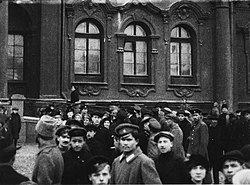
With the October Revolution in 1917, the Bolsheviks took power from the Russian Provisional Government, establishing the first state governed on Marxist principles.
Image source: October Revolution
1919
% complete
In 1919, the nascent Soviet Government established the Communist Academy and the Marx–Engels–Lenin Institute for doctrinal Marxist study and to publish official ideological and research documents for the Russian Communist Party.
Image source: Marx–Engels–Lenin Institute
1921
% complete
The Chinese Communist Party, founded in 1921, conflicted with the Kuomintang over the country's future, eventually leading to decades of civil war and the establishment of a Marxist state in China.
Image source: Chinese Communist Party
1924
% complete
With Lenin's death in 1924, there was an internal struggle in the Soviet Communist movement, mainly between Joseph Stalin and Leon Trotsky, in the form of the Troika of Stalin, Zinoviev and Kamenev and the Left Opposition, respectively.
Image source: Leninism
1949
% complete
The People's Republic of China (PRC) was declared in 1949 following the victory of the Chinese Communist Party under Mao Zedong, establishing a major Marxist-Leninist state.
Image source: Chinese Communist Revolution
1959
% complete
In 1959, the Cuban Revolution led to the victory of Fidel Castro and his July 26 Movement, establishing a Marxist-Leninist state in the Western Hemisphere.
Image source: Cuban Revolution
1966 - 1976
% complete
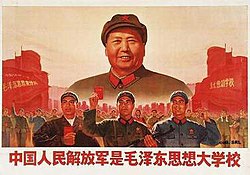
In the People's Republic of China, the Maoist government undertook the Cultural Revolution from 1966 to 1976 to purge Chinese society of capitalist elements and achieve socialism.
Image source: Cultural Revolution
Mar 1985
% complete
The reformist Mikhail Gorbachev became General Secretary of the Communist Party of the Soviet Union in March 1985 and sought to abandon Leninist development models toward social democracy.
Image source: Mikhail Gorbachev
Dec 1991
% complete
Ultimately, Gorbachev's reforms, coupled with rising levels of popular ethnic nationalism, led to the dissolution of the Soviet Union in late 1991 into a series of constituent nations, all of which abandoned Marxist–Leninist models for socialism, with most converting to capitalist economies.
Image source: Dissolution of the Soviet Union
1929
% complete
The theoretical development of Marxist archaeology was first developed in the Soviet Union in 1929, when a young archaeologist named Vladislav I. Ravdonikas applied Marxist principles to archaeological interpretation.
1932
% complete
Marxist humanism was born in 1932 with the publication of Marx's Economic and Philosophic Manuscripts of 1844, and reached a degree of prominence in the 1950s and 1960s.
Image source: Economic and Philosophic Manuscripts of 1844
1938
% complete
Living in Britain when he wrote his most notable work, The Black Jacobins (1938), C.L.R. James was an anti-Stalinist Marxist and so outside of the CPGB, offering a major Marxist history of the Haitian Revolution.
Image source: The Black Jacobins
1946
% complete
A circle of historians inside the Communist Party of Great Britain (CPGB) formed in 1946, becoming a major centre of British Marxist historiography.
1956
% complete
After some members, including E.P. Thompson, left the CPGB after the 1956 Hungarian Revolution, the common points of British Marxist historiography continued in their works.
2000
% complete
The work of Peter McLaren, especially since the turn of the 21st century, has further developed Marxist educational theory by developing revolutionary critical pedagogy, as has the work of Glenn Rikowski, Dave Hill, and Paula Allman.
Image source: Marxism
2007
% complete
According to a 2007 survey of American professors by Neil Gross and Solon Simmons, 17.6% of social science professors and 5.0% of humanities professors identify as Marxists, while between 0 and 2% of professors in all other disciplines identify as Marxists.
1998 - 2011
% complete
The early 21st century saw the election of socialist governments in several Latin American nations, known as the 'pink tide'; dominated by Hugo Chávez's Venezuela, it also included Evo Morales in Bolivia, Rafael Correa in Ecuador, and Daniel Ortega in Nicaragua.
Image source: Pink tide
Jan 10, 2007
% complete
Venezuelan president Hugo Chávez declared himself a Trotskyist during the swearing-in of his cabinet two days before his inauguration on 10 January 2007.
Image source: Hugo Chávez
2008
% complete
At the turn of the 21st century, only China, Cuba, Laos, North Korea, and Vietnam remained officially Marxist–Leninist states, although a Maoist government led by Prachanda was elected into power in Nepal in 2008 following a long guerrilla struggle.
Image source: Pushpa Kamal Dahal
2011
% complete
For Italian Marxist Gianni Vattimo and Santiago Zabala in their 2011 book Hermeneutic Communism, 'this new weak communism differs substantially from its previous Soviet (and current Chinese) realisation, because the South American countries follow democratic electoral procedures and also manage to decentralise the state bureaucratic system through the Bolivarian missions.'
Image source: Hermeneutic Communism
Or browse the full history timeline directory, with more than 2,000 topics.
This Marxism timeline was generated with the help of AI, using information found on the internet.
We work hard to keep these timelines accurate, but mistakes do get through. If you spot one, email us at [email protected] and we'll fix it for future visitors.
Generate yours with AI or build it from scratch, for free.

Export your timeline, add your own events, edit or remove AI-generated events, and much more
No credit card required.
Cancel anytime.
Cancel anytime.
You can create an unlimited number of timelines with up to 10 events on each one, customize how they look, export them to PDF, PNG, PowerPoint, CSV, and Excel, and share them with a link. Paid plans raise the event limit and add features like spreadsheet imports and collaborators.
Yes. You can cancel your subscription from your account page at any time, and you will not be charged again. Your subscription stays active for the rest of the period you already paid for.
Yes. We will email you a reminder before the annual renewal, and we will also email you a receipt.
Yes. You can email us within 15 days of any payment, and we will issue you a full refund.
Check out our pricing docs or send us an email anytime: [email protected].