-
Use Cases
-
Resources
-
Pricing
Mehmed II, known as Mehmed the Conqueror, was an Ottoman Sultan who reigned twice (1444–1446 and 1451–1481) and is best remembered for conquering Constantinople in 1453 at age 21, ending the Byzantine Empire. A brilliant military strategist and patron of arts and sciences, he expanded Ottoman territory across the Balkans and Anatolia, reformed administration, and fostered a cosmopolitan empire centered on his new capital, Istanbul. More Less
Mar 30, 1432
% complete
Mehmed II was born in Edirne, the Ottoman capital, as the son of Sultan Murad II and Hüma Hatun. His birth into the ruling dynasty set him on a path that would eventually transform the Ottoman state into an empire.
Image source: Mehmed II
1444 - 1446
% complete
At just twelve years old, Mehmed was placed on the throne when his father Murad II abdicated. His first reign was short and turbulent, marked by the Crusade of Varna, and his father returned to power in 1446.
Feb 1451
% complete
Following Murad II's death, Mehmed II ascended the throne permanently in February 1451 at age nineteen. He immediately began preparing for the conquest of Constantinople, which he had dreamed of since childhood.
Nov 10, 1444
% complete
During Mehmed's first reign, Ottoman forces under Grand Vizier Çandarlı Halil Pasha and the young sultan defeated a Hungarian-Polish crusader army led by King Władysław III of Poland at Varna, securing the Balkans for the Ottomans.
Image source: Battle of Varna
1454
% complete
Mehmed launched campaigns against Serbian Despotate strongholds along the Danube, beginning a series of expeditions aimed at subduing Hungary's southern vassal and expanding Ottoman control in the region.
Image source: Ottoman Serbia
Jul 4, 1456 - Jul 22, 1456
% complete
Mehmed's forces besieged Belgrade but were defeated by a Hungarian army under John Hunyadi and crusaders inspired by friar Giovanni da Capistrano, delaying Ottoman advance into central Europe for decades.
Image source: Siege of Belgrade (1456)
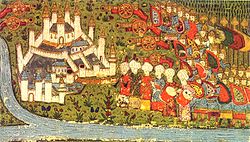
1459
% complete
After years of campaigns, Mehmed annexed the Serbian Despotate following the fall of Smederevo in June 1459, ending Serbian independence and incorporating its lands directly into the empire.
Image source: Serbian Despotate
1460
% complete
Mehmed campaigned in Greece, extinguishing the last remnants of the Byzantine Empire—the Despotate of the Morea—bringing the Peloponnese under direct Ottoman rule.
Image source: Ottoman conquest of the Morea
Aug 15, 1461
% complete
Mehmed led a campaign along the Anatolian coast and captured the Empire of Trebizond, founded by Byzantine exiles in 1204, completing the elimination of independent Greek states.
Image source: Empire of Trebizond
1462
% complete
Mehmed invaded Wallachia to depose the defiant prince Vlad III. Though Vlad famously launched a night attack on the sultan's camp, Mehmed installed Vlad's brother Radu as prince, bringing Wallachia firmly into the Ottoman orbit.
Image source: Night attack at Târgoviște
Sep 1462
% complete
Mehmed seized the island of Lesbos from the Gattilusio family, removing a Genoese maritime power from the northeastern Aegean and tightening Ottoman control over vital sea routes.
Image source: Ottoman conquest of Lesbos
1463 - 1479
% complete
Mehmd engaged in a long naval and land war against the Republic of Venice over the Aegean and Adriatic, capturing Venetian strongholds in Greece and the Aegean before concluding peace by treaty in 1479.
Image source: Ottoman–Venetian War (1463–1479)
Jun 1463
% complete
Mehmed personally led the campaign that conquered the Kingdom of Bosnia, executing its last king Stephen Tomašević and ending the kingdom after the rapid fall of key fortresses including Bobovac.
Image source: Kingdom of Bosnia
1464 - 1474
% complete
Mehmed fought prolonged wars against the Turkmen principality of Karaman and its Aq Qoyunlu allies, gradually extending direct Ottoman administration over most of central and eastern Anatolia.
Image source: Karamanids
Jul 12, 1470
% complete
Mehmed captured the important Venetian stronghold of Negroponte on Euboea after a fierce siege, dealing a major blow to Venetian power in the Aegean Sea.
Image source: Siege of Negroponte (1470)
Aug 11, 1473
% complete
Mehmed decisively defeated the Aq Qoyunlu ruler Uzun Hasan in eastern Anatolia, using firearms effectively against cavalry, and securing Ottoman dominance over rival powers in Anatolia.
Image source: Battle of Otlukbeli
1475
% complete
Mehmed's forces captured Genoese colonies in the Crimea and the coastal fortress of Caffa, forcing the Crimean Khanate into vassalage and giving the Ottomans influence over the northern Black Sea littoral.
Image source: Crimean Khanate
May 1480 - Aug 1480
% complete
Ottoman forces under Mesih Pasha besieged the island fortress of the Knights Hospitaller at Rhodes but failed to take it, leaving the Knights in control until Suleiman the Magnificent's successful siege in 1522.
Image source: Siege of Rhodes (1480)
Aug 1480
% complete
An Ottoman fleet crossed the Adriatic and captured the port of Otranto in Apulia, marking the only time Ottoman forces gained a foothold in mainland Italy; the town fell amid fierce fighting and massacre.
Image source: Ottoman conquest of Otranto
Apr 1452 - Aug 1452
% complete
Mehmed ordered the construction of the fortress Rumeli Hisarı (Boğazkesen) on the European shore of the Bosphorus, completing it in just over four months to control shipping lanes and cut off Constantinople from Black Sea support.
Image source: Rumelihisarı
Apr 6, 1453
% complete
Mehmed's massive army, estimated at 80,000–200,000 men, began the siege of Constantinople with heavy cannon bombardment of the Theodosian Walls, defended by Emperor Constantine XI Palaiologos and roughly 7,000 defenders.
Apr 22, 1453
% complete
In one of history's most audacious maneuvers, Mehmed had dozens of ships dragged overland on greased logs from the Bosphorus into the Golden Horn, bypassing the harbor chain and threatening Constantinople's sea walls.
May 29, 1453
% complete
After weeks of bombardment and repeated assaults, Ottoman troops breached the walls near the St. Romanus Gate. Constantine XI died fighting, the city fell after more than a thousand years as an imperial capital, and Mehmed entered triumphantly as conqueror.
Image source: Fall of Constantinople
Jun 1453
% complete
Shortly after capturing the city, Mehmed converted the great Byzantine cathedral Hagia Sophia into a mosque, preserving its structure while adding Islamic features, symbolizing the transformation of Constantinople into an Ottoman imperial capital.
Image source: Hagia Sophia
1453
% complete
Mehmed made Constantinople the new capital of the Ottoman Empire and worked to repopulate and rebuild the devastated city, inviting Muslims, Christians, and Jews from across the empire to settle there.
Image source: Constantinople
1453
% complete
Claiming the legacy of Rome and its Byzantine continuation, Mehmed adopted the title Kayser-i Rûm, presenting himself as heir to both Islamic caliphate traditions and Roman imperial authority.
Image source: Ottoman claim to Roman succession
1453 - 1481
% complete
A cultured ruler who spoke several languages and collected Greek and Latin classics, Mehmed commissioned the Topkapı Palace complex and patronized painters like Gentile Bellini, fostering a distinctive court culture blending Islamic and Renaissance influences.
Image source: Topkapı Palace
Jul 1, 1453
% complete
Shortly after the conquest, Mehmed executed his grand vizier Çandarlı Halil Pasha, consolidating absolute power in the sultan's hands and reducing the influence of the old aristocratic families in government.
Jan 25, 1479
% complete
Mehmed signed a treaty ending sixteen years of war with Venice, in which Venice ceded Negroponte, Scutari, and other territories and agreed to pay tribute, stabilizing Ottoman relations with Italian powers.
May 3, 1481
% complete
Mehmed II died at age forty-nine, reportedly of illness or possibly poisoning, while marching toward a new campaign in the west. He was buried in the Fatih Mosque complex in Istanbul, having transformed a frontier principality into a vast empire.
Or browse the full history timeline directory, with more than 2,000 topics.
This Mehmed the Conqueror timeline was generated with the help of AI, using information found on the internet.
We work hard to keep these timelines accurate, but mistakes do get through. If you spot one, email us at [email protected] and we'll fix it for future visitors.
Generate yours with AI or build it from scratch, for free.
Export your timeline, add your own events, edit or remove AI-generated events, and much more
No credit card required.
Cancel anytime.
Cancel anytime.
You can create an unlimited number of timelines with up to 10 events on each one, customize how they look, export them to PDF, PNG, PowerPoint, CSV, and Excel, and share them with a link. Paid plans raise the event limit and add features like spreadsheet imports and collaborators.
Yes. You can cancel your subscription from your account page at any time, and you will not be charged again. Your subscription stays active for the rest of the period you already paid for.
Yes. We will email you a reminder before the annual renewal, and we will also email you a receipt.
Yes. You can email us within 15 days of any payment, and we will issue you a full refund.
Check out our pricing docs or send us an email anytime: [email protected].