-
Use Cases
-
Resources
-
Pricing
William the Conqueror, also known as William I or William the Bastard, was the first Norman King of England. Born in Falaise, Normandy around 1028, he became Duke of Normandy at a young age and successfully claimed the English throne after defeating King Harold II at the Battle of Hastings in 1066. His conquest transformed England's culture, language, governance, and architecture, ushering in a new era of Norman rule. More Less
1028
% complete
William was born in Falaise, Normandy, the illegitimate son of Robert I, Duke of Normandy, and Herleva, a woman of non-noble birth. His illegitimacy earned him the nickname 'William the Bastard' and complicated his early claim to power.
Image source: William the Conqueror
1034
% complete
Duke Robert I of Normandy set out on a pilgrimage to Jerusalem, naming the seven-year-old William as his heir before departing. He died on the return journey, leaving his young son vulnerable in a volatile duchy.
Image source: Robert I, Duke of Normandy
1035
% complete
At only about seven or eight years old, William succeeded his father as Duke of Normandy. His minority was marked by chaos, as rival nobles battled for control and several of his guardians and tutors were murdered.
1040
% complete
Assassination attempts and plots plagued William's childhood. His guardian Count Gilbert of Brionne was murdered, and on one occasion William's chamberlain was killed in the boy's own bedchamber while William narrowly escaped.
1047
% complete
With crucial support from King Henry I of France, the teenage William defeated rebel Norman nobles led by Guy of Burgundy at Val-ès-Dunes near Caen. The victory began the consolidation of his authority over the duchy.
Image source: Battle of Val-ès-Dunes
1048 - 1049
% complete
William captured the fortress town of Alençon from Geoffrey II, Count of Anjou, reportedly punishing defenders who had mocked his illegitimate birth by flaying them. The victory secured Normandy's southern border.
1051 - 1053
% complete
William married Matilda, daughter of Count Baldwin V of Flanders, around this period after overcoming initial papal objections to the match. The marriage allied William with powerful Flanders and produced many children, including future kings.
Image source: Matilda of Flanders
1054
% complete
Working with the Church, William promoted the Peace and Truce of God movement in Normandy, restricting private warfare and violence, which strengthened ducal authority and stabilized the region.
Image source: Peace and Truce of God
Feb 1054
% complete
King Henry I of France invaded Normandy with a two-pronged assault. William's forces destroyed one French division at Mortemer, forcing Henry to withdraw and cementing William's growing military reputation.
Image source: Battle of Mortemer
1057
% complete
William ambushed King Henry I's retreating army as it crossed the river Dives at Varaville, inflicting heavy losses. This victory effectively ended external threats to William's rule over Normandy.
Image source: Battle of Varaville
1063
% complete
As part of a papal penance related to their marriage dispensation, William founded the male monastery of Saint-Étienne (the Abbaye-aux-Hommes) in Caen, while Matilda founded the Abbaye-aux-Dames. Both became burial sites for the couple.
Image source: Caen
1063
% complete
William captured Le Mans and took control of the County of Maine, expanding Norman influence south of Normandy. Though the Manceaux later rebelled, Maine remained central to William's continental ambitions.
Image source: List of counties in Maine
1069 - 1070
% complete
In response to rebellion in northern England and Danish support for Anglo-Saxon resistance, William's forces systematically devastated Yorkshire and beyond, destroying crops, livestock, and villages. The resulting famine killed tens of thousands.
Image source: Harrying of the North
1070 - 1078
% complete
William launched a massive castle-building program across England, most famously beginning the White Tower at London around 1078. These fortifications anchored Norman control over the conquered territory.
Image source: White Tower (Tower of London)
1070
% complete
William appointed his trusted advisor Lanfranc as Archbishop of Canterbury, replacing Stigand. Lanfranc reorganized the English Church, replacing English bishops and abbots with Normans and aligning it with continental reform.
Image source: Lanfranc
1075
% complete
A conspiracy involving Ralph de Gael, Roger de Breteuil, and Waltheof sought to overthrow William's regime. The revolt was crushed, and its suppression marked the last serious attempt by native and Norman magnates to reverse the conquest.
Image source: Revolt of the Earls
1080
% complete
William held a church council at Lillebonne in Normandy, approving ecclesiastical reforms that tightened ties between the duchy's church and ducal authority, mirroring his policies in England.
Image source: Lillebonne
1082
% complete
William arrested his half-brother Odo, Earl of Kent and Bishop of Bayeux, who had planned to campaign in Italy using English resources. Odo remained imprisoned until William's death, demonstrating William's insistence on royal supremacy.
Image source: Odo of Bayeux
Dec 1085 - Aug 1086
% complete
William commissioned a comprehensive survey of landholdings, resources, and values across most of England. Completed with astonishing speed, the 'Great Survey' enabled efficient taxation and remains a unique record of medieval England.
Image source: Domesday Book
Aug 1, 1086
% complete
William summoned all major landholders to Salisbury, where they swore direct allegiance to him above all other lords, reinforcing the principle that sub-tenants owed loyalty first to the king.
Image source: Old Sarum
1066
% complete
William obtained the support of Pope Alexander II for his invasion, receiving a papal banner and the framing of the campaign as a holy mission against the perjured Harold. This helped him recruit nobles from across northern France.
Jan 5, 1066
% complete
King Edward the Confessor of England died childless, allegedly having promised the throne to William years earlier. Instead, the Witenagemot chose Harold Godwinson as king, giving William a pretext for invasion.
Image source: Edward the Confessor
Jan 6, 1066
% complete
Harold Godwinson was crowned king at Westminster Abbey the day after Edward's death. William viewed this as both an act of usurpation and perjury, since Harold had supposedly sworn an oath supporting William's claim in 1064.
Image source: Harold Godwinson
Aug 1066 - Sep 1066
% complete
William gathered a fleet of hundreds of ships and thousands of men at Saint-Valery-sur-Somme, waiting weeks for favorable winds while Harold guarded the southern English coast.
Sep 25, 1066
% complete
Harold defeated a Norwegian invasion led by King Harald Hardrada and Harold's own brother Tostig at Stamford Bridge in Yorkshire. Both invaders were killed, but the forced march north left Harold's army weakened before facing William.
Image source: Battle of Stamford Bridge
Sep 28, 1066
% complete
William's fleet landed unopposed at Pevensey on the Sussex coast. His army built a wooden castle at Hastings and raided the surrounding countryside to draw Harold into battle.
Oct 14, 1066
% complete
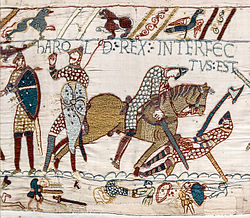
William's Norman army defeated and killed King Harold at Senlac Hill near Hastings after a daylong battle featuring archers, cavalry, and feigned retreats. Harold's death shattered Anglo-Saxon leadership and opened the path to London.
Image source: Battle of Hastings
Dec 1066
% complete
After burning Southwark and circling London, William crossed the Thames and received the submission of Edgar Ætheling and London's leaders, who elected him king. He was crowned on Christmas Day at Westminster Abbey.
Dec 25, 1066
% complete
William was crowned King of England on Christmas Day 1066. Shouting by Norman guards outside the abbey, mistaken by Londoners for a riot, sparked fires and violence in the city during the ceremony.
Image source: Coronations of William the Conqueror and Matilda
Jul 1087
% complete
During a punitive raid against Philip I of France's territories, William's troops sacked and burned Mantes. According to tradition, William suffered a fatal internal injury when his horse stumbled or he was thrown against his saddle pommel amid the burning ruins.
Image source: Mantes-la-Jolie
Sep 1087
% complete
Per William's wishes, his eldest surviving son Robert Curthose inherited the Duchy of Normandy, while his son William Rufus took the throne of England. The youngest, Henry, received money and later seized the English crown in 1100.
Image source: William II of England
Sep 9, 1087
% complete
William died at the priory of Saint-Gervais near Rouen from complications of his injury. His body was so bloated that, according to accounts, it burst during burial preparations at his funeral in Caen.
Or browse the full history timeline directory, with more than 2,000 topics.
This William the Conqueror timeline was generated with the help of AI, using information found on the internet.
We work hard to keep these timelines accurate, but mistakes do get through. If you spot one, email us at [email protected] and we'll fix it for future visitors.
Generate yours with AI or build it from scratch, for free.
Export your timeline, add your own events, edit or remove AI-generated events, and much more
No credit card required.
Cancel anytime.
Cancel anytime.
You can create an unlimited number of timelines with up to 10 events on each one, customize how they look, export them to PDF, PNG, PowerPoint, CSV, and Excel, and share them with a link. Paid plans raise the event limit and add features like spreadsheet imports and collaborators.
Yes. You can cancel your subscription from your account page at any time, and you will not be charged again. Your subscription stays active for the rest of the period you already paid for.
Yes. We will email you a reminder before the annual renewal, and we will also email you a receipt.
Yes. You can email us within 15 days of any payment, and we will issue you a full refund.
Check out our pricing docs or send us an email anytime: [email protected].