-
Use Cases
-
Resources
-
Pricing
Montezuma II (Moctezuma Xocoyotzin) was the ninth ruler of the Aztec Empire, reigning from 1502 until his death in 1520. Under his leadership, the empire reached its greatest territorial extent, but his reign ended with the arrival of Spanish conquistadors under Hernán Cortés, leading to the fall of Tenochtitlan and the collapse of Aztec power. More Less
1466
% complete
Moctezuma Xocoyotzin, retroactively referred to as Moctezuma II, was born around 1466. He would become the ninth emperor of the Aztec Empire, reigning from 1502 or 1503 to 1520.
Image source: Moctezuma II
1480 - 1490
% complete
Before ascending to the throne, Moctezuma participated in celebrated campaigns during Ahuizotl's reign in the late 15th century, including the last stages of the conquest of Ayotlan.
1490
% complete
Approximately in the year 1490, Moctezuma obtained the rank of tequihua, which was reached by capturing at least four enemy commanders.
1502
% complete
Most historians suggest the year 1502 to be the most likely date for Moctezuma's coronation as the ninth emperor of the Aztec Empire, though some have argued in favor of 1503.
Jul 15, 1503
% complete
The Stone of the Five Suns, held at the Art Institute of Chicago, bears a date of 11 Reed, equivalent to July 15, 1503. Fernando de Alva Cortés Ixtlilxóchitl states the coronation took place on May 24, 1503, but most documents say it happened in 1502.
1503
% complete
Approximately in 1503 (or 1507 after the conquest of Tototepec, according to Diego Durán), a massive battle occurred in Atlixco fought mainly against Huejotzingo, one of the most powerful kingdoms in the Valley of Mexico.
1504
% complete
The first important conquest during Moctezuma's rule occurred in the year 1504 when the city of Achiotlan, today known as San Juan Achiutla, was conquered.
1504
% complete
It was approximately in the year 1504 or 1505 when the first large-scale conflicts between Mexico and Tlaxcala began, starting a war that would have devastating consequences decades later.
1505
% complete
In the year 1505, a major drought resulted in widespread crop failure, and thus a large portion of the population of central Mexico began to starve.
1506
% complete
In 1506, the Chapultepec aqueduct was built under Moctezuma to bring fresh water directly from Chapultepec to Tenochtitlan and Tlatelolco. It was later destroyed during the Siege of Tenochtitlan in 1521 by the Spaniards to cut the city's water supply.
May 28, 1506
% complete
The second conquest of Moctezuma's rule occurred at Zozollan, east of Achiutla, on May 28, 1506, during the campaign against the Yanhuitlan rebellion. Approximately 5100 prisoners were taken, many enslaved and the rest sacrificed on the fourth day of his coronation.
1507
% complete
In the year 1507, the year of the New Fire Ceremony, abundant military action occurred, including a campaign launched against Tototepec, which had previously been a territory of Tlachinollan.
1507
% complete
The conquest of Tototepec formed part of the conquests of some of the last few Tlapanec territories of modern-day Guerrero. All the population except children was massacred by Mexica forces, and about 1350 captives were taken.
1507
% complete
According to historians like Durán, an embassy involving Huexotzinca requesting aid was sent in 1507 just after the New Fire Ceremony, though others date it to 1512. The Huexotzinca had made similar requests before, around 1499 under Ahuizotl, which were denied.
1508
% complete
A rebellion occurred in 1508 and was repressed by a prince named Macuilmalinatzin.
1509
% complete
Several military defeats occurred during expansionist campaigns, such as the invasion of Amatlan in 1509, where an unexpected series of snowstorms and blizzards killed many soldiers, leaving the survivors too few to fight.
1510
% complete
A large series of rebellions occurred in 1510, likely as a result of astrological predictions halting some Mexica military operations to a degree.
1511 - 1512
% complete
Moctezuma tried to campaign against the rebellions one at a time throughout the following years, campaigning against territories in Oaxaca, including Icpatepec again, in 1511 or 1512. A war against Icpatepec is recorded to have happened in 1511.
1514
% complete
After the campaigns in Oaxaca, Moctezuma moved his campaigns into northern and eastern territories around 1514, conquering Quetzalapan, a Chichimec territory through the Huastec region, taking 1332 captives with only 95 reported losses.
1514
% complete
Another natural disaster, of lesser intensity, occurred in the winter of 1514, when a series of dangerous snowstorms resulted in the destruction of various crops and property across Mexico.
1515
% complete
Another campaign was launched in 1515 to conquer Acocozpan and Tetenanco and reconquer Atlitepec, which had been previously conquered by Ahuizotl in 1493.
1516
% complete
Nezahualpilli died abruptly in 1516, leaving no indication as to who his successor would be. Around the same time, Huejotzingo abandoned its alliance with the empire, having been weakened by devastating wars into being conquered by Tlaxcala.
1518
% complete
In 1518, Moctezuma received the first reports of Europeans landing on the east coast of his empire: the expedition of Juan de Grijalva, who landed on San Juan de Ulúa, within Totonac territory under Aztec auspices.
Image source: Juan de Grijalva
Jul 1519
% complete
A Totonac rebellion against Moctezuma started in July 1519 after the Spanish arrived. It was retaliated against by a garrison under Spanish captain Juan de Escalante.
Sep 23, 1519
% complete
The war between Mexico and Tlaxcala eventually had devastating consequences, as the Tlaxcalans decided on an alliance with Spain against Mexico on September 23, 1519, after battles proved such an alliance could help them destroy Moctezuma's reign.
Image source: Tlaxcala (Nahua state)
Nov 8, 1519
% complete
When Cortés arrived in 1519, Moctezuma sent emissaries including the noble Tentlil ('Tendile'). On November 8, 1519, Moctezuma met Cortés on the causeway leading into Tenochtitlán, and the two leaders exchanged gifts.
1520
% complete
After the Spanish imprisoned Moctezuma, Cacamatzin, who initially welcomed them in November 1519, attempted to raise an army against them by calling on Coyoacan, Tlacopan, Iztapalapa and the Matlatzinca people to enter the city, kill the Spaniards and free Moctezuma in early 1520.
Image source: Cacamatzin
Apr 1520
% complete
Shortly after imprisoning Moctezuma, in April 1520, Cortés left Tenochtitlan to fight Pánfilo de Narváez, who had landed in Mexico to arrest Cortés.
Image source: Pánfilo de Narváez
Jun 29, 1520
% complete
According to Bernal Díaz del Castillo, on June 29, 1520, the Spanish forced Moctezuma to appear on the balcony of his palace appealing to his countrymen to retreat. Moctezuma died during this period, amid La Noche Triste and the early stages of the Spanish conquest.
Aug 13, 1521
% complete
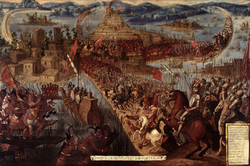
Most of Moctezuma's policies did not last long after his death, as the empire fell into Spanish control on August 13, 1521 as a result of the Spanish conquest of the Aztec Empire, one year after he died. The Totocalli was burnt during the siege, along with other royal constructions.
Image source: Fall of Tenochtitlan
1525
% complete
Ixtlilxochitl continued fighting for the Spaniards afterwards, became a personal friend of Cortés, converted to Christianity and participated in the Spanish conquest of Honduras in 1525.
Image source: Ixtlilxochitl II
1627
% complete
In 1627, Pedro Tesifón de Moctezuma, son of descendants of Moctezuma, was given the title Count of Moctezuma (later altered to Moctezuma de Tultengo) and thus became part of the Spanish nobility.
Image source: Duke of Moctezuma de Tultengo
1733 - 1781
% complete
The Aztec emperor is the title character in several 18th-century operas: Motezuma (1733) by Antonio Vivaldi; Montezuma (1755) by Carl Heinrich Graun; Motezuma (1771) by Josef Mysliveček; and Montesuma (1781) by Niccolò Antonio Zingarelli.
1761
% complete
In the Quisteil rebellion of the Yucatec Maya in 1761, the rebel leader Jacinto Canek reportedly called himself 'Little Montezuma'. Similarly, the Virgin Cult rebellion in Chiapas in 1721 claimed Moctezuma would be resuscitated against the Spanish.
Image source: Jacinto Canek
1766
% complete
In 1766, the holder of the title of Count of Moctezuma de Tultengo became a Grandee of Spain.
1865
% complete
In 1865, coincidentally during the Second Mexican Empire, the title held by Antonio María Moctezuma-Marcilla de Teruel y Navarro, 14th Count of Moctezuma de Tultengo, was elevated to that of duke, becoming Duke of Moctezuma, with de Tultengo again added in 1992 by Juan Carlos I.
1963 - 2005
% complete
Moctezuma is the subject of Roger Sessions' dodecaphonic opera Montezuma (1963), and the protagonist in the modern opera La Conquista (2005) by Italian composer Lorenzo Ferrero, where his part is written in the Nahuatl language.
Image source: La Conquista (opera)
2020
% complete
According to family historian Blanca Barragan Moctezuma, there are between 600 and 700 living descendants of Emperor Moctezuma in Mexico and 350 living in Spain as of 2020. In 2024, descendant Ituriel Moctezuma tried unsuccessfully to run for President of Mexico.
Or browse the full history timeline directory, with more than 2,000 topics.
This Montezuma II timeline was generated with the help of AI, using information found on the internet.
We work hard to keep these timelines accurate, but mistakes do get through. If you spot one, email us at [email protected] and we'll fix it for future visitors.
Generate yours with AI or build it from scratch, for free.
Export your timeline, add your own events, edit or remove AI-generated events, and much more
No credit card required.
Cancel anytime.
Cancel anytime.
You can create an unlimited number of timelines with up to 10 events on each one, customize how they look, export them to PDF, PNG, PowerPoint, CSV, and Excel, and share them with a link. Paid plans raise the event limit and add features like spreadsheet imports and collaborators.
Yes. You can cancel your subscription from your account page at any time, and you will not be charged again. Your subscription stays active for the rest of the period you already paid for.
Yes. We will email you a reminder before the annual renewal, and we will also email you a receipt.
Yes. You can email us within 15 days of any payment, and we will issue you a full refund.
Check out our pricing docs or send us an email anytime: [email protected].