
-
Use Cases
-
Resources
-
Pricing
Nefertiti was one of ancient Egypt's most powerful and celebrated queens, serving as Great Royal Wife of Pharaoh Akhenaten during the 18th Dynasty. She played a central role in the Amarna Period, a time of dramatic religious and artistic change centered on the worship of the sun disk Aten, and her famous bust remains one of the most recognizable symbols of ancient Egypt. More Less
1370 BC
% complete
Nefertiti was born around 1370 BC. She would rise to become one of the most famous queens in the history of Ancient Egypt.
Image source: Nefertiti
1353 BC
% complete
Nefertiti served as a queen of the 18th Dynasty of Ancient Egypt and was the great royal wife of Pharaoh Akhenaten, playing an exceptionally prominent role alongside him during his reign.
1338 BC
% complete
Pre-2012 Egyptological theories assumed that Nefertiti vanished from the historical record around Year 12 of Akhenaten's reign, with no word of her existence thereafter. She is thought to have died around 1330 BC.
1345 BC
% complete
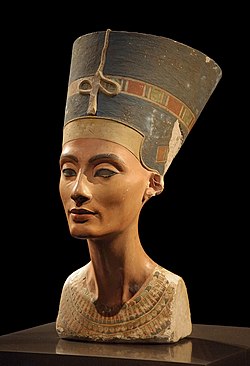
The famous painted bust of Nefertiti is attributed to the Egyptian sculptor Thutmose. It was created during her lifetime and later became one of the most iconic images of the ancient world.
Image source: Nefertiti Bust
1898
% complete
In 1898, French archeologist Victor Loret found two female mummies among those cached inside the tomb of Amenhotep II in KV35 in the Valley of the Kings. These mummies, known as the Elder Lady and the Younger Lady, later became candidates for identification as Nefertiti.
Image source: KV35
1900 - 1999
% complete
In the 20th century, Nefertiti was made famous by the discovery and display of her ancient bust, which transformed public perception of the ancient queen and made her a global icon of beauty and power.
1900 - 1999
% complete
The bust of Nefertiti went on display in Berlin's Neues Museum, where it remains one of the museum's most celebrated treasures and continues to draw millions of visitors.
2015
% complete
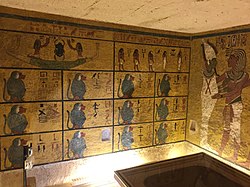
In 2015, English archaeologist Nicholas Reeves announced that high resolution scans revealed voids behind the walls of Tutankhamun's tomb, which he proposed to be the burial chamber of Nefertiti.
2016
% complete
Following Nicholas Reeves' proposal, subsequent radar scans showed that there are no hidden chambers behind the walls of Tutankhamun's tomb, ruling out his suggested location of Nefertiti's burial chamber.
Image source: Tomb of Tutankhamun
1973
% complete
Nefertiti was portrayed by Geraldine Chaplin in 'Nefertiti and Akhenaton,' a 1973 Mexican short film directed by Raul Araiza depicting the famous royal couple of the Amarna period.
Dec 1998
% complete
In December 1998, Leo-Neferuaten Boyle and Sovra Wilson-Dickson wrote the song 'Nefertiti, Sun Goddess,' which celebrates the legendary ancient Egyptian queen.
Oct 2002
% complete
In October 2002, 'Nefertiti, Sun Goddess' appeared on Leo-Neferuaten Boyle's studio recorded demo album, 'The Aten Shines Again,' bringing the musical tribute to the queen to listeners.
Sep 8, 2012
% complete
Nefertiti was portrayed again by Riann Steele in Doctor Who (2012), in the episode 'Dinosaurs on a Spaceship,' where the queen appears as a companion figure aboard a spaceship, introducing the historical figure to a new generation of viewers.
Image source: Dinosaurs on a Spaceship
Nov 2012
% complete
In November 2012, a YouTube video of the song 'Nefertiti, Sun Goddess' was created, extending the reach of this artistic homage to the ancient queen to a global online audience.
2024
% complete
Nefertiti (presented as the same person as Neferneferuaten) is a key part of the archaeological topics in Jacqueline Benson's 2024 historical fantasy novel, Tomb of the Sun King, continuing the enduring fascination with the queen in modern fiction.
2001
% complete
An article in KMT magazine in 2001 suggested that the Elder Lady, one of the female mummies found in KV35, might be Nefertiti, adding to the debate over identifying the queen's remains.
Jun 9, 2003
% complete
On 9 June 2003, archaeologist Joann Fletcher, a specialist in ancient hair from the University of York in England, announced that Nefertiti's mummy may have been the Younger Lady, one of the two female mummies discovered in KV35 in 1898.
Image source: The Younger Lady
2009
% complete
In a 2009 paper written in memory of William J. Murnane, James P. Allen argued that the female coregent Neferneferuaten was Akhenaten's fourth daughter, reasoning that it seemed a logical progression in Akhenaten's attempts to produce a son, and because evidence appeared to lack confirmation that Nefertiti was still alive in Akhenaten's final years.
2012
% complete
In 2012, the discovery of an inscription dated to Year 16, month 3 of Akhet, day 15 of the reign of Akhenaten was announced. This finding challenged the long-held belief that Nefertiti had disappeared from the record after Year 12, suggesting she remained alive and active much later than previously assumed.
2014
% complete
Athena van der Perre's 2014 scholarly contribution examined the chronological evidence surrounding Nefertiti's life and reign, helping establish the case for her continued prominence late into Akhenaten's rule.
2014
% complete
Egyptologist Athena van der Perre published research contributing to the growing body of scholarship identifying the female pharaoh Neferneferuaten as Nefertiti, supported by evidence including the 2012 Year 16 inscription.
2016
% complete
Aidan Dodson published an updated edition of his influential work in 2016, originally issued in 2014, contributing to scholarship on the Amarna period and supporting the identification of Nefertiti with the female king Neferneferuaten.
2016
% complete
The number of Egyptologists who agree that the female pharaoh Neferneferuaten was Nefertiti includes Chris Naunton, Aidan Dodson, Athena van der Perre, Nozomu Kawai and James Peter Allen since 2016, reflecting a significant scholarly consensus on the queen's later career as a ruler.
Image source: Neferneferuaten
2016
% complete
In his updated 2016 paper, published in Göttinger Miszellen, James P. Allen revised his earlier position and now identifies the female pharaoh as Neferneferuaten Nefertiti herself, rather than Akhenaten's daughter who was named Neferneferuaten Tasherit (the younger) as he had previously suggested.
2020
% complete
Aidan Dodson published a new major work in 2020 covering the royal families of Ancient Egypt, incorporating the latest understanding of Nefertiti's role and her possible identity as the female pharaoh Neferneferuaten.
Or browse the full history timeline directory, with more than 2,000 topics.
This Nefertiti timeline was generated with the help of AI, using information found on the internet.
We work hard to keep these timelines accurate, but mistakes do get through. If you spot one, email us at [email protected] and we'll fix it for future visitors.
Generate yours with AI or build it from scratch, for free.
Export your timeline, add your own events, edit or remove AI-generated events, and much more
No credit card required.
Cancel anytime.
Cancel anytime.
You can create an unlimited number of timelines with up to 10 events on each one, customize how they look, export them to PDF, PNG, PowerPoint, CSV, and Excel, and share them with a link. Paid plans raise the event limit and add features like spreadsheet imports and collaborators.
Yes. You can cancel your subscription from your account page at any time, and you will not be charged again. Your subscription stays active for the rest of the period you already paid for.
Yes. We will email you a reminder before the annual renewal, and we will also email you a receipt.
Yes. You can email us within 15 days of any payment, and we will issue you a full refund.
Check out our pricing docs or send us an email anytime: [email protected].