-
Use Cases
-
Resources
-
Pricing
The Nuremberg Trials were a series of military tribunals held by the Allied forces after World War II to prosecute prominent members of the political, military, and economic leadership of Nazi Germany for war crimes, crimes against humanity, and crimes against peace. Held in Nuremberg, Germany, these trials established groundbreaking precedents in international law and accountability. More Less
Sep 1, 1939
% complete
Between 1939 and 1945, Nazi Germany invaded many European countries, including Poland, Denmark, Norway, the Netherlands, Belgium, Luxembourg, France, Yugoslavia, Greece, and the Soviet Union.
Image source: Nuremberg trials
Sep 1, 1939 - May 8, 1945
% complete
Between 1939 and 1945, Nazi Germany invaded many countries across Europe, inflicting 27 million deaths in the Soviet Union alone. These aggressions and atrocities would later form the basis of the charges brought at the Nuremberg Trials.
Jan 1, 1942
% complete
In early 1942, representatives of nine governments-in-exile from German-occupied Europe issued a declaration demanding an international court to try the German crimes committed in their occupied countries.
Oct 1, 1943
% complete
The London-based United Nations War Crimes Commission—without Soviet participation—first met in October 1943 and became bogged down in the scope of its mandate, with Belgian jurist Marcel de Baer and Czech legal scholar Bohuslav Ečer arguing for a broader definition of war crimes that would include 'the crime of war'.
Image source: United Nations War Crimes Commission
Nov 1, 1943
% complete
On 1 November 1943, the Soviet Union, United Kingdom, and United States issued the Moscow Declaration, warning Nazi leadership of the signatories' intent to 'pursue them to the uttermost ends of the earth' and deliver them to justice.
Oct 1, 1944 - Mar 31, 1945
% complete
The United States Department of War was drawing up plans for an international tribunal in late 1944 and early 1945, laying groundwork for the eventual prosecution of Nazi leaders.
Feb 4, 1945 - Feb 11, 1945
% complete
At the Yalta Conference in February 1945, the Allied leaders discussed how Nazi criminals would face justice, but the form that retribution would take was left unresolved.
Image source: Yalta Conference
May 8, 1945
% complete
Germany surrendered unconditionally on 8 May 1945, bringing an end to the war in Europe and clearing the way for the Allies to prosecute captured Nazi leaders.
Image source: German Instrument of Surrender
Jun 1, 1945 - Aug 31, 1945
% complete
In mid-1945, France, the Soviet Union, the United Kingdom, and the United States agreed to convene a joint tribunal in Nuremberg, occupied Germany, with the Nuremberg Charter as its legal instrument.
Jun 26, 1945 - Aug 2, 1945
% complete
At the London Conference, held from 26 June to 2 August 1945, representatives of France, the Soviet Union, the United Kingdom, and the United States negotiated the form that the trial would take.
Image source: Nuremberg trials
Jun 26, 1945 - Aug 2, 1945
% complete
During the 1945 London Conference, both the United States and the Soviet Union explicitly resisted giving the International Military Tribunal broad jurisdiction over a state's peacetime treatment of its own citizens, seeking to protect their own domestic affairs from international scrutiny.
Nov 20, 1945 - Jan 31, 1946
% complete
Vyshinsky demanded extensive corrections to the charges of crimes against peace, especially regarding the role of the 1939 German–Soviet pact and its secret protocols in starting World War II.
Nov 20, 1945 - Oct 1, 1946
% complete
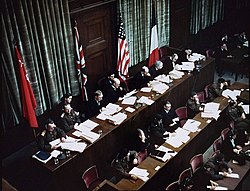
Between 20 November 1945 and 1 October 1946, the International Military Tribunal (IMT) tried 22 of the most important surviving leaders of Nazi Germany in the political, military, and economic spheres, as well as six German organizations.
Nov 20, 1945 - Oct 1, 1946
% complete
Also on trial were propagandists Julius Streicher and Hans Fritzsche; Rudolf Hess, Hitler's deputy who had flown to Britain in 1941; Hans Frank, governor-general of the General Government of Poland; Hitler Youth leader Baldur von Schirach; Arthur Seyss-Inquart, Reich Commissioner for the Netherlands; and Ernst Kaltenbrunner, leader of Himmler's Reich Security Main Office.
Nov 20, 1945
% complete
The International Military Tribunal began trial on 20 November 1945, after postponement requests from the Soviet prosecution, who wanted more time to prepare its case, were rejected.
Jan 1, 1946
% complete
In early 1946, there were a thousand employees from the four countries' delegations in Nuremberg, of which about two thirds were from the United States.
Jan 1, 1946
% complete
The French prosecutor, François de Menthon, had just overseen trials of the leaders of Vichy France; he resigned in January 1946 and was replaced by Auguste Champetier de Ribes.
Image source: François de Menthon
Jan 17, 1946 - Feb 7, 1946
% complete
In contrast to the other prosecution teams, the French prosecution delved into Germany's development in the nineteenth century, arguing that it had diverged from the West due to pan-Germanism and imperialism.
Jan 17, 1946 - Feb 7, 1946
% complete
From 17 January to 7 February 1946, France presented its charges and supporting evidence before the International Military Tribunal.
Mar 1, 1946 - Jul 31, 1946
% complete
From March to July 1946, the defense presented its counterarguments against the charges leveled by the four Allied prosecution teams.
Mar 5, 1946
% complete
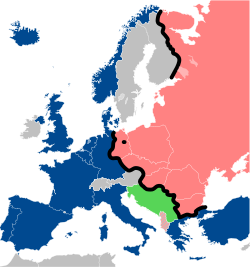
In the context of the brewing Cold War—for example, in early March 1946, Winston Churchill delivered the Iron Curtain speech—the trial became a means of condemning not only Germany but also the Soviet Union.
Image source: Iron Curtain
Jan 1, 1946 - Dec 31, 1950
% complete
In a 1946 poll, 78 percent of Germans assessed the trial as fair, but four years later that had fallen to 38 percent, with 30 percent considering it unfair.
Dec 11, 1946
% complete
On 11 December 1946, the United Nations General Assembly unanimously passed a resolution affirming 'the principles of international law recognized by the Charter of the Nuremberg Tribunal and the judgment of the Tribunal'.
Image source: Nuremberg principles
Dec 9, 1948
% complete
The 1948 Genocide Convention was much more restricted than Raphael Lemkin's original concept, and its effectiveness was further limited by Cold War politics.
May 23, 1949
% complete
The pardon of convicted war criminals also had cross-party support in West Germany, which was established in 1949, pressuring the occupying powers to show leniency.
Jan 1, 1950
% complete
In 1950, the International Law Commission drafted the Nuremberg principles to codify international criminal law, although the Cold War prevented the adoption of these principles until the 1990s.
Jan 1, 1953
% complete
A permanent International Criminal Court (ICC) was proposed in 1953, building on the precedent set at Nuremberg, though it would take decades to become reality.
Image source: International Criminal Court
Dec 14, 1961 - Jan 1, 2025
% complete
The IMT is one of the most well-studied trials in history, and it has been the subject of an abundance of books and scholarly publications, along with motion pictures such as Judgment at Nuremberg (1961), The Memory of Justice (1976), Nuremberg (2000), and Nuremberg (2025).
Image source: Judgment at Nuremberg
Sep 30, 1946
% complete
The judges ruled that there had been a premeditated conspiracy to commit crimes against peace, whose goals were 'the disruption of the European order' and 'the creation of a Greater Germany beyond the frontiers of 1914'.
Sep 30, 1946
% complete
Contrary to Jackson's argument that the conspiracy began with the founding of the Nazi Party in 1920, the verdict dated the planning of aggression to the 1937 Hossbach Memorandum.
Sep 30, 1946
% complete
The judges determined that crimes against humanity concerning German Jews before 1939 were not under the court's jurisdiction because the prosecution had not proven a connection to aggressive war.
Oct 1, 1946 - Aug 17, 1987
% complete
The IMT defendants required Soviet permission for release; Albert Speer was not successful in obtaining early release, and Rudolf Hess remained in prison until his death in 1987.
Image source: Rudolf Hess
Jan 1, 1949
% complete
The Americans satisfied these wishes to bind West Germany to the Western Bloc, beginning early releases of Nuremberg Military Tribunal convicts in 1949.
Image source: Subsequent Nuremberg trials
Jan 1, 1951
% complete
In 1951, High Commissioner John J. McCloy overturned most of the remaining sentences of convicted war criminals, commuting many death sentences and ordering releases.
Image source: John J. McCloy
Jan 1, 1958
% complete
After McCloy's clemency decisions, the last three prisoners, all convicted at the Einsatzgruppen trial, were released in 1958.
Image source: Einsatzgruppen trial
Or browse the full history timeline directory, with more than 2,000 topics.
This Nuremberg Trials timeline was generated with the help of AI, using information found on the internet.
We work hard to keep these timelines accurate, but mistakes do get through. If you spot one, email us at [email protected] and we'll fix it for future visitors.
Generate yours with AI or build it from scratch, for free.
Export your timeline, add your own events, edit or remove AI-generated events, and much more
No credit card required.
Cancel anytime.
Cancel anytime.
You can create an unlimited number of timelines with up to 10 events on each one, customize how they look, export them to PDF, PNG, PowerPoint, CSV, and Excel, and share them with a link. Paid plans raise the event limit and add features like spreadsheet imports and collaborators.
Yes. You can cancel your subscription from your account page at any time, and you will not be charged again. Your subscription stays active for the rest of the period you already paid for.
Yes. We will email you a reminder before the annual renewal, and we will also email you a receipt.
Yes. You can email us within 15 days of any payment, and we will issue you a full refund.
Check out our pricing docs or send us an email anytime: [email protected].