
-
Use Cases
-
Resources
-
Pricing
The Scopes Trial, also known as the Scopes Monkey Trial, was a landmark 1925 legal case in Dayton, Tennessee, in which high school teacher John T. Scopes was tried for violating a state law prohibiting the teaching of human evolution. The trial became a national spectacle, pitting scientific modernism against religious fundamentalism and featuring famous lawyers William Jennings Bryan and Clarence Darrow. More Less
1858
% complete
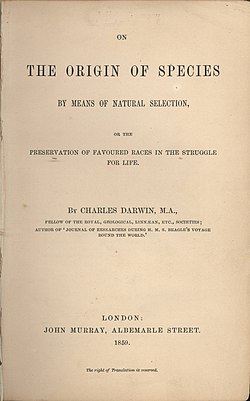
In the mid-19th century, English naturalists Charles Darwin and Alfred Russel Wallace independently developed the theory that populations evolve over the course of generations through a process of natural selection, and that all life on earth is descended from a common ancestor. Their work was jointly published in 1858, and further expanded upon the following year in Darwin's book On the Origin of Species.
Image source: On the Origin of Species
1900
% complete
In the early 20th century, a schism known as the Fundamentalist–modernist controversy arose within American Protestant Christianity, especially Presbyterianism, in response to the cultural, scientific, and technological developments of the time.
Image source: Fundamentalist–modernist controversy
Mar 21, 1925
% complete
After reading that boys and girls were coming home from school telling their parents the Bible was nonsense, Tennessee governor Austin Peay signed the bill on March 21, 1925 to gain support among rural legislators, though he believed the law would neither be enforced nor interfere with education in Tennessee schools.
Image source: Butler Act
Apr 5, 1925
% complete
On April 5, 1925, George Rappleyea, the local manager for the Cumberland Coal and Iron Company, arranged a meeting with county superintendent of schools Walter White and local attorney Sue K. Hicks to plan a challenge to the new anti-evolution law, beginning what historian Edward Larson called a publicity stunt.
Image source: Scopes trial
1925
% complete
The event became known as the "Trial of the Century" and has been described as the most-covered trial in American history, with only the murder trial of O. J. Simpson rivaling it in media attention. H. L. Mencken's reports in 1925 are credited by some creationists with turning public opinion against creationism.
Jul 10, 1925
% complete
The Scopes Monkey Trial, an American legal case in which high school teacher John T. Scopes was tried for teaching evolution, began on July 10, 1925 in Dayton, Tennessee. The press coverage of the "Monkey Trial" was overwhelming, making it one of the most-covered events in American history.
Jul 10, 1925 - Jul 21, 1925
% complete
During the trial, Life magazine adorned its masthead with monkeys reading books and proclaimed that "the whole matter is something to laugh about." Both Literary Digest and Life (1890–1930) ran compilations of jokes and humorous observations garnered from newspapers around the country.
Jul 21, 1925
% complete
On July 21, 1925, Scopes was found guilty and ordered by Judge Raulston to pay a $100 fine (equivalent to about $1,800 in 2025), but the verdict was later overturned on a technicality.
1926
% complete
Some scholars accept that changes in textbooks resulted from the Scopes trial: Hunter, the author of the biology text which Scopes was on trial for teaching, revised the text by 1926 in response to the trial's controversy.
1927
% complete
By 1927, there were 13 states, both in the North and in the South, that had deliberated over some form of anti-evolution law. Nearly all these efforts were rejected, but Mississippi and Arkansas did put anti-evolution laws on the books after the Scopes trial.
1932
% complete
Though the ACLU had taken on the trial as a cause, in the wake of Scopes' conviction they were unable to find more volunteers to take on the Butler law and, by 1932, had given up their campaign against it.
1958
% complete
In 1958, during the height of the Cold War, the National Defense Education Act was passed with the encouragement of many legislators who feared the United States education system was falling behind that of the Soviet Union. This led to a weakening of the backlash in Texas and increased trust for science after the Sputnik era began in 1957.
Image source: National Defense Education Act
1965
% complete
The anti-evolutionary legislation was not challenged again until 1965, and in the meantime, William Jennings Bryan's cause was taken up by a number of organizations, including the Bryan Bible League and the Defenders of the Christian Faith.
1967
% complete
Mississippi and Arkansas' post-Scopes anti-evolution laws would outlive the Butler Act itself, which was repealed in 1967 amid a national climate more favorable to science education.
1968
% complete
In 1968, the Supreme Court of the United States ruled in Epperson v. Arkansas that bans on teaching evolution were unconstitutional, effectively ending legal enforcement of laws like the Butler Act.
Image source: Epperson v. Arkansas
1930
% complete
Bryan College is a private Christian college in Dayton, Tennessee that was established in 1930 in honor of William Jennings Bryan, who had defended the anti-evolution cause at the Scopes Trial.
Image source: Bryan College
1988
% complete
Since 1988, locals have participated in a play called "Destiny in Dayton", a re-enactment of key moments of the trial that takes place in the historic Rhea County Courthouse courtroom during July.
1989
% complete
In 1989, "Destiny in Dayton" evolved into the larger Scopes Trial Festival, which includes vendors, craftsmen, and live music alongside the yearly re-enactment.
2005
% complete
In 2005, a statue of William Jennings Bryan was dedicated on the Rhea County Courthouse lawn, funded by a donation from nearby Bryan College.
Image source: Rhea County Courthouse
2007
% complete
In 2007, Bryan College purchased the rights to Gale Johnson's play Inherit the Truth (1987), written as a rebuttal of the 1955 play and 1960 film based on original transcripts, and began work on a student film version screened at that year's Scopes Festival.
Image source: Scopes trial
2009
% complete
Gale Johnson's play Inherit the Truth was performed yearly during the Dayton Scopes Festival until the festival ended its run in 2009.
2017
% complete
In 2017, a statue of Clarence Darrow was unveiled near William Jennings Bryan's statue outside the Rhea County Courthouse, funded by a donation from the Freedom From Religion Foundation.
1955
% complete
Jerome Lawrence and Robert Edwin Lee's 1955 play Inherit the Wind fictionalizes the Scopes trial as a means of discussing the then-contemporary McCarthy trials. It has been credited with shaping popular perceptions of the trial and of fundamentalism.
Image source: Inherit the Wind (play)
1960
% complete
The 1955 play Inherit the Wind was adapted into a 1960 film directed by Stanley Kramer, with Spencer Tracy as Drummond and Fredric March as Brady. The play and movie have been credited with causing millions of Americans to ridicule religious-based opposition to the theory of evolution.
Image source: Inherit the Wind (1960 film)
1965
% complete
There have been three television adaptations of Inherit the Wind, beginning with one starring Melvyn Douglas and Ed Begley in 1965.
1988
% complete
A second television adaptation of Inherit the Wind aired in 1988, starring Jason Robards and Kirk Douglas.
1988
% complete
Bruce Springsteen performed a song called "Part Man, Part Monkey" during his 1988 Tunnel of Love Express Tour, and recorded a version in 1990 that was first released as a 1992 B-side and later on the 1998 multi-volume Tracks collection.
Image source: Tracks (Bruce Springsteen album)
1997
% complete
The 1997 The Simpsons episode "Lisa the Skeptic" drew inspiration from the Scopes Trial, along with the Cardiff Giant and Piltdown Man hoaxes, exploring themes of science versus belief.
Image source: Lisa the Skeptic
1999
% complete
The third television adaptation of Inherit the Wind starred Jack Lemmon and George C. Scott, completing a series of screen versions of the famous 1955 play.
2006
% complete
Ronald Kidd's 2006 novel, Monkey Town: The Summer of the Scopes Trial, set in summer 1925 in Dayton, is based on the Scopes Trial and brings its events to life for young readers.
2009
% complete
Peter Goodchild's 1993 play The Great Tennessee Monkey Trial was based on original sources and transcripts with the goal of historical accuracy; it won AudioFile's 2006 D.J.S. Earphones Award and was broadcast by the BBC in 2009 as a radio version starring Neil Patrick Harris and Ed Asner.
2010
% complete
The 2010 film Alleged, a romantic drama set around the Scopes trial, starring Brian Dennehy as Clarence Darrow and Fred Thompson as William Jennings Bryan, was released by Two Shoes Productions. Dennehy had coincidentally played Brady, Bryan's counterpart, in the 2007 Broadway revival of Inherit the Wind.
Image source: I'm Still Here (2010 film)
2013
% complete
In 2013, the Comedy Central series Drunk History retold portions of the Scopes trial in its "Nashville" episode, with Bradley Whitford portraying Bryan, Jack McBrayer as Darrow, and Derek Waters as Scopes.
Image source: Drunk History
Or browse the full history timeline directory, with more than 2,000 topics.
This Scopes Trial timeline was generated with the help of AI, using information found on the internet.
We work hard to keep these timelines accurate, but mistakes do get through. If you spot one, email us at [email protected] and we'll fix it for future visitors.
Generate yours with AI or build it from scratch, for free.
Export your timeline, add your own events, edit or remove AI-generated events, and much more
No credit card required.
Cancel anytime.
Cancel anytime.
You can create an unlimited number of timelines with up to 10 events on each one, customize how they look, export them to PDF, PNG, PowerPoint, CSV, and Excel, and share them with a link. Paid plans raise the event limit and add features like spreadsheet imports and collaborators.
Yes. You can cancel your subscription from your account page at any time, and you will not be charged again. Your subscription stays active for the rest of the period you already paid for.
Yes. We will email you a reminder before the annual renewal, and we will also email you a receipt.
Yes. You can email us within 15 days of any payment, and we will issue you a full refund.
Check out our pricing docs or send us an email anytime: [email protected].