-
Use Cases
-
Resources
-
Pricing
The Gilded Age was a period of rapid economic growth, industrialization, and urbanization in the United States from roughly the 1870s to 1900. Coined by Mark Twain, the term highlights the era's glittering surface of wealth that masked deep social problems, including political corruption, corporate monopolies, harsh labor conditions, and stark inequality between the wealthy elite and working-class immigrants. More Less
Nov 5, 1868
% complete
Civil War hero Ulysses S. Grant won the presidency, beginning eight years of leadership marked by Reconstruction efforts, attempts to protect African American civil rights, and persistent scandals involving his associates despite his personal integrity.
Image source: Ulysses S. Grant
Feb 3, 1870
% complete
The Fifteenth Amendment prohibited denying citizens the right to vote based on race, color, or previous condition of servitude, a landmark of Reconstruction that would later be undermined by Jim Crow laws during the Gilded Age.
Image source: Fifteenth Amendment to the United States Constitution
Sep 4, 1872
% complete
Investigations revealed that Union Pacific executives had bribed members of Congress with discounted stock in the Crédit Mobilier construction company to block oversight of railroad contracts. The scandal tarnished the Grant administration and epitomized Gilded Age political corruption.
Image source: Crédit Mobilier scandal
Mar 1877
% complete
An informal deal resolved the disputed 1876 presidential election by awarding Rutherford B. Hayes the presidency in exchange for withdrawing federal troops from the South, effectively ending Reconstruction and opening the way for segregation and disenfranchisement of Black Americans.
Image source: Compromise of 1877
Jul 2, 1881 - Sep 19, 1881
% complete
Charles Guiteau shot President Garfield at a Washington railroad station, motivated by resentment over not receiving a government post. Garfield died months later from infections caused by his medical care, shocking the nation and galvanizing civil service reform.
Image source: Assassination of James A. Garfield
May 6, 1882
% complete
Congress passed the first significant law restricting immigration into the United States, prohibiting Chinese laborers from entering the country. Driven by nativism and anti-Chinese sentiment on the West Coast, it remained in effect until 1943.
Jan 16, 1883
% complete
Following President Garfield's assassination by a disappointed office seeker, Congress passed the Pendleton Act, establishing merit-based examinations for federal jobs and creating the Civil Service Commission to combat the spoils system.
Image source: Pendleton Civil Service Reform Act
Feb 4, 1887
% complete
Responding to public outrage over railroad rate discrimination, Congress created the Interstate Commerce Commission, the first federal regulatory agency. Though initially weak, it set a precedent for government regulation of big business.
Feb 8, 1887
% complete
The Dawes Act authorized the division of Native American reservation land into individual allotments, aiming to assimilate Indigenous peoples. It resulted in the loss of vast amounts of tribal territory and devastated Native communities.
Nov 6, 1888
% complete
Benjamin Harrison won the presidency over incumbent Grover Cleveland despite losing the popular vote, thanks to narrow victories in key states aided by political machines and tariff politics, illustrating the fiercely competitive elections of the era.
Image source: 1888 United States presidential election
Jul 2, 1890
% complete
Named for Senator John Sherman, this landmark law outlawed monopolistic business practices and combinations restraining trade. Enforcement was weak at first, but it later became a crucial tool against trusts under Theodore Roosevelt.
Jul 4, 1892
% complete
Farmers and laborers organized the People's (Populist) Party in Omaha, demanding free silver, a graduated income tax, direct election of senators, and government ownership of railroads. Their platform challenged both major parties and shaped Progressive-era reforms.
Image source: People's Party (United States)
May 18, 1896
% complete
The Supreme Court upheld Louisiana's segregated railway cars, ruling that 'separate but equal' facilities were constitutional. The decision legitimized Jim Crow segregation for nearly six decades until Brown v. Board of Education.
Image source: Plessy v. Ferguson
Nov 3, 1896
% complete
Republican William McKinley defeated populist Democrat William Jennings Bryan, whose 'Cross of Gold' speech championed free silver. McKinley's victory, backed by businessman Mark Hanna, affirmed the gold standard and marked the decline of Populism.
Image source: 1896 United States presidential election
Apr 21, 1898 - Aug 13, 1898
% complete
Spurred by the sinking of the USS Maine and sympathy for Cuba, the United States defeated Spain in a brief war, acquiring Puerto Rico, Guam, and the Philippines. The conflict signaled America's emergence as a global imperial power at the close of the Gilded Age.
Image source: Spanish–American War
May 10, 1869
% complete
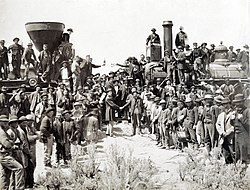
The Union Pacific and Central Pacific railroads met at Promontory Summit, Utah, completing the first transcontinental railroad. The achievement revolutionized transportation and commerce but also symbolized the era's corruption through scandals like Crédit Mobilier.
Image source: First transcontinental railroad
Jan 10, 1870
% complete
John D. Rockefeller established Standard Oil in Ohio, which grew to dominate the American petroleum industry through aggressive consolidation and the innovative trust structure, making Rockefeller one of the wealthiest men in history and exemplifying Gilded Age monopoly capitalism.
1873
% complete
The Comstock Lode in Nevada became one of the most productive silver mining operations in American history, generating enormous fortunes and spurring technological innovations in mining while fueling debates over silver currency that would dominate Gilded Age politics.
Image source: Comstock Lode
Sep 1873
% complete
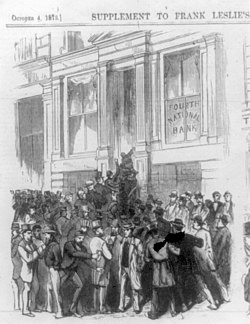
The failure of the banking house Jay Cooke & Company sparked a financial panic that plunged the United States into the Long Depression. Railroads overextended themselves, banks collapsed, and unemployment soared, fueling labor unrest and shaping economic policy debates for the rest of the decade.
Image source: Panic of 1873
Oct 22, 1879
% complete
Thomas Edison demonstrated a long-lasting incandescent lamp at his Menlo Park laboratory, ushering in the age of electric lighting. His subsequent development of power distribution systems transformed urban life and industry.
Image source: Incandescent light bulb
1881
% complete
Andrew Carnegie built Carnegie Steel into the world's largest steel producer using the Bessemer process and vertical integration. His company's growth embodied the rise of heavy industry and the concentration of wealth in the hands of industrial titans.
Image source: Carnegie Steel Company
May 1893
% complete
The collapse of the Philadelphia and Reading Railroad and National Cordage Company triggered bank failures and a stock market crash. The resulting depression saw unemployment reach 20 percent, thousands of businesses fail, and widespread protest movements emerge.
Image source: Panic of 1893
Oct 8, 1871 - Oct 10, 1871
% complete
A catastrophic fire destroyed much of Chicago, killing hundreds and leaving thousands homeless. The city's rapid rebuilding showcased Gilded Age ambition and architectural innovation, transforming Chicago into a modern metropolis.
Image source: Great Chicago Fire
1873
% complete
Mark Twain and Charles Dudley Warner published their satirical novel 'The Gilded Age: A Tale of Today,' mocking the era's greed, political corruption, and superficial glitter. The book's title gave the period its enduring name.
Image source: The Gilded Age: A Tale of Today
Oct 28, 1886
% complete
France gifted the Statue of Liberty to the United States, and President Cleveland dedicated it on Bedloe's Island. The monument came to symbolize freedom and welcome millions of immigrants arriving during the Gilded Age and beyond.
Image source: Statue of Liberty
Mar 11, 1888 - Mar 14, 1888
% complete
One of the most severe blizzards in U.S. history dumped up to 50 inches of snow on the Northeast, killing more than 400 people. The disaster prompted cities like New York to bury utility lines underground and build subway systems.
Image source: Great Blizzard of 1888
May 31, 1889
% complete
The collapse of the South Fork Dam released a massive wall of water onto the town of Johnstown, Pennsylvania, killing over 2,200 people. The dam had been maintained by an exclusive club of wealthy industrialists including Andrew Carnegie, fueling criticism of elite negligence.
Image source: Johnstown Flood
Jun 1889
% complete
Andrew Carnegie argued that the wealthy had a moral obligation to use their fortunes to benefit society through philanthropy. His essay shaped American charitable giving and led him to fund thousands of libraries and institutions.
Image source: The Gospel of Wealth
Jan 1, 1892
% complete
Ellis Island opened in New York Harbor as the primary federal immigration processing center. Over its lifetime it processed some 12 million immigrants, many fleeing poverty and persecution in Europe, reshaping America's demographic and cultural landscape.
Image source: Ellis Island
Sep 18, 1895
% complete
Booker T. Washington addressed the Cotton States Exposition in Atlanta, urging Black Americans to pursue economic advancement and accommodation rather than immediate demands for social equality. The speech made him the era's most influential Black leader.
Image source: Atlanta Compromise
Jun 21, 1877
% complete
Twenty Irish-American coal miners were hanged in Pennsylvania after being convicted as members of the Molly Maguires, an alleged secret society accused of violence against mine owners. The trials highlighted tensions between labor and capital in the anthracite coal region.
Image source: Molly Maguires
Jul 14, 1877 - Aug 1877
% complete
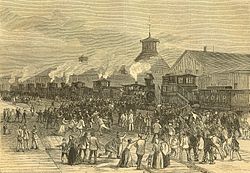
Wage cuts on the Baltimore & Ohio Railroad triggered the first major nationwide strike in U.S. history. Workers halted rail traffic across the country until federal troops violently suppressed the uprising, leaving over a hundred dead and revealing deep class conflict.
Image source: Great Railroad Strike of 1877
1884
% complete
Under leader Terence Powderly, the Knights of Labor expanded dramatically, advocating for an eight-hour workday and broad social reforms. The organization welcomed workers of all skills, races, and genders, becoming the largest labor organization of its time before declining after Haymarket.
Image source: Knights of Labor
May 4, 1886
% complete
A bomb exploded at a labor rally in Chicago's Haymarket Square, killing police officers and civilians. The ensuing trial and execution of anarchist leaders damaged the labor movement's reputation and fueled fears of radicalism across America.
Image source: Haymarket affair
Dec 8, 1886
% complete
Samuel Gompers led the founding of the American Federation of Labor, a federation of craft unions focused on practical goals like higher wages, shorter hours, and better conditions. The AFL became the dominant labor organization in America for decades.
Image source: American Federation of Labor
Jul 6, 1892 - Nov 1892
% complete
Henry Clay Frick locked out workers at Carnegie's Homestead mill and hired Pinkerton detectives, leading to a deadly battle. The defeat of the Amalgamated Association shattered unionism in steel and symbolized the raw power of industrial capital.
Image source: Homestead strike
Mar 25, 1894 - May 1, 1894
% complete
Businessman Jacob Coxey led a march of unemployed workers from Ohio to Washington, D.C., petitioning Congress for public works jobs. Though the protest failed legislatively, it was the first significant march on the nation's capital and foreshadowed future activism.
Image source: Coxey's Army
May 11, 1894 - Jul 20, 1894
% complete
Workers at George Pullman's company town struck over wage cuts and high rents; Eugene V. Debs' American Railway Union joined in sympathy, halting railroads nationwide. Federal troops broke the strike, and Debs was jailed, turning him toward socialism.
Image source: Pullman Strike
Or browse the full history timeline directory, with more than 2,000 topics.
This Gilded Age timeline was generated with the help of AI, using information found on the internet.
We work hard to keep these timelines accurate, but mistakes do get through. If you spot one, email us at [email protected] and we'll fix it for future visitors.
Generate yours with AI or build it from scratch, for free.
Export your timeline, add your own events, edit or remove AI-generated events, and much more
No credit card required.
Cancel anytime.
Cancel anytime.
You can create an unlimited number of timelines with up to 10 events on each one, customize how they look, export them to PDF, PNG, PowerPoint, CSV, and Excel, and share them with a link. Paid plans raise the event limit and add features like spreadsheet imports and collaborators.
Yes. You can cancel your subscription from your account page at any time, and you will not be charged again. Your subscription stays active for the rest of the period you already paid for.
Yes. We will email you a reminder before the annual renewal, and we will also email you a receipt.
Yes. You can email us within 15 days of any payment, and we will issue you a full refund.
Check out our pricing docs or send us an email anytime: [email protected].