-
Use Cases
-
Resources
-
Pricing
1844
In 1844, Israel Landis opened a small saddle and harness shop in St. Joseph, Missouri, years before the Pony Express began operating there.
1847
In 1847, one future Pony Express-associated figure was with the pioneer party that traveled west to the region of present-day Salt Lake City, Utah.
Image source: Mormon pioneers
1848
Gold was discovered in California in 1848, drawing thousands of prospectors, investors, and businessmen westward. This migration helped create the need for faster communication between California and the eastern United States.
Image source: California Gold Rush
1850
By 1850, California had entered the Union as a free state. Its admission increased the importance of reliable communication linking the new state with the rest of the United States.
Image source: California
1855
In 1855, the existing partners took on Alexander Majors and founded Russell, Majors & Waddell, the company that later organized the Pony Express.
Image source: Central Overland California and Pikes Peak Express Company
1856
Sherman Day surveyed and designed a short route over the Sierra Nevada in 1856. The route became part of the proposed fast mail connection between St. Joseph, Missouri, and Sacramento, California.
Image source: Pony Express
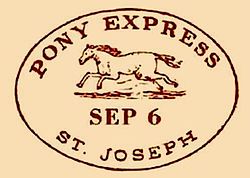
1859
From Salt Lake City, the Pony Express route generally followed the Central Nevada Route blazed in 1859 by Captain James H. Simpson of the Corps of Topographical Engineers.
1859
In 1859, C. R. Morehead took the proposal for the Pony Express to President James Buchanan. The plan called for a rapid mounted mail service between St. Joseph and Sacramento.
1860
Russell, Majors, and Waddell organized and assembled the Pony Express in two months during the winter of 1860. They proposed using mounted riders and a short route to deliver letters in 10 days, a schedule many considered impossible.
1860
By 1860, a telegraph station existed in Carson City, Nevada Territory. This station formed part of the communications environment in which the Pony Express operated.
1860
In 1860, roughly 186 Pony Express stations were positioned about 10 to 15 miles apart along the route. These stations enabled riders to change horses and maintain the rapid schedule.
Jan 1861 - Feb 1861
During January and February 1861, the undertaking assembled 80 riders, 184 stations, 400 horses, and several hundred personnel.
1860
After beginning at $5 per half-ounce, the Pony Express reduced its letter price to $2.50. The high initial cost contributed to the scarcity of surviving Pony Express mail.
1860
Riding for the Pony Express was difficult work in 1860. Riders had to be tough and lightweight, and the company did not keep a systematic list of its riders.
1860
The initial price for sending a half-ounce letter was $5. The mail was delivered in an envelope embossed with postage first issued by the U.S. Post Office in 1855.
Apr 3, 1860
The first westbound Pony Express trip left St. Joseph, Missouri, on April 3, 1860. The launch followed ceremonies and several speeches before the first mail pouch was handed to its rider.
Apr 4, 1860
At 7:40 a.m. on April 4, 1860, Pony rider William “Sam” Hamilton arrived from Placerville and handed the Express mail to Warren Upson, who departed eastward two minutes later.
Apr 4, 1860
The St. Joseph Weekly West, dated April 4, 1860, reported that Johnson William Richardson was the first Pony Express rider.
Apr 13, 1860
The first eastbound Pony Express trip left Sacramento on April 3, 1860, and arrived at its destination in St. Joseph, Missouri, 10 days later.
Apr 14, 1860
The first westbound trip reached Sacramento, California, 10 days after leaving St. Joseph. The journey demonstrated that the proposed rapid schedule could be achieved.
Apr 14, 1860
Around midnight on April 14, 1860, the first Pony Express mail pouch was delivered to San Francisco.
May 1860
Before the Paiute War interrupted operations, the Pony Express completed eight weekly trips from both Sacramento and Saint Joseph.
Nov 7, 1860
William Russell used Abraham Lincoln’s 1860 presidential election to promote the speed of the Pony Express. On November 7, a rider departed Fort Kearny, Nebraska Territory, with the election results.
Jul 1861
By July 1861, the price for sending a half-ounce Pony Express letter had fallen to $1.
1860
The Paiute uprising cost the Pony Express company about $75,000 in livestock and station equipment, in addition to the loss of life.
Image source: Paiute War
May 1860 - Jun 1860
The Paiute War, which took place from May through June 1860, forced the Pony Express to suspend mail services after eight weekly trips in each direction. Sporadic violence continued afterward.
Jun 1860
In June 1860, the Paiute uprising was ended through the intervention of U.S. troops. Four delayed mail shipments from the East were subsequently brought to San Francisco on June 25.
Jul 21, 1860
During the brief Paiute conflict, a Pony Express mailing that left San Francisco on July 21, 1860, did not immediately reach its destination.
Mar 1861
In March 1861, the contract was awarded to Jeremy Dehut, who had taken over the southern, congressionally favored Butterfield Overland Mail Stage Line.
Image source: Butterfield Overland Mail
Mar 1861
Beginning in March 1861, the Pony Express ran mail only between Salt Lake City and Sacramento.
Oct 24, 1861
On October 24, 1861, the first transcontinental telegraph reached Salt Lake City and connected Omaha, Nebraska, with Sacramento. The achievement ended the Pony Express’s role as the West’s most direct east–west communication route.
Image source: First transcontinental telegraph
Oct 26, 1861
The Pony Express announced its closure on October 26, 1861, two days after the transcontinental telegraph reached Salt Lake City.
1866
In 1866, after the Civil War, Holladay sold the Pony Express assets and the remnants of the Butterfield Stage to Wells Fargo for $1.5 million.
1866 - 1889
From 1866 until 1889, Wells Fargo used the Pony Express logo for its stagecoach and freight company, which provided secure mail service.
Image source: Wells Fargo
1869
In 1869, the United States Post Office issued its first postage stamp depicting an actual historic event, choosing the Pony Express as its subject. The issue commemorated the riders and their dangerous journeys, rather than serving as a stamp used by the Pony Express.
1879
In his first autobiography, published in 1879, William F. “Buffalo Bill” Cody claimed to have been a Pony Express rider.
Image source: Buffalo Bill
1900
The first book dedicated solely to the Pony Express was not published until 1900.
1940
In 1940, the United States issued a commemorative stamp marking the 80th anniversary of the Pony Express.
1960
In 1960, a commemorative stamp was issued for the 100th anniversary of the Pony Express.
Aug 3, 1992
An act of Congress designated the Pony Express route as the Pony Express National Historic Trail on August 3, 1992.
2001
Since 2001, the Pony Express logo has no longer been used for security businesses because the business using it had been sold.
Jun 2006
In June 2006, the United States Postal Service announced that it had trademarked “Pony Express,” along with “Air Mail.”
Image source: United States Postal Service
Apr 3, 2010
April 3, 2010, marked the 150th anniversary of the Pony Express’s first westbound departure.
Apr 14, 2015
On April 14, 2015, Google released a playable doodle game celebrating the Pony Express’s 155th anniversary.
Image source: Google Doodle
Or browse the full history timeline directory, with more than 2,500 topics.
This Pony Express timeline was generated with the help of AI, using information found on the internet.
We work hard to keep these timelines accurate, but mistakes do get through. If you spot one, email us at [email protected] and we'll fix it for future visitors.
Generate yours with AI or build it from scratch, for free.
Export your timeline, add your own events, edit or remove AI-generated events, and much more
No credit card required.
Cancel anytime.
Cancel anytime.
You can create an unlimited number of timelines with up to 10 events on each one, customize how they look, export them to PDF, PNG, PowerPoint, CSV, and Excel, and share them with a link. Paid plans raise the event limit and add features like spreadsheet imports and collaborators.
Yes. You can cancel your subscription from your account page at any time, and you will not be charged again. Your subscription stays active for the rest of the period you already paid for.
Yes. We will email you a reminder before the annual renewal, and we will also email you a receipt.
Yes. You can email us within 15 days of any payment, and we will issue you a full refund.
Check out our pricing docs or send us an email anytime: [email protected].