-
Use Cases
-
Resources
-
Pricing
The War of 1812 was a military conflict fought between the United States and Great Britain, along with their respective allies, primarily over British maritime restrictions, trade interference, and the impressment of American sailors. The war included notable events such as the burning of Washington D.C., the Battle of Baltimore, and the Battle of New Orleans, and it concluded with the Treaty of Ghent, which restored pre-war boundaries. More Less
Jun 22, 1807
% complete
The British warship HMS Leopard attacked the American frigate USS Chesapeake off the coast of Virginia, killing and wounding several sailors before boarding and impressing four alleged deserters. The incident outraged the American public and became a major grievance that contributed to the eventual declaration of war in 1812.
Image source: Chesapeake–Leopard affair
Dec 22, 1807
% complete
President Thomas Jefferson signed the Embargo Act, prohibiting American ships from trading with foreign ports in an attempt to pressure Britain and France to respect American neutrality during the Napoleonic Wars. The embargo devastated the American economy, particularly New England shipping, and fueled resentment toward the federal government.
Image source: Embargo Act of 1807
1808
% complete
Shawnee leader Tecumseh and his brother Tenskwatawa, known as the Prophet, worked to unite Native American tribes into a confederacy to resist American expansion into the Northwest Territory. The movement received British support from Canada, deepening American suspicions of British interference on the frontier.
Image source: Tecumseh's confederacy
Nov 7, 1811
% complete
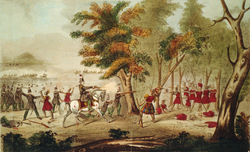
Governor William Henry Harrison led American forces against Tenskwatawa's warriors at Prophetstown near present-day Lafayette, Indiana. Though casualties were heavy on both sides, Harrison claimed victory, and the battle discredited the Prophet and pushed Tecumseh's confederacy closer to an alliance with Britain.
Image source: Battle of Tippecanoe
Jun 18, 1812
% complete
President James Madison signed the declaration of war after Congress voted largely along party lines, with War Hawks like Henry Clay pushing for conflict over British impressment of American sailors, trade restrictions, and support for Native resistance. It was the first time the United States formally declared war on another nation.
Image source: Declaration of war by the United States
Aug 15, 1812 - Aug 16, 1812
% complete
British General Isaac Brock, allied with Tecumseh's warriors, bluffed American General William Hull into surrendering Detroit without a fight. The humiliating loss cost the United States control of the Michigan Territory and was a serious early setback for the American war effort.
Image source: Siege of Detroit
Oct 13, 1812
% complete
American forces crossed the Niagara River to attack the Canadian village of Queenston but were ultimately defeated by British and Canadian militia under Roger Sheaffe. British General Isaac Brock was killed early in the battle, making him a national hero in Canada.
Image source: Battle of Queenston Heights
Jan 18, 1813 - Jan 23, 1813
% complete
American troops under James Winchester were defeated by British and Native forces at Frenchtown, Michigan Territory. After the surrender, dozens of wounded American prisoners were killed by Native warriors in what became known as the River Raisin massacre, inspiring the rallying cry 'Remember the Raisin.'
Image source: Battle of Frenchtown
Apr 27, 1813
% complete
American forces under Zebulon Pike captured and burned parts of York, the capital of Upper Canada. Pike was killed when an exploding ammunition magazine killed scores of soldiers on both sides. The burning of public buildings later served as a justification for the British burning of Washington in 1814.
Image source: Battle of York
May 1, 1813 - May 9, 1813
% complete
British forces and Native allies under Tecumseh besieged Fort Meigs in northwestern Ohio, but American defenders under William Henry Harrison successfully repelled repeated assaults. The failed siege preserved American control of the region and weakened the British position in the Northwest.
Image source: Siege of Fort Meigs
Jun 6, 1813
% complete
A surprise night attack by a much smaller British force routed American troops near Stoney Creek in Upper Canada, capturing two American generals. The victory halted the American advance into the Niagara Peninsula and helped secure the Canadian border.
Image source: Battle of Stoney Creek
Oct 5, 1813
% complete
William Henry Harrison's army pursued retreating British and Native forces into Upper Canada and won a decisive victory. Shawnee leader Tecumseh was killed in the fighting, shattering his confederacy and ending effective Native resistance in the Northwest.
Image source: Battle of the Thames
Oct 26, 1813
% complete
A small force of French Canadian militia and Mohawk warriors under Charles de Salaberry turned back a much larger American invasion force advancing on Montreal along the Chateauguay River. The defeat, combined with failure at Crysler's Farm, ended the American campaign against Montreal.
Image source: Battle of the Chateauguay
Nov 11, 1813
% complete
A British and Canadian force decisively defeated an American army advancing down the St. Lawrence River toward Montreal. Together with the defeat at Chateauguay, it ended the twin-pronged American offensive aimed at capturing Montreal in late 1813.
Image source: Battle of Crysler's Farm
Mar 27, 1814
% complete
Andrew Jackson's forces, aided by Cherokee and Lower Creek allies, crushed the Red Stick faction of the Upper Creeks in Alabama, ending the Creek War. The victory opened vast tracts of Native land to American settlement and made Jackson a national hero.
Image source: Battle of Horseshoe Bend
Jul 5, 1814
% complete
American regulars under Jacob Brown and Winfield Scott defeated British troops on the Niagara frontier in one of the war's few clear American battlefield victories against British regulars. The battle demonstrated the growing professionalism of the United States Army.
Image source: Battle of Chippawa
Jul 25, 1814
% complete
One of the bloodiest battles of the war, fought at night near Niagara Falls between roughly equal American and British forces. Both sides suffered heavy casualties and claimed victory, but the exhausted Americans withdrew, ending their offensive on the Niagara Peninsula.
Image source: Battle of Lundy's Lane
Aug 24, 1814 - Aug 25, 1814
% complete
British troops routed American militia at the Battle of Bladensburg and marched into Washington, D.C., burning the White House, Capitol, and other public buildings in retaliation for the American burning of York. President Madison and his government fled, and the nation was deeply humiliated.
Image source: Burning of Washington
Sep 12, 1814 - Sep 14, 1814
% complete
After defeating American land forces at North Point, the Royal Navy bombarded Fort McHenry for 25 hours but failed to take Baltimore. Francis Scott Key, witnessing the bombardment, wrote 'Defence of Fort M'Henry,' which later became 'The Star-Spangled Banner,' the national anthem of the United States.
Image source: Fort McHenry
Jan 8, 1815
% complete
Andrew Jackson's diverse force of regulars, militia, free Black soldiers, pirates, and Choctaw warriors inflicted devastating casualties on a veteran British army assaulting fortified positions south of New Orleans. Fought after the Treaty of Ghent was signed but before news reached America, the lopsided victory made Jackson a national icon.
Image source: Battle of New Orleans
Aug 19, 1812
% complete
The American frigate USS Constitution, commanded by Isaac Hull, destroyed the British frigate HMS Guerriere in a single-ship engagement off Nova Scotia. British cannonballs reportedly bounced off the Constitution's thick oak hull, earning her the nickname 'Old Ironsides' and boosting American morale.
Image source: USS Constitution vs HMS Guerriere
Sep 10, 1813
% complete
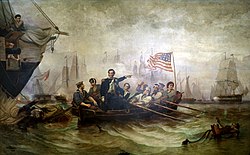
Commodore Oliver Hazard Perry's squadron defeated and captured a British naval force near Put-in-Bay, Ohio, giving the United States control of Lake Erie. Perry famously reported 'We have met the enemy and they are ours,' enabling the recapture of Detroit.
Image source: Battle of Lake Erie
Sep 11, 1814
% complete
An American naval squadron under Thomas Macdonough defeated a British fleet on Lake Champlain while ground forces repelled a British invasion from Canada. The decisive victory forced the British to abandon their northern offensive and strengthened the American negotiating position at Ghent.
Image source: Battle of Plattsburgh
Dec 14, 1814
% complete
A British flotilla overwhelmed American gunboats on Lake Borgne near New Orleans, securing passage for the British invasion force. Despite the American loss, the delay bought Andrew Jackson valuable time to strengthen defenses around New Orleans.
Image source: Battle of Lake Borgne
Feb 20, 1815
% complete
Days after the war officially ended, USS Constitution engaged and captured two British warships simultaneously off Madeira. The final naval action of the war cemented Old Ironsides' legendary reputation among American sailors and the public.
Image source: Capture of HMS Cyane and HMS Levant
Dec 15, 1814 - Jan 5, 1815
% complete
New England Federalists met secretly in Hartford, Connecticut, to air grievances over the war and propose constitutional amendments to protect their region's interests. News of peace and Jackson's victory arrived as the convention ended, discrediting the Federalist Party as unpatriotic and hastening its decline.
Image source: Hartford Convention
Dec 24, 1814
% complete
American and British negotiators in Belgium signed a peace treaty restoring pre-war boundaries and requiring the return of captured territory. The treaty said nothing about impressment or neutral rights—the issues that had sparked the war—but ended hostilities once ratified in February 1815.
Image source: Treaty of Ghent
Feb 17, 1815
% complete
Congress ratified the Treaty of Ghent and President Madison exchanged ratifications with Britain, formally ending the War of 1812. Peace ushered in the 'Era of Good Feelings,' a period of national unity and expansion marked by declining partisan bitterness.
Jun 30, 1815
% complete
A U.S. naval squadron under Stephen Decatur forced Algiers to end its demands for tribute from American ships, following up victories over Tunis and Tripoli. Coming right after the War of 1812, it affirmed America's ability to protect its maritime interests abroad.
Image source: Second Barbary War
Apr 29, 1817
% complete
The United States and Britain agreed to sharply limit naval armaments on the Great Lakes and Lake Champlain, demilitarizing the border between the two nations. The agreement became a lasting foundation of peaceful Anglo-American relations and the world's longest undefended border.
Image source: Rush–Bagot Treaty
Or browse the full history timeline directory, with more than 2,000 topics.
This War of 1812 timeline was generated with the help of AI, using information found on the internet.
We work hard to keep these timelines accurate, but mistakes do get through. If you spot one, email us at [email protected] and we'll fix it for future visitors.
Generate yours with AI or build it from scratch, for free.
Export your timeline, add your own events, edit or remove AI-generated events, and much more
No credit card required.
Cancel anytime.
Cancel anytime.
You can create an unlimited number of timelines with up to 10 events on each one, customize how they look, export them to PDF, PNG, PowerPoint, CSV, and Excel, and share them with a link. Paid plans raise the event limit and add features like spreadsheet imports and collaborators.
Yes. You can cancel your subscription from your account page at any time, and you will not be charged again. Your subscription stays active for the rest of the period you already paid for.
Yes. We will email you a reminder before the annual renewal, and we will also email you a receipt.
Yes. You can email us within 15 days of any payment, and we will issue you a full refund.
Check out our pricing docs or send us an email anytime: [email protected].